
Author: Amory Crane
A young boy waits at the threshold of his childhood home. He is frightened and disorientated, a witness to something he does not fully understand. Inside, the sound of women wailing blends with the commotion of male neighbours come to restrain his father, to keep him from beating his mother to death. His grandmother, screaming, blames herself as ‘the one who gave my girl to the drunkard’s son, the killer’s grandson and I might as well have buried her with my own two hands.’ Eventually, when his mother is lifted and carried from the house by two men, he notices how ‘her left calf hung from the stretcher with the hands of our metal clock imprinted on it. Ten minutes past eleven, I recognised the time, painfully.’
Details like this strike us immediately as significant, despite, or even because of their obscurity. The words seem to light up on the page. Often they have a quiet, understated poetry about them, born seemingly of a paradox. On the one hand, as with the imprint of a clock face on the mother’s calf, there is an intense specificity. Yet it is this exactitude which seems to broaden rather than curtail our imagination. Why ten minutes past eleven? Why not ten-to, or half-three? Such questions draw us away from the text, they lend us the ability to weigh in our minds our own variant details as if we have some part in creating what we are reading. In doing so, we hold each phantom detail against that laid down on the page, which only plunges us more intently back into the text. Likewise, as here, there is often a further tension, given the surrounding drama of the moment, which makes such an observation strike us as bizarre, detached, perhaps even a little callous. For what feels appropriate is an expression of feeling, duly tendered by the word ‘painfully’. Yet between the specific observation and the marking of this feeling there appears if not a non sequitur, then certainly a circuitous route. What, we come to ask ourselves, is the relationship between the imprint of the clock-face and the boy’s pain?
Undoubtedly we are moved by this detail and by its position as the seemingly impenetrable nucleus of the scene’s feeling; but also aware that we are more so than any trite description of anger or sadness would elicit. For such moments stick out, they have elbows which refuse to be folded in, and in this case appear to speak to that nature of trauma which seems, like a bookmark, to leave a part of ourselves in the moment of its effect. It is in small details like this that the fault-lines of a novel disclose themselves. They act like hinges, about which the tensions of the book fold toward and away from one another; or, to use another analogy, those accrued meanings of the narrative bend toward them, like creeping vines toward the sun. The specific detail taunts and seduces us with its opacity, one that — in this case — the character is also subject to. So in the end we are torn, watching aloof at the character’s bemusement, wondering what this seeming triviality tells us as readers about the unfolding pattern of the book, and yet drawn closer to his inner vision, as he struggles to understand himself as a man. Somewhere we feel, buried in all these tensions, is a question to which we have the answer.
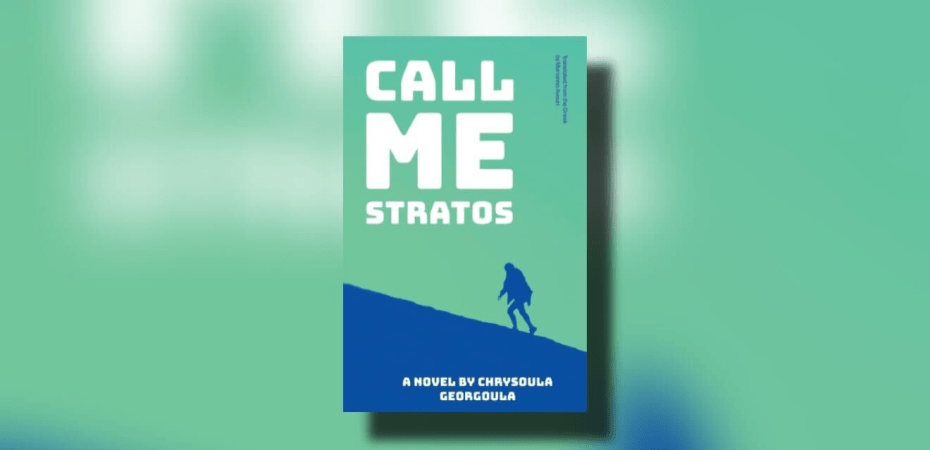
This incident, of a son witnessing the brutalising of his mother by his own father, is relayed about one third of the way into Call Me Stratos, a novel of masculine pride, vanity, anger, and aimlessness, but it takes place much earlier. Set principally in Greece between 2005, after the Summer Olympics in Athens the previous year, and sometime around mid-2010s, we follow the eponymous Stratos, a married construction worker with two children, as he recounts his life throughout this period. Beginning in medias res, we meet him after the high-points of his marriage — the days of plentiful work and easy cashflow, the birth of his two children — have come to their end, but before the scourges of unemployment and moral failure have driven it finally to divorce. One realises after only a few pages that his author, Chrysoula Georgoula, has set out here to present a character study of that particularly male and particularly mediterranean pattern of outlook and behaviour known primarily to the Anglophone world as ‘machismo’. We are of course aware that such a subject is topical, but what Georgoula leaves us in no doubt about is the capacity for real poetry such a vantage point can provide.
Take Stratos’s description of Lola, the Albanian waitress at his local café, and her tantalising derrière:
I like her ass, the way it spreads like a loaf of bread over the seat of her bike, her long blonde hair that opens up like a net over the street as she drives up on Irakliou, against the flow of traffic, revving the engine as if she is riding a wild horse with the coffees and the juices in one hand, and the steering wheel in the other.
Surely it is crude, yes, and inflected with the chauvinistic impulse — but that it is poetry there can be no doubt. For like all men of his type, Stratos reserves his close examinations of life to a crude appreciation of the womanly form; a fact which will not keep the shock of recognition from striking in the hearts of even the most enlightened and courteous of male readers. Just compare that first image, of Lola’s bottom spread out like a loaf of bread, against its more prosaic and romanticised companions: of the motorcycle as a wild horse or her hair widening like a net. The manly register is here energised by urges to be gratified, and by that which twin and further provoke its desires, and so necessarily it is required to fall back on flattened images for that which it has little interest in but perhaps feels some vague obligation towards. Namely, that which is redolent of the more romantic and chivalric, provided here in images of horses and long maidens’ hair.
Yet it is no mistake of the author’s that she provides us here, as elsewhere, with the prosaic alongside the energised. For the book’s chief force, just as in the recollection of his mother’s calf, is caught between two conflicting spheres. On one side sits the boyish, crass, funny, ecstatic, violent, and often petulant note of arrested development, which nevertheless brings alive such moments, and on the other, in failing contest, are all those responsibilities which men are to bear in civilised society — responsibility for one’s actions, for one’s wife and children, and of acquiring the knowledge and restraint which differentiates the tender caress from the clenched fist, and which delineates between their appropriate and inappropriate expressions. That it is the juvenile which serves the chief engine of this masculine register, and that the tender feelings men feel toward women are left to be articulated in well worn and flattened images, is a subtle means of approaching the subject of delayed manhood, of whose chief failures Georgoula need make no overt judgements.
Furthermore, that this tone is maintained throughout the book with a high degree of verisimilitude — and by a woman, no less — is no mean feat. Though there is the occasional wrong note, as when Stratos describes an Amstel beer ‘easing the pain in my bleeding soul,’ these thankfully are few in instance and occur predominantly in moments of lesser consequence. What’s remarkable is that, as in the moment I mention above, when Stratos is describing the beating of his mother by his father, this machismo melts away, if only momentarily, and the soft kernel stands beside the hard but brittle shell without the whole structure falling apart. When his mother has returned home after weeks recuperating, for instance, Stratos watches as his father prostrates himself:
We sat at the table, crossed ourselves and started eating silently. We couldn’t eat a thing. Father dropped his fork and started crying. We run to hug him. He kneeled down before my mother and started rolling down the sock on her left foot. When he came across the scar of the clock, he leaned forward to kiss it. My mother’s tears fell like rain upon us.
This whole scene, both the beating and its reconciliation, lays the pattern for two men, Stratos and his father, for both of whom it is consciously enunciated. His father, for instance, promises never to raise his hand to his mother again — a vow he keeps — and to abandon drinking, which he does not, and which we are lead to understand is the end of him. Meanwhile this entire memory is spurred by Stratos’s own moral law regarding marital relations, which is imparted after his long-suffering wife, Sotiria, berates him for his own carelessness, which has resulted in him seriously damaging his leg:
I felt the urge to hit her in the head with the ashtray full of cigarette butts or beat her with the crutches, but I restrained myself and I shut up, primarily because I needed her, and secondly, because unless she did something wrong to me—which she actually did—I’d be the last man on earth to raise a hand to his wife after that incident in the village many years ago.
Of course, Stratos seems unaware that by his own logic it is not only ‘primarily’ but solely by reason of self-interest that he does not beat her with the ash-tray, given he acknowledges she has, in fact, met his own and — given his tone — what he believes ‘reasonable’ threshold for physical riposte. All the same, that note of special pleading ‘the last man on earth…’ displays once again this unsettled attitude between what he is and what, however reluctantly, he knows society expects of him. It is with no surprise the reader comes to find such a thin and protean line inevitably crossed.
Here though is where the book opens out. For being a character study, the vicissitudes of national life are necessarily to be witnessed as miniature reflections in Stratos’s own. He is no great dreamer of the Raskolnikov or Julien Sorel type. There are no intellectual passions or inchoate longings which draw him to enter and conquer high society. He yearns to break from his sphere of the modest and domestic not for idealistic reasons, but for those of personal nostalgia. For it is quite clear, given the tone of Stratos’s own reminiscences and the note of tired melancholy which inflects the conversation between his friends, that there was a moment in their youth which they are continually trying to reclaim, and about which their unerring failure is a source of bitter disappointment. Those days of the early 2000s, in the run-up and time immediately following the Athens Olympics, when they were young, construction jobs were flourishing, and when that great gift of youth — the absence of responsibility — coalesced into a perfect dream, has for all its sense of national and personal optimism set a scar upon them, like that on the calf of Stratos’s mother. Forever they return to it, and it colours their appreciation of all else.
Here Georgoula is quite shrewd. Rather than resorting to wistful longueurs that would necessitate an uncharacteristic reflective side to Stratos, she has created a subtle pattern that binds the book together. There is the continual description Stratos gives of feeling as if a ‘colourful pinball machine inside me turned on all the lights, releasing an insane cheerfulness that spread through the body like a warm and rumbling river which climbed upon my chest and my brain’. This image recurs throughout the book whenever Stratos feels some semblance of that joy once felt in the pool-halls of his youth. Yet the most striking and subtle image comes from when he looks forward to opening his carwash business, to buying his wife a convertible car and taking her on holiday: ‘I would be the man of the house again, like the time when I emptied my pockets and the coffee table in the lounge here turned green.’ The parallel image or echo here is the green baize of the pool-halls. For even in married life, his proximity to the freedom of youth — and its relationship to money — is the only manner by which he configures success.
Lest all this sound exclusively like a castigation of the masculine, Georgoula is alive to the manner by which such untampered vigour has its own power over women. Sotiria, for all her suffering, is a wife partially complicit, partially enabling of her husband’s behaviour, because for good or ill it is from here his most attractive (as well as despicable) qualities flow. She helps scam a few hundred euros out of a false car claim and places their son’s pool on the balcony to enact revenge on their neighbour. This, incidentally, is a shrewd mirroring of her husband’s own endless blasting of music in the small hours of the morning. Yet Stratos never fundamentally changes between the highs and lows of their marriage. Their happiness is for the most part completely unrelated to his fundamental character, and in their holiday to Meganisi we see captured wonderfully, however disenchanting the thought may be, the manner by which prosperity covers the cracks of a failing marriage — if for a time.
All this must explain why, despite the predominant part of this novel being a man recounting his life, Stratos seems incapable of pointing to one moment as the fork in the path, the point at which he made the wrong choice. For this is a book which insists that character is indeed fate, and Stratos does not evaluate himself because he does not reflect; rather, he is reflexive, and commits to nothing but avenging himself against whatever damages his pride or impinges on his appetites. That he regularly keeps whole neighbouring streets awake at all hours with his music and singing, but resents anyone impinging on his own agency appears to present no contradiction to him at all. Similarly, he is not even a committed racist, for while he objects to his daughter schooling with an Albanian boy he is quite happy hiring a Syrian at his carwash and having sex with the Albanian girl who waitresses at the next-door café. If he has a worldview at all, it is summed up in his exchange with a policeman, when he says apropos of his neighbours, ‘They’re jealous, I’m telling you, jealous, but I’ll fix them. Stratos may be late to respond, but he doesn’t forgive.’ Such hypocrisies are hardly novel, and I’m sure most men and women will know even by instinct the manner by which the exigencies of mammon and libido melt all other concerns.
It should come as no surprise then given the time in which the novel is set that the political element in the latter part of the book follows the rise of the Golden Dawn. But Georgoula’s point is less concerned with polemics as with relating how that rudderless vanity, and the unwillingness to look firmly at oneself, is only ever an abdication of one’s life to other forces. Responsibilities in this sense are as much begetting of agency as they are its curtailment. For little by little, we watch as the tedium of contemporary life saps Stratos of what drive he has, and as he lashes out at the world, ruining his neighbours’ civil compact by drunken rowdiness, destroying his own marriage in the process, we see how in failing to come to terms with his own responsibilities such feelings of fraternity and mutual respect are consummated not with the woman he loves, but with a group he was not entirely comfortable with when he was first invited to their biker hangout by an old school friend.
It is here that the book shows its weakness, for toward the end we find the narrative skips forward much more frequently and with greater leaps. Before, we witness the near endless iterations of Stratos keeping the neighbourhood up with his hi-fi system, his fallings out and not-so-occasional violent exchanges with friends, and various other anti-social behaviour, with the effect that one begins to sympathise with the terrorised neighbours. Yet repetition is a tricky tool for the novelist, who is always at risk when deploying it in order to render a certain monotony of then inducing this in the reader himself. This Georgoula doesn’t quite avoid, but it is a minor slight rather than a blunder. The greater weakness is in the fact that with the greater frequency and elapses of time between episodes as the book reaches its conclusion, one can’t help but wish there was a little more loitering over the transformation of Stratos from the prideful, selfish, chauvinistic arrested youth, to the violent Golden Dawn foot soldier.
I do not mean to suggest this progression is unconvincing — in fact, it’s highly plausible. Rather, it’s precisely because of its plausibility that I should have wished to see it rendered with the granular detail of the brunt of the book. For when we come to near the end, when after his latest arrest Stratos calls his old friend Stathogiannis to pick him up, it is not what he has been lead to (a life a crime) but from all that he has lost that we read with a sense of tragedy that he has learned nothing at all about himself:
I take this life at face value and I keep on getting the short end of the stick. No matter what I do, no matter what I try to do, it goes to waste. I work in construction, houses are no longer built; I build the Tsunami, that bugger sets it on fire; I start a family, my wife gives me the boot; I drive a taxi, I get loonies for customers; I work with air conditioners, they kick me out; I try to help Nikifiros, the coppers arrest me. Everything is wrong and I have neither the strength nor opportunity to change anything.
Here, between the litany of Is and the inevitable fallouts, there is a shameless omission of agency, as if all such events were external impositions on himself or were not exacerbated by his own recklessness. Yes, certainly there is extenuation: there was a monetary crash, his carwash was burnt down — but even so that never stopped him spending money on drink or provoking grudges as eventuated that attack of arson. For Stratos everything, every vice can be explained as a means of escape from the mundane, as revenge even against fate, that great dealer of lousy cards and thrower of weighted dice. In the end it is here that we find a key to the clock face. For it is not time passing which lies like a weight on Stratos, nor time having passed, but of time to come — the weight of tomorrow bearing down on today, the knowledge that one’s actions now will impact the next day and the next and the next. And in this petty pace a clock has no appreciable use. Indeed, a clock stopped and imprinted by means of a scar is no clock at all, but an indelible mark of a horrid action which reminds him always of the next vital moment approaching, when time shall expect from him his next compromised act. For the pain Stratos feels remembering the time imprinted on his mother’s calf is from his refusal to acknowledge, just as his father before him, that such a retreat from the world can only ever end in those twin modes of moral decay: of outrageous transgression and pitiful, conceited apology. As a portrait then, this book paints the bleak reality of someone always in search for an escape from the predicament of being a man. But no escape exists. Like Stratos, if you refuse to acknowledge the petite domain over which you wield power — however simply — you can only fail.
Call Me Stratos is published by Istros Books and is out now and available for purchase.
Amory Crane is Editor-in-Chief at Decadent Serpent. He covers such topics as Art, Literature, and the more broadly Cultural, reporting straight from the chamber of what Shelley once called the ‘unacknowledged legislators of the world’. You can follow him @LaughingCav1 on X or on Substack. He also writes fiction.
Discover more from Decadent Serpent
Subscribe to get the latest posts sent to your email.
