
Author: Dinah Kolka
‘For we are young and our art is violently revolutionary.’– Giacomo Balla, Umberto Boccioni, et al.
‘Artists; those savage beasts that can’t get enough of too much.’ – Nick Land
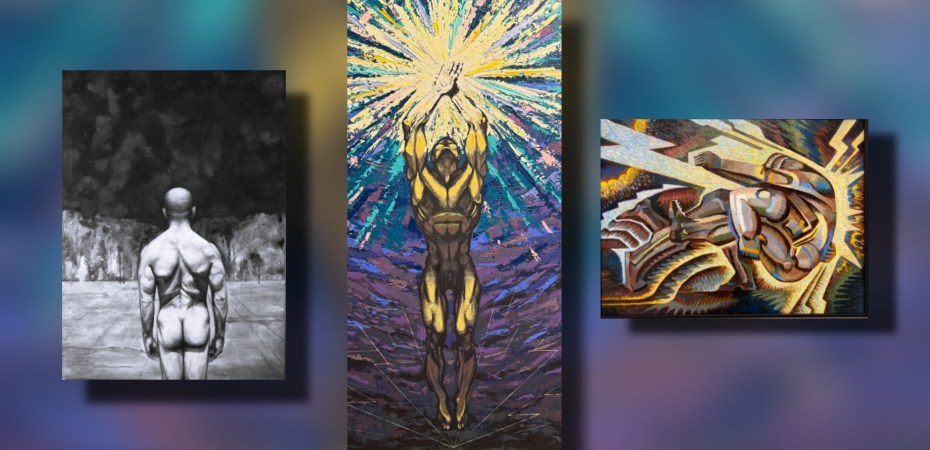
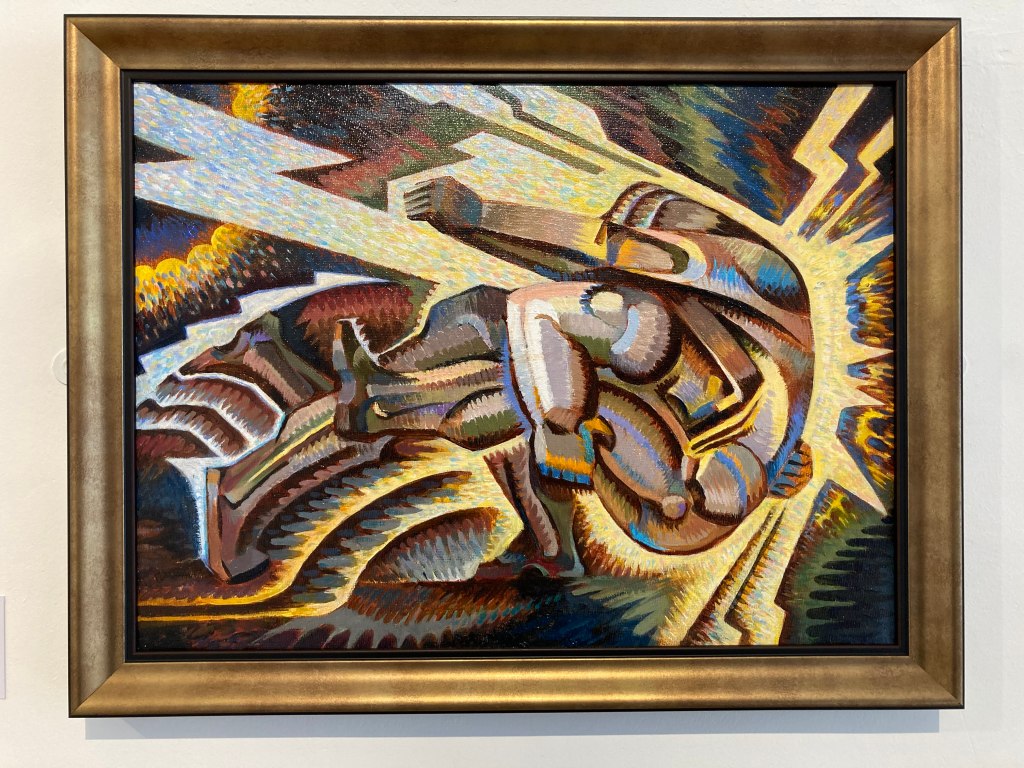
The explosion of colour on a large canvas was electrifying, just like the energy in the gallery, the buzz of the conversation, the cigarette smoke, and the sharp festive smell of brut. Prometheus, the one who brought fire to the people, stretching his arms upwards, the muscular body highlighted in its peak Übermenschian glory. Rejected by the gods, hanging in the limbo of time and space, he nonetheless shines bright, bringing hope to humankind. This is, naturally, Samuel Wild’s masterpiece, which is also the poster image for the ‘Power and Intimacy’ exhibition taking place in London. There’s ecstasy in every brushstroke which could be easily missed if not seen in person. The fire is heavily textured, which adds expression; and the shape of the body is heavily accentuated, akin to pastel work, which is Samuel’s forte. The painting uses oil as a medium, and this confluence of methods and styles makes his work reach new heights.
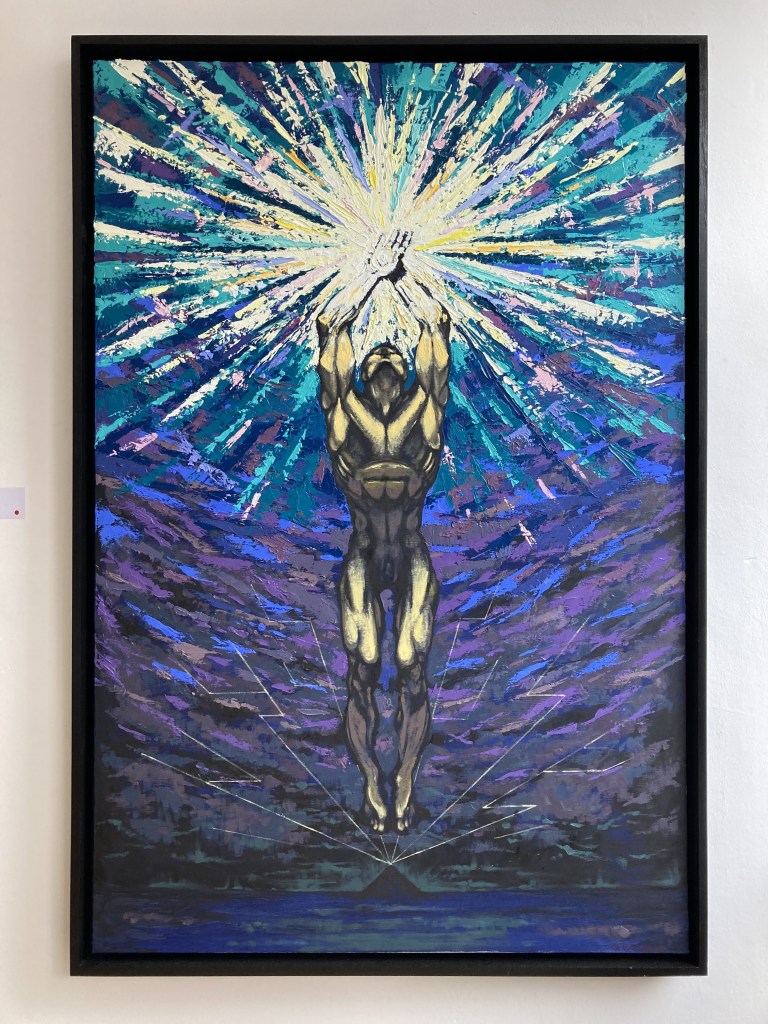
It was an exhibition in a single-room gallery, but it was filled with promise and glory. By combining power with intimacy, we are guests at the feast of masculine and feminine to create a perfect whole. It’s an unlikely marriage and yet, where there’s power, there is also space for tenderness, and where one finds depth and subtlety, one also uncovers great force.
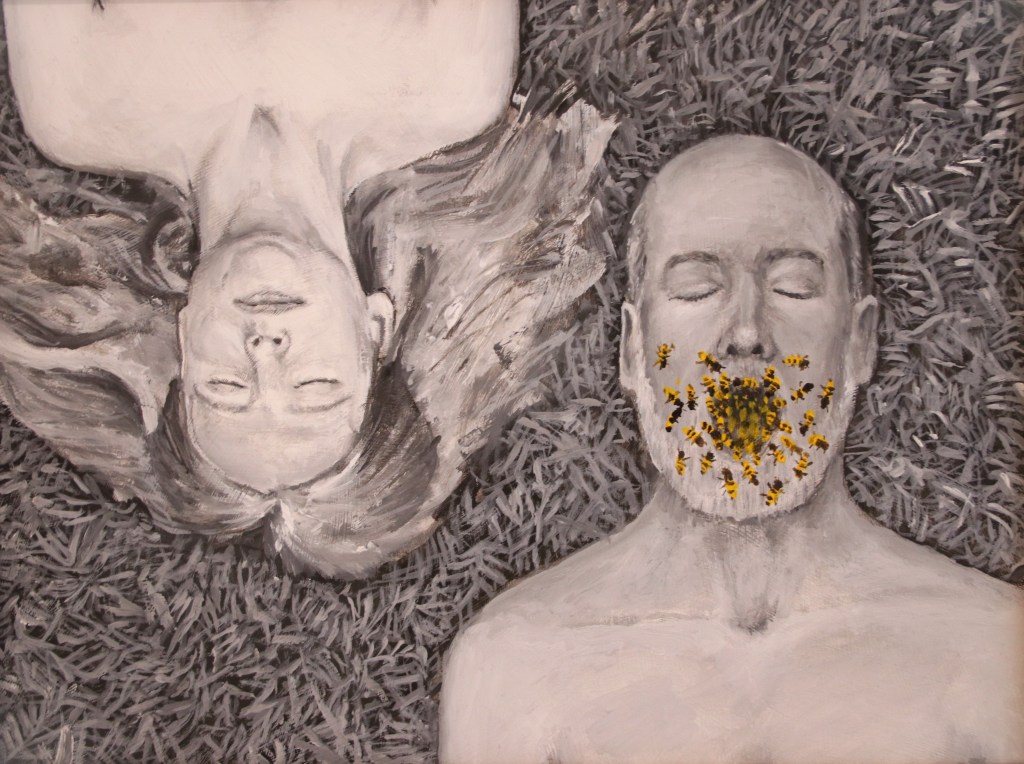
Where Sam’s opening piece captures us with its sheer power and intensity, the exhibition marries it with softer, more tender work. For example, we have Emanation by Alexander Adams. A painting entirely done in monochrome except for bees flittering out of the artist’s mouth. The man lies on the field of grass next to a woman (who, as we learn, is the artist’s wife), her hair sprawled like a halo. The piece, thematically touching on grief, love, and closure, provides a welcome break from all the grand and great while maintaining its own strength.
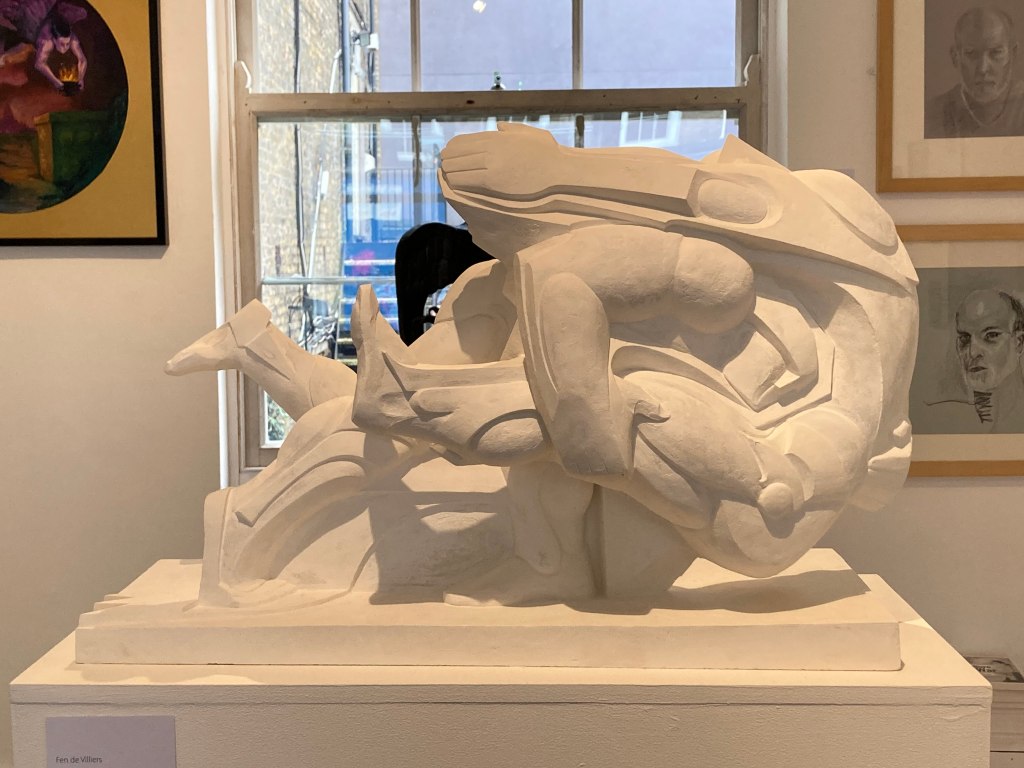
This wasn’t the only hallmark of the exhibition. Besides paintings, there were sculptures from some known names: Fen de Villiers and Ferro. Fen’s Tackle was deliciously dynamic with sharp, quasi-futurist shapes and movement that practically caused vibrations in the air. This was well paired with Matthew Fall Mckenzie’s acrylic painting under the same name, which embodied sharp bright colours, shades of yellow and orange, to make a perfectly accompanying piece, creating a marriage of candid colour and sharp shapes.
This symphony of power and passion was broken up by work from the Australian artist Ryan W Daffurn. Grace Encircled and Punktverschiebung were completely distinct, connected only by the hands that made them. I particularly liked Punktverschiebung and its abstract nature, human forms moving towards something we are not able to see in the frame. Dark, ominous shapes, yet torn open by vivid colours. On the other hand, Grace Encircled proved to be a tender and beautiful painting with a particular softness and a dreamy gleam that disrupted the domination of other works (singled out by our editor, Amory, to be his favourite).
My eyes, however, rested mainly upon one of Sam’s pastels. King Numa teaching the Roman Youth blending blues and yellows seamlessly into a dark and curious piece, shows Numa, known for his wisdom and kindness, teaching small, curious Romans whose faces seem to bask in the light of their teacher’s instruction.
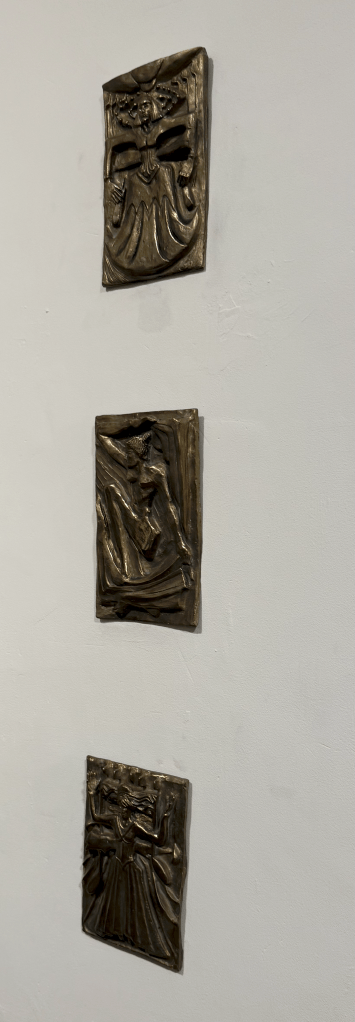
However, in my frenzy, I continued, moving away from comforting pastels and casting a glance at the other side of the room, where stood Ferro, the man known for his tapestries and sculptures. Sporting a Russian-style hat and a uniform, he guided us through the works, relishing in the opportunity to explain the symbolism of treasures on display. Across the wall, there sprawled a large tapestry with a gryphon and near the window, a large Byzantine-inspired double-headed eagle rested, bejewelling the rest of the room. But what really got my attention were the muses — three bronze plates representing a muse for a different discipline. I will leave it to the reader to guess what they symbolise for the air of mystery, but I will say, there are sounds, stars, and movement captured within them.
This exhibition collated works that exemplified authenticity, honesty, and fire. It was an eclectic collection made by people who all share similar values — freed from the demands of the politicised mainstream, they instead gathered to create that which is truest to themselves. As Nick Land once put it: ‘Irrational surplus, or the ineliminable and beautiful danger of unconscious creative energy.’
If I must cast judgement for the sake of fairness, I suppose I could only comment on the perfectly subjective problem of mine — I didn’t find that One Holy Grail of Personal Resonance. Where I adored each and every one of the items, I could not pick a favourite.
In Art After Metaphysics, John David Ebert said that in this era of contemporary art ‘the Modernist hypersphere has collapsed, and Being has, as Heidegger often put it, abandoned Being in this age. The grand metanarratives, are, indeed gone, apparently for good. The transcendental signifieds, including Jungian archetypes, have vanished as ultimate anchoring terms of reference for the signifiers of the art.’
In this small gallery in London, in an inconspicuous location, these features are still very much alive — they live and breathe transcendence and grand narratives. Vision and power are rhythmically pulsating underneath the thin layer of pretence of the mainstream, ready to burst and swallow the serpent that calls itself contemporary art.
The exhibition is still open Friday/Saturday 10am- 7pm, and Sunday 10am -12pm at 11 Caledonian Road, London, N1 9DX.
Featured images (from the left): Argonaut, Alexander Adams; Prometheus, Samuel Wild; Tackle, Matthew Fall Mackenzie
Discover more from Decadent Serpent
Subscribe to get the latest posts sent to your email.
