

(Note: if you wish to read the article which sparked this exchanged you can find it here, along with Paul’s first response here.)
Author: Paul Rhoads
Dear Editor,
Sam, Fen, and I agree that “contemporary art” is a travesty, that our time is artistically dark. Our reaction is boredom or disgust to the inhuman International and Brutalist architectural styles and the ridiculous and revolting things which sometimes continue to be called painting or sculpture. This ugly architecture and fake art is a civilizational negative; we dream of correcting it. But how?
Sam and Fen say we should revive Art Deco. Sam calls Art Deco the last human manifestation of art. He says its source is the French furniture designer and interior decorator Jacques-Emil Ruhlmann. Fen says Art Deco was not a single style (not “locked into one path”) but also that it was an “entirely new language”, a “conscious integration of multiple wide ranging influences”. He claims that the masters of Art Deco were “searching for a fresh synthesis for the modern age” and urges us to push towards such a synthesis for today.
Should we, on one hand, walk in the footsteps of Ruhlmann whose early work was labeled Art Nouveau, or on the other not imitate Art Deco styles but follow its example by searching for a new language, a fresh synthesis of old art for our own time? Before reacting to these programs I will repeat a point which Fen ignored in my first letter.
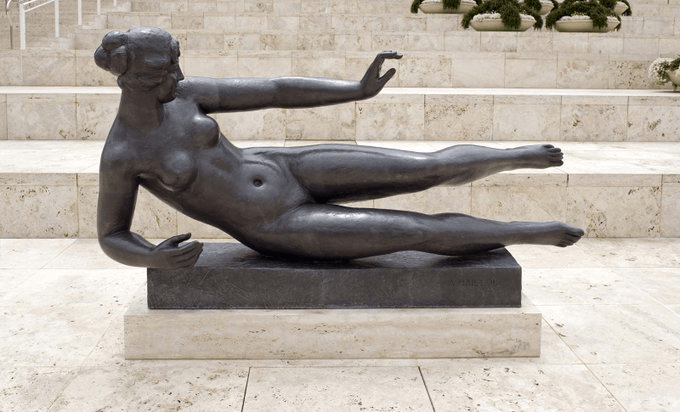
Fen names certain sculptors who used a certain style which at the time was thought of as neoclassical to distinguish it from the turgid and optically academic style, or the frilly, degenerated style both of which were current in the 19th century. The greatest exponent of this 20th century neoclassicism (to be distinguished from late 18th and 19th century neoclassicism) was Aristide Maillol. Maillol was never considered an exponent of Art Deco but his influence, or the same rejection of uninspired anatomical exactitude and fashionable frivolity, gave many sculptors of the time this neo-grecian direction — including such little known artists as John Wallace Purcell, an early influence on my father, George Rhoads. Important sculptors like Jacques Lipchitz, however, became Cubist and remained Cubist, while Picasso abandoned Cubism for neoclassicism in the 20s and 30s. But Picasso’s neoclassical work, to say nothing of his Cubism, was never called Art Deco. Meanwhile some historians consider painters like Boutet de Monvel to be Art Deco who were neither Cubists nor neoclassical but simply illustrators.
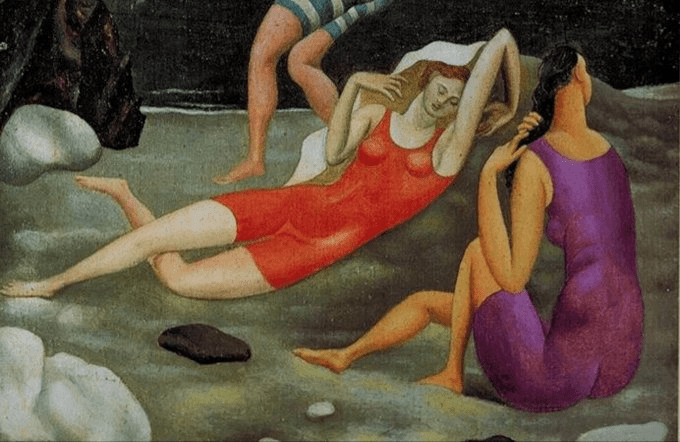
Art Deco was not a movement in the same sense as Impressionism or Cubism which were approaches initiated by certain painters and embraced by many painters. Art Deco, by contrast, is a fashion in decoration like ‘Louis XIII’ or “Second Empire”. The painting of Poussin is not ‘Louis XIII’ painting, just as the painting of Corot or Delacroix is not ‘Second Empire’ painting, and no one has ever suggested such a thing. Art Deco, like ‘Second Empire’ is a label attached to a decorative fashion of a certain time. Like all such fashions it was made of what people were doing, interested in, and capable of at the time in question.
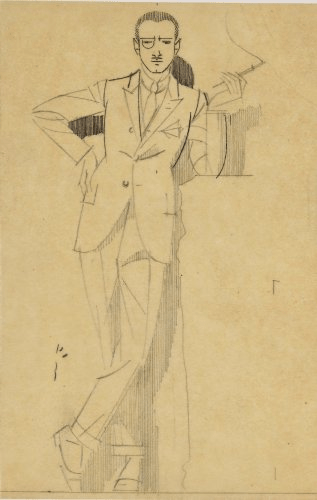
As I mentioned in my first letter, one manner of painting in the 20s and 30s was Post-Impressionism, a flavor of which was a combination of Cubism and 20th century or modernist neoclassicism. It was a manner in the middle of a stylistic spectrum from modernist influenced academic painting (Symbolism was often of this sort) to a manner like that of Fernand Leger. This style of painting, with its emphasis on clean and straight lines was translatable to stamped metal, or stone carved by journeymen working from drawings. It was a style that lent itself to the tastes, needs, and techniques of the time. It was not the only style of the 20s and 30s. Important painters like Bonnard, Vuillard, Sickert, and Jaques-Emile Blanche, to say nothing of Dali or Balthus, were tempted neither by Cubism nor by neoclassicism. Art Deco, with its elegant and mechanical aura, was not the universal style. The arabesques and delicate colors of Art Nouveau persisted, and the Bauhaus was already making itself felt. Art Deco was used to express modernity and luxury for apartments, ocean-liners, and prestige projects. It overran its class boundaries in the stamped metal decor of diners and radio housings to help integrate industrial products into the human world while still having an up-to-date machine-like feel. It could be luxurious, but it was never as totally hand-made as ‘Louis XV’ interiors where the furniture and wooden wall panels were hand carved and the upholstery embroidered by seamstresses. After World War 2 a sparer, even more modernist decor became fashionable. It provided the slowly rising middle class with nice things at affordable prices, thanks to designs adapted to emerging industrial processes. Such goods were luxurious when made of bronze and leather and for the common man when made of steel and plastic. Art Deco, unlike Cubism and Impressionism, is a label for a style of decoration related to architecture: furniture, fabric, wall paper design and drapery, as well as ‘objects d’art’ and murals for Art Deco interiors, and architectural decoration including monumental sculpture. The painting and sculpture in question was not Art Deco as such. Typically, it was the cubistic neoclassical Post-Impressionism which had developed independently of the Art Deco aesthetic. It may be that that aesthetic was the reaction of decorators to cubistic neoclassicism; the cubist aspect felt modern; the neoclassical aspect felt timeless. It is a scholarly question but my guess is that the artists responsible for the interiors and façades we most associate with Art Deco were influenced by many things; and, if we accept Art Deco as a term like ‘Louis XV,’ as a style of decor which integrates the painting of it’s time be it cubistic neoclassicism or a manner of illustration, then artists such as Maillol stand in the same relation to it as Boucher did to the Louis XV style. For Boucher’s painting is called Rococo — not ‘Louis XV’ — because Rococo painting had its own sources and development just as Post-Impressionist painting, including its Cubist and neoclassical aspects, had its own causes, influences, and development.
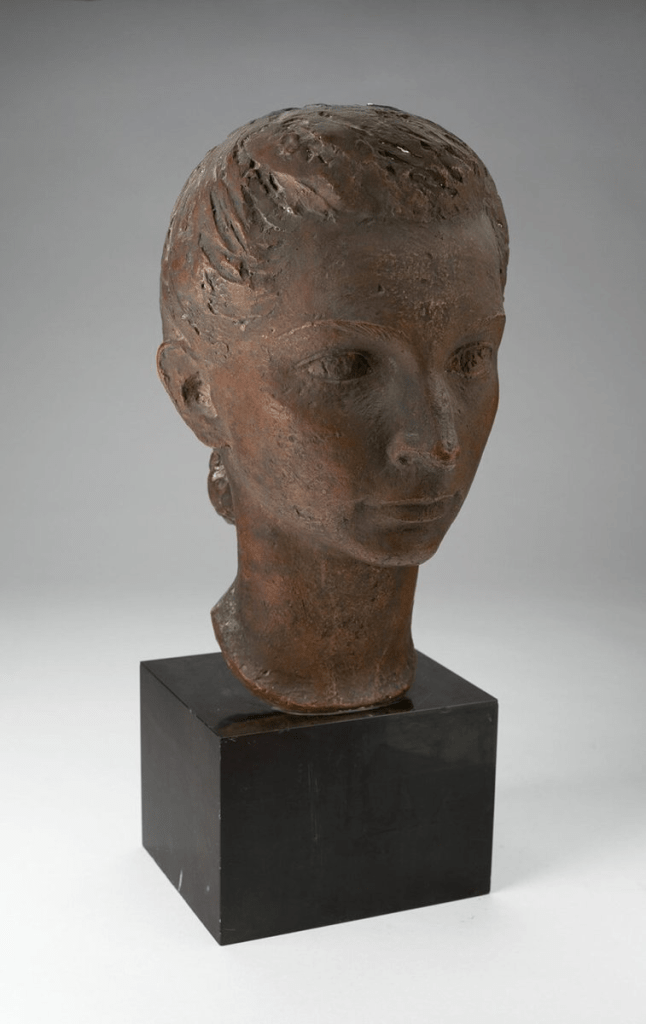
So, is Sam right that we should follow the lead, and work in the manner of Ruhlmann? Or is Fen right when he urges us to do as he claims the masters of Art Deco did: search for a new and original synthesis of old styles adapted to our situation of today? I am not sure what following the lead of Ruhlmann, a furniture designer, means for painters and sculptors; I leave it to Sam to develop that point. As for searching out an original synthesis for our modern age, I would ask: what is our modern situation? What characterizes it? If we knew, then maybe we could develop the art of which Fen dreams. What is our situation? What is “our modern age”? From an artistic point of view, particularly regarding painting and sculpture, I would say that, unlike the artists of the 20s and 30s who had at least some training and were raised in the respect of certain traditions, our situation is to have been denied any training, and to have been raised as detractors of everything not contemporary. We have been taught that each era, our own in particular, has a special quality which cannot be compared to any other. It is not worse, it is not better, but it is certainly one thing: it is ours! But we are free to betray it. Instead of being in tune with that quality, being IN our zeitgeist, we can fade out of it by larping at the past. Larping makes us irrelevant because only really “being” IN our time without larpery has meaning — at least until the next zeitgeist emerges. The logic of this situation is that what we do, so long as it is original, so long as it expresses something never before expressed, is “good” for our time.
Sam and Fen however are beginning to have doubts about these attitudes, doubts about the zeitgeist fatwa against larpery. They may still regard larping Rococo as irrelevant but they do not regard larping Art Deco as irrelevant!
I find myself in an odd position. I am older than Sam and Fen and my early circumstances were such that I was witness to the emergence of “contemporary art” and its defeat and denigration of the art it drove out. The epicenter of that drama was the New York art world of the 1960s, the world into which I was born. My personal orientation turned out to be towards the older art. For the crime of that orientation I was relentlessly labeled irrelevant. Strong in the conviction that such nonsense could not last I endured it through the 70s and 80s — twenty long years, all of my youth. But three more decades have since come and gone, and nothing has changed. . . but suddenly! the very people who continue to label me irrelevant because in their eyes I am a larper, have themselves become larpers! True, they do not, like me, love the whole past and try to live up to everything they find beautiful and wonderful as best they can; they only larp something not more than one hundred years old: Art Deco. And yet Fen himself insists that Art Deco is itself larpery of things as various and lost in the mists of time as Egyptian sculpture! Fen, who complains that sculptors are debasing their art by using carving machines working from 3D models, wants us to use the skills we have managed to develop, in spite of lacking the education and attitudes of the Art Deco masters, to revive something elements of which might be Assyrian sculpture and Fauvism! What would a melding of Assyrian sculpture and Fauvism look like, and how is it relevant to our time, to the zeitgeist of now? Might it be the source of an emergent zeitgeist? Perhaps Fen can enlighten me, because I have no idea what such a possibility has to do with Art Deco.
Regards,
Paul Rhoads
You can follow Paul on X here.
Discover more from Decadent Serpent
Subscribe to get the latest posts sent to your email.

[…] Letter to Editor: Paul Rhoads II […]
LikeLike