
Author: Amory Crane
It was a remark, I think, of Gore Vidal’s, that when writers meet at parties they seldom if ever, to their host’s dismay, exchange advice on the technical intransigences of their latest work. Instead they resolve merely to discuss matters of money. One might even add they discuss the lack of it. For whenever this writer has spent an evening in the company of another member of the guild, one’s first drink has hardly pressed lips before the question of sales figures and percentages rears its eager head. The reasons for this are clear to all those engaged in the practice, even if opaque to the populace at large: writers — indeed, all artists — are poor. You may now dispel the image of drink-sodden and emaciated figures lingering over the ash-stained copies of their latest drafts. For we do not all live in abject poverty. Yet the reason for this is not that writing pays any more than it used to, but that poverty costs so much more.
Back when George Orwell penned his now famous description of the struggling writer, the image of the Grub Street hack whose aspirations were soiled long before his clothes ever were was a well wrought one in the public mind. Yet even while exploiting this stereotype, Orwell was describing what were still then the ubiquitous circumstances of a whole class of society:
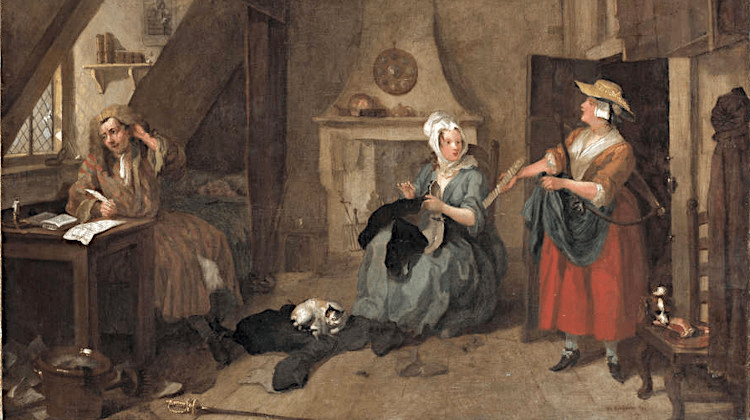
In a cold but stuffy bed-sitting room littered with cigarette ends and half-empty cups of tea, a man in a moth-eaten dressing-grown sits at a rickety table, trying to find room for his typewriter among the piles of dusty papers that surround it. He cannot throw the papers away because the wastepaper basket is already overflowing, and besides, somewhere among the unanswered letters and unpaid bills it is possible that there is a cheque for two guineas which he is nearly certain he forgot to pay into the bank. There are also letters with addresses which ought to be entered in his address book. He has lost this address book, and the thought of looking for it, or indeed of looking for anything, afflicts him with acute suicidal impulses.
Substitute new money for old, laptop for typewriter, and phone or e-mail for address book and the image still holds up pretty well. The disparities lie then not in the acute circumstances but the pervasive ones. For writers of all types today do not so much have the luxury of exchanging comfort and security for pursuit of artistic (or artistic adjacent) ends, as having the necessity of pursuing a nine-to-five job for the luxury of penning a book review. Affix ‘after work,’ to the beginning of the above paragraph, and you will soon see how it is brought up to date with the realities of twenty-first century living. All of what Orwell describes is now available to the novice by regular attendance at a middle-class job, long before his fingers have been deployed in the writing of witty aperçu.
It is of course ironic that what was once the subsistence labour of many a young artist or poet (even if it became the graveyard of his dreams) has now become the dream itself. Men and women with degrees from top universities across the world, some of whom are far brighter than their first-class degrees from Oxbridge would otherwise have you believe, now return home from their jobs in the service economy, and after donning the moth-eaten dressing gown and lighting up a cigarette (or, alas, a ‘vape’), sit down to compose a review or feature piece with hopes of one day seeing it placed in a magazine. That old reality then, of once living hand-to-mouth by such exertions, has been replaced and even reversed, so that the word hack, at least as it pertains to arts journalism, is no longer enunciated except between self-satisfied and bloviating eminences who wear their self-deprecation like the rouge of a pantomime dame. The truth is that the budding writer of today works long and meaningless hours to support his exalted dreams of writing an 800 word book review and maybe one day getting a regular gig; or, to put it another way, he longs for the poverty, wretchedness, stress, and squalor of yesteryear, over the supposedly middle-class realities of today.
Before I’m accused of advocating for further democratisation of the arts, I should say that I subscribe to the belief that every institution should have its barriers to entry. After all, as George Moore once pointed out, ‘no place in England where everyone can go is considered respectable,’ and I remain a great advocate of the Simon Raven theory of institution building, which holds firmly the belief that ‘a good club, a good college, a good regiment, a good school — you make them by keeping people out.’ So I point to the Orwell piece as much as an illustration of yesterday’s barriers than as a description of a particular literary pursuit. Back then, if you were literate and could turn out reasonable copy, you could live however precariously on the money earned writing for little magazines and journals. Those who did so were often educated to a greater or lesser degree, and just as often forwent careers in the law or medicine to do so. That is a price paid. If they went hungry then they fed on their dreams to continue; if thirsty, they sipped at tomorrow’s promise. And if they were lonely, they had recourse to a teeming culture made up of young men with whom they shared a common pursuit, and who made up the clientele of those nearby bars and restaurants with reputations almost as low as their pricing.
That the pittance paid on receipt of weekly book reviews has found itself replicated in waged e-mail drudgery is a travesty in itself, but that the dream of this different kind of poverty remains can only be explained by the simple current lack of romance. The bohemian existence which once provoked — still provokes — much comment and artistic fruit is one that sustained itself on the fevered brow of young hopefuls. If it was predatory in this way it nonetheless bred a culture for people who were otherwise incapable of existing in any other form of life. After the war, when such an existence first began to wain, academia picked up much of the slack. With the extension of the universities poets and novelists often found, particularly in the early parts of their careers, a settled and secure home. Now that this fanciful state of affairs is quickly running into its final stage the question forming on everyone’s lips is, where are such people to go?
Now, whenever there is an area of cultural life on its last legs the question of government assistance is inevitable. We are aware that opera in this country would simply cease to exist if it were not for grants from public funds. So the whispers this month that the government are considering winding up the department for Culture, Media, and Sport and scattering its duties to the four corners of the cabinet have brought with them discussion of how public art should be funded, and, indeed, whether it should be funded at all. This question has not been a dormant one, even if now, with the Trump administration’s threat of dissolving the National Endowment of Humanities and the increasingly depleted share of Arts Council funding found among cultural venues’ revenue streams have made it all the more pressing. The obvious answer, which only a few years ago felt forward thinking, has quickly revealed itself to be a recycling of an old worn out idea. I’m referring here to the subscription model, whereby one subscribes to those writers, artists, production companies, and ‘creators’ (whatever the hell they are) that one likes and eschews the rest. This amounts to nothing short of the same kind of ideological marketeering that would let the opera house hang if it meant a glass and steel skyscraper could be put up in its place. We need only go read the latest IEA paper for that.
Of course the ‘consumer,’ to use that phrase, will always play his part, but in an increasingly atomised society it seems strange that just as the desire for some focal point or points is being voiced, and voiced explicitly, the answer offered up is more of the same. Those who argue that such a state of affairs is a suitable replacement simply cannot see it is exactly this mode of thought which brought us to this mess in the first place. If you want evidence just ask yourself why magazines — even prestigious journals — no longer publish short stories, and publish poems only under duress. The proponents of what we might call this decentralised patronage model will no doubt say, well, no one wants to read them. Yet this is the excuse all libertarians give for their defence of the general race to the bottom in all spheres of human life. Libertarian, after all, is just another way of saying being wilfully open to subversion. All our tastes, or perhaps I should say their direction, are laid long before we click subscribe. No one reads short stories or poetry in magazines because no one reads. Look at the education system and its degradation over the past sixty years, and ask yourself whether the modes of entertainment and cultural engagement that have come to be popular are not the result of a deliberate programme in the pervasion of ignorance. This freedom then, so beloved by libertarians, and by which an individual engages in the marketplace of ideas, can only ever exist within the boundaries laid out for him, and increasingly the higher reaches of human expression are made to lie without. All this is before the machinations of various individuals, as laid out recently by Academic Agent in regards to jazz, rock, and R and B music, who by one means or another shape the more acute interests of the mass.
I am not, to be clear, arguing there is no talent to be found. That individual writers producing some really quite high quality work can be found now on Substack and elsewhere is indisputable. These blogging sites thereby satiate briefly the desires of those budding writers in their hours after work. Yet for all the good this mode of dissemination does it neglects the fundamental purpose of a group of people producing a cultural artefact together, in person. It is this group experience which caters to a number of societal and individual needs which otherwise are left unfulfilled. First, it lends a welcome place for those budding writers to place their work — and not only writers, for magazines need art and cover pieces and cartoons. Second, an office by which a group of people work together in the collective effort to produce those necessary prerequisites for a thriving culture will itself prove that culture in microcosm. Writers, thinkers, artists, young and old, passing in and out, going for editorial lunches and after-hours drinks, rubbing shoulders with their fellow pursuers after higher things: this is what a cultural nucleus looks like. It is, above all, a kind of education.
I am reminded here of the point once made by Michael Oakeshott, that university education revolves around ‘the belief that learning to think scientifically is best achieved by studying, not some so-called ‘scientific method,’ but some particular branch of science; and learning to think historically is to be achieved, not by studying the ‘historical method’, but by observing and following an historian at work.’ Let us remind ourselves that despite the modern elision of academics and ‘hacks’ this cultural institution, the magazine, is not a university. It is perhaps closer to an artists’ workshop. Yet still the belief that there is a ‘literary method’ would be anathema to the enterprise. Young scribblers observing, following, and rubbing shoulders with other more experienced writers at work is the means by which all those great magazines of yesterday existed, and which are now looked to as sacred texts. The likes of The English Review, Blast, The Little Review, The Criterion, Horizon, and all the rest of these now sacred cows were once places where ink was spilled and writers, in essence, lived.
Over a century ago now, Arthur Ransome, in Bohemia in London, the book which first made his name, chronicled the texture of this mode of life extensively, as well as the very manner by which this education occurred:
That is one of the chief merits of Soho dinners — the company is always entertaining. Sometimes there would be an old philosopher at the table opposite, who would solemnly drink his half-bottle, and then smoke a cigarette over some modern book. One day he leaned across towards our table with Haeckel’s Riddle of the Universe in his hand. ‘Read the book, young people,’ he said, ‘but you should read it as you read Punch.’ That was his introduction to our party, and thenceforward, when he had finished his meal, he would always smoke his cigarette with us, and, smoothing his white beard with a pensive hand, employ himself upon our instruction in philosophy.
If then you are a wealthy individual, and desire to make some real mark upon the current culture, consider paying for the office and staff of a magazine — it needn’t even be in London, but Winchester, Canterbury, Worcester, Stoke, Norwich or Northampton, or anywhere else. You needn’t even pay them very much either, for there are many who will exchange living on the breadline in HR for living on the breadline to pay fealty to the muses. Just remember you shall make nothing but losses. The Medici, after all, did not patronise Botticelli or Brunelleschi for a return in capital, but for clout.
The failure to do any of this will leave ever more in the absurd position of working full time to fund their desire of finding a precarious job. Such figures, over time, will become more and more to look like the young man Ransome meets one night in Soho, of whom ‘it turned out that he worked in a bank from ten to four every day, and played the wild bohemian every night. His beard was a disguise. He spent his evenings seeking adventure, he said, and apologised to me for earning an honest living.’
Ultimately, the formation of a state of affairs which allows for such an environment as I have described to exist is perhaps the only purpose I can imagine an arts policy, whether public or private, to have. That it does not exist is, as I point out earlier, the result of choices made and not, as certain people would have you believe, simply the natural enervation of a culture. For every great society has had some equivalent. Bohemia flourishes, mutatis mutandis, wherever civilisation flows. And, to bowdlerize the late Clive James, while it is not essential to art, it is certainly essential to civilisation.
Amory Crane is Editor-in-Chief at Decadent Serpent. He covers such topics as Art, Literature, and the more broadly Cultural, reporting straight from the chamber of what Shelley once called the ‘unacknowledged legislators of the world’. You can follow him @LaughingCav1 on X or on Substack. He also writes fiction.
Discover more from Decadent Serpent
Subscribe to get the latest posts sent to your email.

[…] have of course written on this topic before, but I wish here to address more explicitly the nature of what a critic actually does, or perhaps, […]
LikeLike