
Author: George Marsden
The prized relic in the Church of St George at Diospolis, towards the end of the 4th century at least, was a torn skirt. It hung from the wall just behind the altar, where its exalted position benefited from the shafts of light that entered from the south-facing door. I say benefited: in the days of Deacon Thomas’s senescence, the sunlight had so bleached the skirt that Thomas was the only person in Diospolis who could tell you it had once been green. In fact, Thomas was also the only one who knew why it was there in the first place. Other relics had an obvious association with the military saint: a chip of wood from his lance, a few plates of armour, and a sharp tooth that old women told their grandchildren had been pulled from the dragon’s jaws. But the skirt? Thomas never explained it. Once, when a cheeky child had asked if the skirt looked as flattering on George as he imagined, Deacon Thomas threw a copper chalice at his head and chased him down the street. It was generally assumed that Thomas nursed a special devotion for St George. As it happens, Thomas’s own bishop was as ignorant of its significance as the children. He’d even once travelled to Diospolis for the express purpose of asking the notorious deacon if such an object was really worthy of the dignity of the house of God? But on approaching the church he beheld Thomas at his breakfast in the portico, rapidly scooping potage by the handful from a bucket to his mouth. This made him uneasy. He decided to let the matter rest.
Entering the Church of St George through that south door, on your right, you will find a full-body icon of its eponymous saint. George sits upon a horse, in what seems like full enjoyment of divinely sanctioned martial glory: his sword and reins are marked out in gilt, a spear in one hand takes the eye heavenward, while a hoof delivers an entirely gratuitous blow to the dead dragon underneath. But look closer: the eyes are strange. Stare at them for long enough and their leftward gaze (in conjunction with the tight and slightly arched lips) impresses you as the look of a man not a little uncertain of his position. George then appears as if actually cringing away from the halo that surrounds his head. Stay looking for a while longer; his face and posture become a tacit signal of sheer panic, a wordless expression of fear at being mistaken for someone else—and of finding himself too late to correct the error. This perplexing depiction of Diospolis’s only saint constituted another element of the church that the religious authorities would prefer to see altered. But Thomas had not only painted the icon himself, he was also the only man living to have met St George. That’s just how he looked, Thomas argued.
He would have been a young man when George was martyred. At that time, George the Cappadocian was an officer in the Roman army with special responsibilities in the districts north of Jerusalem. Whatever the content of these responsibilities was in the minds of his superiors, to outward appearance they seemed to entail nothing more than the hunting of lions and feasting. Though raised as a Christian in an aristocratic family, George can’t be said to have gleaned many spiritual goods from his residence in the Holy Land. George would quote scripture to the presbyters in the villages that were his ward as soon as toast Mithra with his men. He attended the sacrifices to Apollo, when his presence was expected from the civilian authorities, and returned home pleasantly sleepy after plate upon plate of roast beef. Religions were so many gewgaws with value for others, but were, for George, mere piles of inconsequential glitter and tinsel. But he would don as many as were necessary to make his job easy.
The post at Diospolis was a favour from an obliging relative; a relative who rather overestimated the returns his benevolence would receive. Governor Maximus lived in fear, to the point of insanity, of a general rising amongst the region’s Christians. Believing that some bloody example-making would be very necessary, very soon, he cautioned that anything short of extreme vigilance at Diospolis would engender the loss of the whole Empire. George was indolent by nature; he cursed that kind relative. But on arriving in Palestine he found not a single ground for the governor’s fears: far from being on the brink of rebellion, the local Christians were, in fact, solely concerned with the state of their olive groves. It didn’t matter who ruled over them, so it seemed, as long as their crops got a good price in Jerusalem. George found no trouble in gathering their taxes; he quickly grew to like his new job. His letters to the governor, however, portrayed a different scene: he filled them with the details of foiled plots against His Eminence, of secret hilltop gatherings at night. He would need more time, more money, he wrote. Loath to give up what was, by now, the most congenial post in the Empire, George pressed hard on his powers of lurid invention rather than risk it all by allaying the Governor’s fears. And every time George asked, George received.
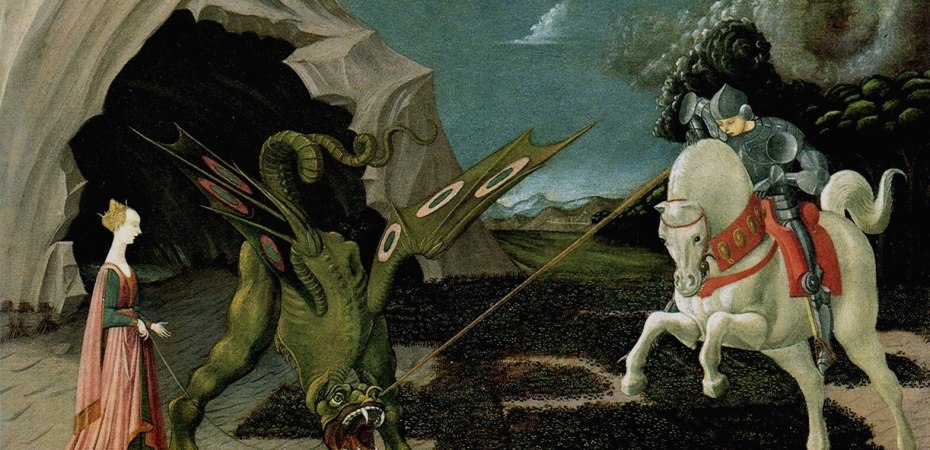
It was whilst enjoying the fruits of this plot that the business with the dragon occurred. Most days, George went hunting for lions. It was on one of these hunts, roaming the wilds alone, that spotted a girl among the rocks; the locale being remote and dangerous, spot, this fact naturally demanded an explanation. Getting closer and observing that her arms and legs were also tied to a post was enough to satisfy him that nothing was out of place, however. Unless my readers take this for a sign of some especial depravity on George’s part, we should recall that he was, by now, a familiar and dispassionate observer of the exotic rituals of the dozen or so cults that flourished under his tutelage. Taking the bound woman for a participant in some savage devotion, he ignored her sobs and passed her by. But it was as he did so that George caught sight of a white thigh through a rent in her skirt. Now, there must have been an arresting quality in this detail that the woman’s tears had failed to communicate because George stopped his horse. Perhaps, after all, there was some advantage in talking with her.
She didn’t raise her head when he approached. “May I ask what a lady like yourself is doing here?” said George.
“For sins I am too shallow to understand”, she replied, in the tone of dejected piety characteristic of the rural Christian communities. Our hero chuckled. “Surely none as pretty as you can be guilty of anything serious.” The woman vomited green bile over the horse’s front legs.
While making her apology she related that famous and sorry tale. A dragon had terrorised her home for over a year. Her father, the king, had done his best to mitigate the worst of the horror: through a negotiation of sorts with the dragon, two sheep offered daily kept it from dining on his subjects. But running out of sheep, and the dragon finding no savour in a diet of shepherds, lots were cast to decide who would be offered to sate the beast’s hunger. Alas for the royal house: it fell to the princess. Ever loyal to his subjects, the king tearfully ordered her bound and placed near the dragon’s layer. Christian mercy induced him to administer a sort of sleeping drug that, he hoped, would spare her the worst of the pain. But like nearly everything that went as medicine in that country, all it effected was a serious vomiting bout.
Resisting a smirk at the girl gauchely translating her family’s tribal rank into regal terms, George asked if His Majesty had no soldiers mighty enough to kill the dragon? Nearly all the village gallants had perished in the very attempt, she said—a summary that granted George a vision of drunken farmhands desperately waving spades at a pair of fiery jaws. He fingered his sword as he snuck another look at the bared thigh.
“Which way?”, he said. The girl gestured in the right direction with her head and fell once again to vomiting. George dismounted and walked along the cleft that her forehead indicated.
George was most of the way along the cleft when he finally had occasion to ask himself what, in whichever Lord’s name, had he just undertaken? He swore that he could smell smoke. Praying that this would be the last time his mind abdicated responsibility at the mere presence of a girl, he rushed through another passage in an attempt to escape without the princess noticing—what about the horse? Oh, sod the horse! His foot hit something soft. He tumbled. Fortunately, his hand grabbed a pinecone that proffered itself as a handy fulcrum, and he managed to winch his armoured body upwards. But wondering how it was that a pine tree found itself among the arid rocks, he turned to look at it; he discovered his hand grasping the scaly corn atop the head of a green dragon.
The next few moments were eventually telescoped in George’s memory, but their true chronology was this: a snout brandished smoking nostrils at his face as two yellow eyes became distinct among fat and scaled folds of green. Grunting in a manner that seemed to register shock in an almost human way, the head pulled back a few inches. A second later and George’s panic-driven sword had severed it from the neck. He stood, panting, above the bleeding corpse.
Gaining his breath, George returned to the girl with the head in hand. He rehearsed the script in his own head, but there was no need: George was highly adept at winning over Christian girls. She was overjoyed at seeing her terror vanquished, ecstatic at being untied, and seemed (or seemed to George, at any rate) most pleased at the speech he delivered. He dedicated himself to her, her father, and their whole village for ever onwards, in nomine Patris et Filii et Spiritus Sancti. If she would only be true, then this was but the first of Satan’s foes he would strike down in her name. In the name of the lamb, in the name of the virgin. Thank you! She cried. Her gratitude was too great. Of course, she and all her tribe would be true.
Escorting her back to the village, George was unsure which of the two was the greatest triumph: slaying the dragon, or the winning of the princess with the pretty thigh? However, he soon got given a reason to make a choice. The girl was but a yard within the village confines when she jumped off the horse and leapt into the arms of a surprised young man just then emerging from one of the larger huts. She was so pleased, she said to George, to introduce such a brave Christian knight to her fiancé.
“Oh, fiancé?” mumbled George. As the girl then proceeded to relate the story of her rescue, poor George felt a hot desire to get back to Diospolis. Fiancé? That’s the sort of thing you mention to a chap promising to take on Satan for you, no? So distracted was he by this train of thought that it was only at the fifth tug of his saddle that he noticed an old man peering up at him, asking how one man could be so brave?
“Just Christian charity, or whatever, I suppose,” shrugged George. But the assembled crowd roared back at him with joy. Much to his annoyance, they followed him all the way back to Diospolis. Christ’s Avenger! They cheered. The Dragon Slayer! George has come to kill great Satan!
It was as the crowd reached the city’s suburbs that the cheers were heard by the newly arrived legion, just dispatched from Constantinople on the Governor’s request. Maximus had taken George’s warning of the imminence of Christian rebellion extremely seriously. God’s Hammer is with us! The Lamb will vanquish the Serpent, and other martial slogans drifted over the sands and into the ears of the eager soldiery. They formed ranks immediately. Marching into the middle of the approaching crowd they speared and stabbed without stint. Apprehending the rider they took for a gang leader, his pleading that they must be mistaken! he was their commanding officer! They surely knew they’d be punished for this? punished severely? was scorned. Gustavus the Geat, a tall northern captain, pulled him forward. “The Nazarene promises Life Eternal,” he said, “so what are you balling for?” George was beheaded and left on the rocks to rot.
Of course, the truth eventually revealed itself. The embarrassment was acute, but George was wrong: the legion was simply swapped out for one from Anatolia, one whose reputation did not include a propensity towards infamous massacre. Gustavus was ordered back to his woods. With time, Christians and Pagan alike lost touch with the story’s details. The former forgot more than it forgave the episode. That is, except for Thomas. Thomas remembered it all, especially the part the girl had played in it. Every night he looked at the skirt and its consequential rent, the skirt he’d recovered himself from the site of his compatriots’ slaughter. He gazed upon it, croaking with laughter at the miracle of the white legs that had made a man a saint.
George Marsden is a graduate of Glasgow University, where he read English and Classics. His writing has appeared in IM-1776, The Mallard, and Sublation Magazine, among other outlets. As song writing is the only form of modern poetic expression with a mass audience, George thinks it merits special critical attention. He also aims to counter the nefarious influence that Oasis have had on British culture. Read his work here.
Discover more from Decadent Serpent
Subscribe to get the latest posts sent to your email.

Wonderful ♥️
LikeLike
Absolutely Brilliant.. Well done George Marsden.. 👏x
LikeLike