
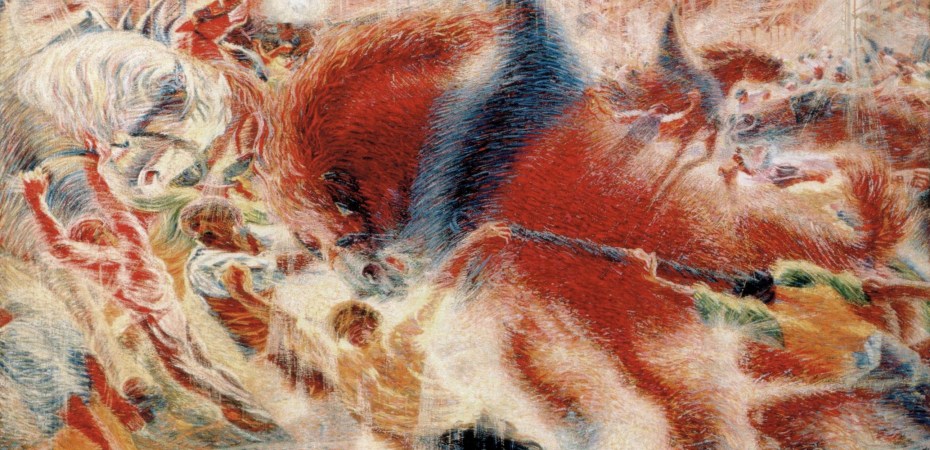
Author: Dinah Kolka. Dinah is the founder of Decadent Serpent and a graduate of Edinburgh Napier University with a BA(Hons) in English Literature. Her work has been featured in publications such as The Salisbury Review and The Mallard. She was also published in the Scottish Book Trust’s 2018 anthology Rebel. In 2023, Dinah self-published her own collection of short stories, The Search and Other Stories.
“We will glorify war—the world’s only hygiene—militarism, patriotism,the destructive gesture of freedom-bringers, beautiful ideas worth dying for, and scorn for woman” F.T Marinetti in Futurist Manifesto.
20th-century Italy, still shaken up by the post-unification struggles needed a way forward. The unification was largely led by the middle classes with no input from the agricultural parts of Italy. And the middle classes were largely divided on how to unite the country. This civil inter-class quasi-war led to competing ideas on how to lead this newly reformed country. The nationalist spirit was mainly forced upon the peasants who were not involved in these movements. However, as there was such a gap, there had to be an idea of how to unite everyone. While the socialists were in power at the time, there were divided opinions on how to orientate the nation from all sides of the political spectrum. One of the ideologies that surfaced as a result of this was futurism.
Founded by F.T. Marinetti, it proved to offer interesting ideas that excited a moderate number of people at the time. As a result of a minor car accident that Marinetti was a victim of, he proceeded to venerate the speed and glory of technology. As described by Günter Berghaus –
‘Futurism was an art movement that aimed at nothing less than a total makeover of the social and political conditions prevailing in Italy and a permanent revolution in all spheres of human existence.’
With a propensity for extravagance and flamboyance, Marinetti proceeded to write a Futurism manifesto of his newly founded ideology. Futurism characterised itself with a passion for war, technology, and art.
FOUNDING
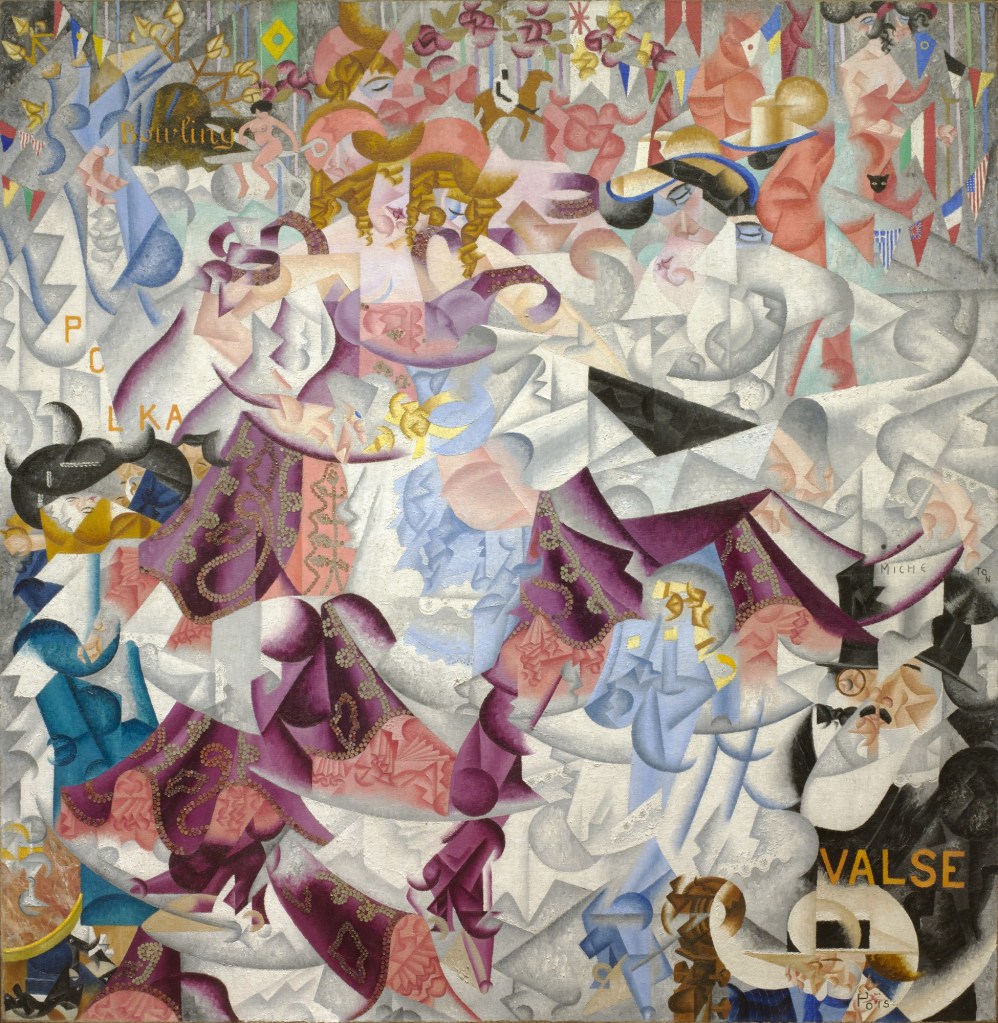
Futurism was founded in 1909 by F.T. Marinetti. Inspired by his accident, he decided to create a collective that would harness pure, unadulterated passion for the machine. What brought them together was a passion for the destruction of tradition and all its gods; veneration for speed and the machine; and above all – the sheer PASSION itself. Futurism has found its way into art, literature, poetry, music, and even fashion or cooking.
In the Founding and Manifesto of Futurism, first sent to his friends and family and then published on the first page of Le Figaro, a popular Italian magazine, Marinetti sets out the scene for the creation of futurism with his characteristic flamboyant vernacular: ‘We had crushed our ancestral lethargy’. One of the first statements made by Marinetti was his disassociation from the traditions and the past. Essentially, there is a sentiment that in order to succeed, one must rise above the tradition and conservatism of their ancestors. In this quasi-Nietzschean way, Marinetti’s idea for a new world was to burn everything and create anew. Initially comprised of only 5 people (all painters except Marinetti): Umberto Boccioni, Carlo Carrà, Giacomo Balla, Gino Severini, and lastly Marinetti. Initially struggling, eventually in 1910 and 1911 futurism grew, leading to a futurist exhibition in Paris in February 1912. When WW1 started, the futurists proudly joined protests for Italy to join in the war effort as the war was the ultimate expression of what they believed in. Even the active participation in the war did not dampen Marinetti’s spirit – while on leave from a severe injury, he wrote more manifestos.
FUTURISM IN LITERATURE AND POETRY
‘Up to now, literature has exalted contemplative stillness, ecstasy, and sleep. We intend to exalt movement and aggression, feverish insomnia, the racer’s stride, the mortal leap, the slap and the punch.’
Futurism in literature called for ignorance of norms, worshipped sound and rhythm and disdain for the past. ‘One must simply create because creation is useless, unrewarded, ignored, despised; in a word, heroic. To the poetry of nostalgic memory, we oppose the poetry of feverish expectation’. It embraced new forms and themes with an intention to ‘liberate words’ from ‘the prison of the Latin period’. Literature was meant to be akin to a ’swirling propeller’, without syntax and making verbs infinitive, as well as abolishing adjectives and adverbs. One of my favourites, however, taken from the Technical Manifesto of Literature was the following:
‘Every noun must have its double, which is to say, every noun must be immediately followed by another noun, with no conjunction between them, to which it is related by analogy. Example: man—torpedo boat, woman—bay, crowd—surf, piazza—funnel, door—faucet.’
Safe to say – there was a lot of chaos in futurist literature!
FUTURISM IN ART

‘We want to fight implacably against the mindless, snobbish, and fanatical religion of the past, religion nurtured by the pernicious existence of museums. We rebel against the spineless admiration for old canvases, old statues, and old objects, and against the enthusiasm for everything worm-eaten, grimy, or corroded by time; and we deem it unjust and criminal that people habitually disdain whatever is young, new, and trembling with life.’
The art was focused on speed, dynamic imagery, and technology. It focused on beauty in movement while rejecting the static PAST. There was a significant focus on dynamism, using vibrant colours and geometry. They wanted to derive their inspiration from contemporary life and the machines, such as rail, planes, and cars. They hated art critics as well as harmony. They cherished speed and dynamism which they wanted to capture in art. Futurist art proves to still reign supreme in many regards – the bold lines and colours are an inspiration and a true force of talent.
FUTURISM IN MUSIC

‘Futurist melody will draw from the innumerable combinations and various relationships that derive from them. This melody will be none other than a synthesis of harmony, similar to the ideal line that is formed by the incessant surging of a thousand waves with unequal crests.’
Futurists included the sounds of machines in their music, they incorporated noise and focused on spontaneity. Once again, they wanted to reject anything that had been done before and breathe fresh air into the music world. They supported free and polyrhythmic music, with the alternation and succession of ‘all tempos and all possible rhythms.’ They also craved the music to represent ‘the music spirit of the masses, the grand industrial factories, trains, transatlantic steamers, battleships, automobiles, and aeroplanes,’
I still maintain that Marinetti would have loved Death Grips.
FUTURISM IN FASHION

‘Humanity has always dressed itself in mourning clothes, or heavy armor, or the hieratic cape, or the trailing mantle. Man’s body has always been saddened with black, or imprisoned with belts, or stifled with draperies.’
Futurist fashion was bold, colourful and geometrical. Once again, they hated the suffocating winds of the past and celebrated dynamic shapes and asymmetrical clothing, with little buttons. To quote the manifesto, as it speaks for itself:
‘Fabrics with colors of thrilling iridescence. Fabrics with muscular colors, crazy violets, very very very very reds, green times 300,000, blue times 20,000, yellow, oraaaange, vermiillllion.’
We have an idea of what type of clothing they were advocating for. Marinetti would have LOVED the 80s.
One of my favourite elements that came out of Futurist fashion, however, was the Antineutral Suit. This was designed to incite violence, and proclaim war, it was the banner for the support of the war. The suit was designed by Giacomo Balla, who proudly unveiled it at a student lecture of a professor who most certainly did not align with Futurist ideals. Unfortunately, it was ruined in the riot that followed. Nonetheless, one must appreciate the Futurist zest for novelty and the many inventions that came from it.
FUTURISM IN COOKING

One of the more bizarre elements of Futurism was the many rules for cooking, and Marinetti ensured that there were clear guidelines for do’s and don’t’s of cooking.
This included his war on pasta. Cooking needed to be an experience, it required using a machine to cook and a rejection of FORK AND KNIFE. One should embrace new, previously unused utensils in order to revolutionise the eating process.
Naturally, you’d be expected to eat in ‘a room in a restaurant decorated with aluminium and chrome pipes.’ One of the dishes, called ‘Aerodish’ offers the following experience:
‘From the right, the diner is served a plate containing black olives, hearts of fennel, and kumquats. From the left, the diner is served a rectangle composed of sandpaper, silk, and velvet. The foods must be carried directly to the mouth by the right hand, while the left hand lightly and repeatedly brushes the tactile rectangle. Meanwhile, the waiters spray the necks of the guests with a carnation conprofumo, and a violent contrumore of an aeroplane engine issues from the kitchen at the same time as a dismusica piece by Bach.’
The futurist cookbook offers the most eclectic collection of sensory experiences that would make the most bizarre fine-dining restaurant owner hang his head in shame.
INTERNATIONAL FUTURISM

Interestingly, futurism has reached many surprising places, such as Japan and Poland. Polish futurism, however, was influenced by Russian Futurism which was often communist in nature, rather than Marinetti’s flirtation with fascism. Russian futurism was perhaps one of the biggest offshoots of Italian futurism. This impacted the style and content of the works that permeated Polish futurism. As at the time, Poland was not as developed and struggled – the calls for technological progress were met positively. It also inspired formism, which focused on geometrical figures and high contrast. It even reached South America in Chile and Brazil.
CONCLUSION
To conclude, Futurism was one of the most eccentric art movements that came from the 20th century. With its passion for speed, dynamism, technology and bold colours and words, it has certainly made a statement in the world. To this day, the impact of it is recognised and replicated, often in new and extravagant forms. One of the examples is Fen de Villiers, or Matthew Fall McKenzie, previously mentioned by Samuel Wild in his article on future of art. Marinetti was a madman, but he was a madman with charisma and a great commitment to his work. The lesson here is clear – no matter how insane your idea is, you should pursue it. And personally – I really want to host a futurist dinner party one day, although I worry that I might terrify my friends.
Sources:
Berghaus, Günter, Violence, War, Revolution: Marinetti’s Concept of a Futurist Cleanser for the World, Annali d’Italianistica, Vol. 27, A Century of Futurism: 1909–2009 (2009), pp. 23-71
Futurism: An Anthology, edited by Lawrence Rainey, Christine Poggi, Laura Wittman, Yale University Press, 2009
FT Marinetti, and Filla, Futurist Cookbook, Sternberg Press, 2014
Discover more from Decadent Serpent
Subscribe to get the latest posts sent to your email.

Interesting article.
LikeLiked by 1 person