I first read Ted Allbeury’s thriller as a teenager, and in recent years I’ve often thought about its significance for the predicament in which we find ourselves. I discovered a copy online and revisited it. Here are my thoughts on its message today.
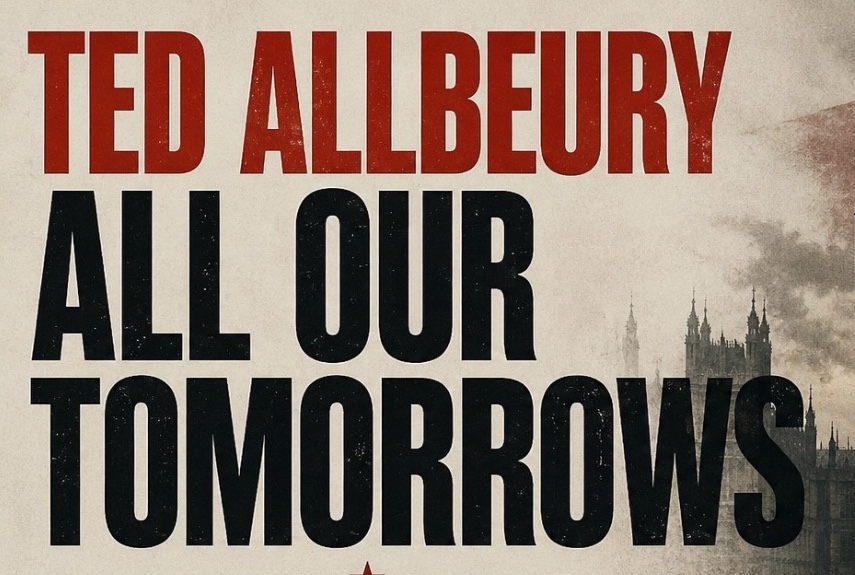
Some political novels become more interesting after their predictions have failed. They cease to be warnings about specific futures and serve to shed light on permanent truths. They remain true even when they are no longer literally correct. Ted Allbeury’s 1982 novel All Our Tomorrows belongs to this category.
On the surface, it is a failed prophecy. The novel imagines Britain drifting into the Soviet sphere of influence and eventually becoming a satellite state. Through a combination of political weakness, diplomatic compromise, economic exhaustion and elite capitulation, Britain effectively abandons its independence. Soviet influence becomes Soviet control, and the nation finds itself occupied not merely territorially but psychologically. None of this happened. The Soviet Union ceased to exist less than a decade after the book was published. The Warsaw Pact was dissolved. The Red Army withdrew from Eastern Europe. The Cold War ended not with communist triumph but communist collapse. Indeed, it could be argued that Britain long ago abandoned its independence to the USA not the USSR, that Britain was an American satellite when Allbeury wrote his book.
Yet All Our Tomorrows remains strangely relevant because its true subject was never Soviet power. The Soviet Union was merely the instrument through which Allbeury examined a more enduring question: what happens when a country loses confidence in itself? Read today, the novel seems less concerned with geopolitics than with morale, legitimacy and civilisational self-belief. The Soviet threat that loomed so large in the imagination of the 1980s has passed into history. The problem of cultural and political confidence has not.
To understand the novel properly, one must recover something of the atmosphere in which it was written. The Britain of the early 1980s was not the Britain remembered by later generations. Today, it is easy to view the Thatcher era as one of eventual recovery. We know that Britain remained democratic, that NATO survived, and that the Soviet Union imploded. We know how the story ends. Allbeury did not. He was writing at the close of a decade marked by high inflation, industrial unrest, political violence and a pervasive sense of national diminishment. The country that had once governed an empire seemed increasingly uncertain of its place in the world. Economic decline was accompanied by something more difficult to measure: a loss of confidence in the nation’s institutions, traditions and future prospects.
Many observers feared not simply temporary difficulties but a deeper civilisational malaise. Britain appeared tired. Its governing class often seemed detached from the historical sources of the nation’s identity. Its cultural mood oscillated between cynicism and resignation. Whether these perceptions were accurate is beside the point. What matters is that they were widely felt. It was from this atmosphere of uncertainty that All Our Tomorrows emerged. The novel is therefore best understood not as a prediction but as a thought experiment. What would happen if a nation already afflicted by self-doubt encountered a determined external power? What if the decisive weakness wasn’t military inferiority but spiritual exhaustion?
What distinguishes the book from more conventional invasion fiction is that the conquest begins long before any visible occupation. In earlier British thrillers, such as those of William Le Queux and John Buchan, danger arrives from without. Foreign armies prepare to cross the seas, spies infiltrate institutions, and military conflict follows. Allbeury presents something subtler and more unsettling. The decisive victory occurs in the realm of assumptions. Political leaders persuade themselves that resistance is futile. Officials adapt to changing circumstances. Institutions gradually alter their understanding of what is normal, prudent and possible. Language changes. Citizens learn which opinions are rewarded and which are discouraged. By the time direct coercion becomes necessary, much of the work has already been accomplished. Sounds entirely familiar, doesn’t it?
The insight is not uniquely applicable to Soviet communism. Indeed, one of the reasons the novel retains its force is that it identifies a universal mechanism of power. Every durable political order seeks to make force unnecessary. The ideal subject is not one who obeys under threat but one who accepts the legitimacy of the system under which he lives. The most unsettling passages in the novel are therefore not those involving overt repression, but the scenes of adjustment. Life goes on. People go to work, read newspapers, raise families and pursue their ambitions. The routines of everyday existence remain largely intact. Yet beneath the surface, the assumptions governing society have changed. The occupation becomes normal not because it is welcomed but because it is accommodated.
In this respect, All Our Tomorrows is less interested in heroism than in conformity. That is one reason it feels plausible. Most people in any political system are neither heroes nor villains, just ordinary men and women attempting to navigate circumstances not of their own making. They adapt because adaptation is easier than resistance, because they have responsibilities, because they wish to avoid trouble, or simply because human beings possess a remarkable capacity to normalise just about anything. Ted Allbeury understood this. His concern was not that Britain would suddenly fill with collaborators, but that ordinary people would gradually reconcile themselves to their diminished condition.
Recent British history suggests that he had identified something real. Most regimes are sustained not by fanatics but by conformists. Most political transformations occur because enough people decide that accommodation is preferable to uncertainty. The enemy in Allbeury’s novel is therefore not merely coercion. It is resignation. The real danger comes when a society ceases to believe that alternatives exist.
What Allbeury got wrong is obvious enough. Like many observers of the period, he overestimated the durability of Soviet power. From the perspective of 1982, this was not an unreasonable mistake. The USSR possessed vast military forces, nuclear weapons, an extensive intelligence apparatus and effective control over half of Europe. To many Western observers, it appeared to be a permanent feature of the international landscape. Yet the Soviet system was already suffering from a crisis of confidence of its own. Its economic foundations were weak, its ideological appeal was fading, and its governing elite increasingly lacked faith in the gods they purported to serve.
The irony is striking. Many of the weaknesses that Allbeury attributed to Britain were becoming visible within the Soviet bloc itself. The Soviet Union ultimately collapsed not because it was defeated militarily but because it ceased believing in itself. Its institutions continued to function, but the convictions that animated them had evaporated. Its elites no longer possessed genuine confidence. Its citizens certainly didn’t. The soviet system died from a failure of legitimacy. In a curious sense, Allbeury correctly diagnosed the disease while misidentifying the patient.
Yet what he got right was ultimately more important than what he got wrong. He recognised that confidence is a strategic necessity. Nations require more than armies, economies and bureaucracies. They require belief. A people must believe that their institutions deserve preservation, that their history possesses meaning and that their future is worth defending. Without such confidence, material strength becomes surprisingly fragile. The twentieth century is filled with examples of states that appeared formidable from the outside but proved hollow within. Political systems often collapse not when they lose power but when they lose faith.
For this reason, the most valuable lesson of All Our Tomorrows may be that political decline is not primarily a material phenomenon. It begins in the imagination. A civilisation weakens when increasing numbers of its citizens cease to regard it as worthy of loyalty, sacrifice or continuation. Once this occurs, every setback becomes evidence of inevitable decline, every challenge appears insurmountable. The process can continue for years, even decades, before its consequences become fully visible.
Yet history also suggests that decline is rarely the end of the story. Societies are not mechanical systems governed by immutable laws. They are human creations, and human beings possess the capacity to rethink, renew and recover. The confidence that sustains a civilisation may be lost, but it can also be regained. Again and again, periods of apparent exhaustion have been followed by periods of renewal when a relatively small number of individuals began articulating a more compelling vision of the future than the one offered by the prevailing establishment.
Such figures rarely seize power directly. More often, they exert influence through avenues such as culture, religion, literature and personal example. They establish alternative centres of intellectual gravity. They recover neglected traditions, challenge prevailing assumptions and demonstrate that the future need not resemble the present. Over time, their ideas spread through networks of influence and eventually reach those who occupy positions of authority. The result is not a revolution but a reorientation. A society that appeared resigned to decline discovers reserves of confidence and energy that had merely lain dormant.
If Allbeury’s novel is fundamentally a study of how a nation can lose faith in itself, history provides abundant evidence that the process can also work in reverse. Elites are not immutable. Institutions are not permanently captured by any single outlook. New generations emerge, old assumptions lose their authority, and ideas once regarded as marginal become influential. The lesson is not that renewal is guaranteed, but that decline is no more inevitable than progress. The most resilient societies are not those that avoid crises of confidence altogether, but those that eventually produce individuals capable of restoring confidence when all has been lost.
This is why I think All Our Tomorrows deserves to be remembered. Not because it accurately foresaw Britain’s future, but because it understood something deeper than the geopolitical anxieties of its own time. The novel recognised that the ultimate strength of a civilisation lies not in its military capabilities or economic power but in the confidence with which it views itself and its future. The Soviet Union is long gone. The questions that interested Allbeury remain. What happens when a civilisation loses faith in itself? But much more importantly, what happens when it begins to recover that faith once again?
This is why I write popular fiction. In order to help people recover their faith in the future, to show them the way forward, and to inspire them with characters worthy of emulation. One such character is Justin Martello. Learn about him in this review, The Differentiated Man.
Gomery Kimber is the author of six novels, including the Big Shilling hitman trilogy, the Justin Martello adventures (‘A New Kind of Hero’), and the Wyvern series of historical novels (esotericism and espionage). In 2023, Gomery Kimber was chosen by best-selling author Mark Dawson as the winner of the SPF Foundation Thriller Award.