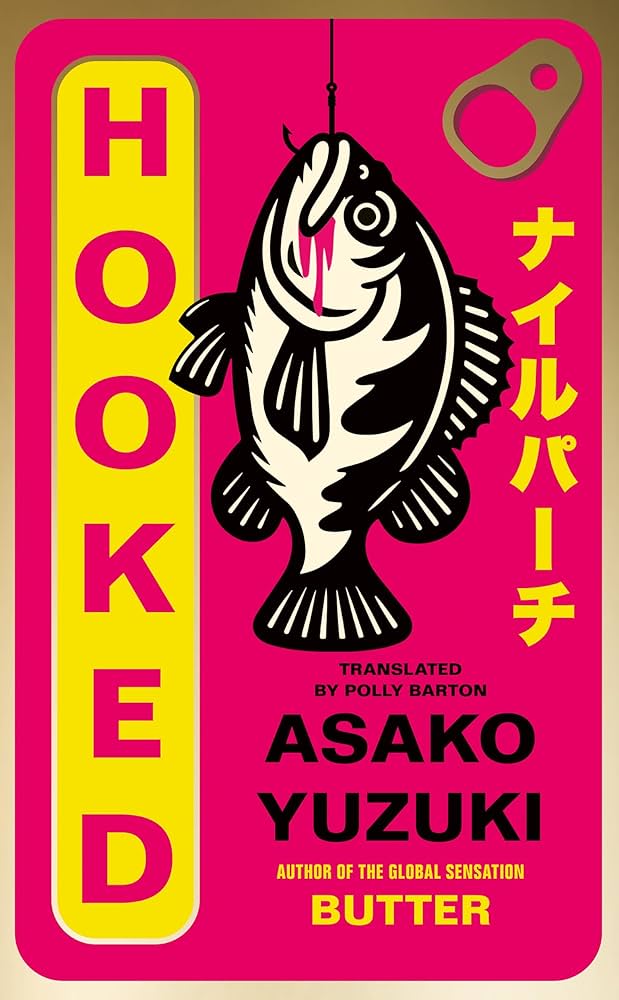
Hooked, written by Asako Yuzuki and translated by Polly Barton, is a beautiful, heavy and viscous dive into the complexity of human relationships, generational trauma, impossible societal expectations, and how hard it can be to just communicate with each other.
When we meet Eriko, for instance, she has what appears to be the perfect life. She’s a young, beautiful and successful woman, who works in the seafood division of one of Japan’s largest trading companies. Yet, despite a loving family and a pristine apartment in Tokyo, she struggles with a deep loneliness, feeling incapable to strike any friendship with women her age, or any relationship outside of work.
In her spare time though, she reads the blog of a local, lazy, food-lover and convenience store housewife, the Diary of Hallie B, the World’s worst wife. Eriko quickly becomes fascinated by her, as she appears so far from the standard Japanese homemaker ideal. Where other bloggers, all mothers, present perfectly curated sushi platters, immaculate flower arrangements, or picture perfect houses, Hallie B. (whose real name is Shōko) lives child free while grazing on instant noodles, cakes and coffee from the local chain cafés, all while binge watching TV series with her husband. She’s the exact opposite of Eriko, who has always been extremely ambitious and hard working, and yet Eriko feels an affinity toward her, believing Shōko could be the perfect friend for her. So she tracks her down at her favourite café and befriends her. What then seems like the beginning of a beautiful friendship quickly spirals into unhealthy obsession on Eriko’s side.
The lens of Eriko is a lot like an alien observing humans for the first time, dissecting their rituals in minuscule parts to execute them to perfection, in a way that will remind readers of Patrick Bateman’s endless routines in American Psycho. Both Eriko and Shōko’s inner monologues analyse these intricacies of our rituals, often brutal and humiliating with no reason to be. The vapidity of so many layers of expectations and rules imposed on us by an invisible, inexplicable tribal force. While Eriko wants to follow them like a manual for existence, Shōko refuses to engage with them, drifting away like the dust motes in the sunlight, defying every expectation of her gender and social status.
Yet, the experience of what is expected from women, often constructed by society as either angels or whores, never seen as whole individuals, resonates and echoes beyond Japanese culture. Men aren’t spared from this eternal struggle either, and both Eriko and Shōko look at them with pity, knowing they can’t even find the solace of girl friendship. The relationship between Eriko and Shōko often treads the line between obsession, resentment and devotion, where two women, broken in different ways, are trying to navigate a world incapable of hearing them.
Not that Hooked is only about the struggle of gender, it’s about the struggle of what identity is and what it means to be alive. Water, for example, is a recurring theme across the book, and reading it feels like a slow immersion. At first, it’s like entering a warm, clear pool, where you can see the pebbles at the bottom. But as you advance, soon it gets deeper, thicker and murkier. The current grows strong and takes you to the dark recesses of the mind, where everything leads back to every single person’s deepest fear: being alone. This is a world where feelings die in our throat, and where we are destined to become like the Nile perch (a fierce predator that dominates its surrounding and feeds on fish, including its own species) that Eriko often references throughout the book, comparing it to her own reality.
The novel captures what it’s like to be a fish navigating in a series of different aquariums with different rules, eternally afraid of being left behind by the pack or eaten by the bigger fish. She also reflects on the fundamental fact that, as humans, we find it increasingly hard to talk to each other openly. We build forts around us, made of virtual relationships and hollow entertainment, and bask in loneliness as it’s painless. But eventually, it is dull. And becomes even more painful to just drift away.
All this is presented through a prose, beautifully translated by Polly Barton, which flows like butter on a hot pan. Precisely detailed and expansive, but not overbearing, it strikes the balance between dialogues and inner monologues. The rich descriptions of both urban and rural Japanese landscapes are filled with the late night noises of Tokyo and the cold of the mountains, making it for a reading trip that leaves the mark of physical sensations and foreign sights. And while food is understandably not as central as in Butter, it is still a crucial part of the characters’ background, culture and daily interactions. In a culture where impossibly elaborate plates of sushi are the ultimate aspiration, buying convenience store natto becomes an act of defiance in itself.
True, some scenes do challenge the suspension of belief, injecting unexpected traits in the characters, making them more complex. The descriptions can get in the way of the dialogues, breaking the rhythm up on occasions. Although the pace holds, thanks to Yuzuki’s masterful use of language, the rhythm is so tight and tense that I felt it fizzled out at the end, in the last four chapters. After such a deep, involving journey on their sides, I was perhaps expecting a more definitive closure for every character.
Overall, Hooked is another amazing work that confirms both Yuzuki and Barton’s incredible talents. It makes me hope for more English translations to read more of her work.