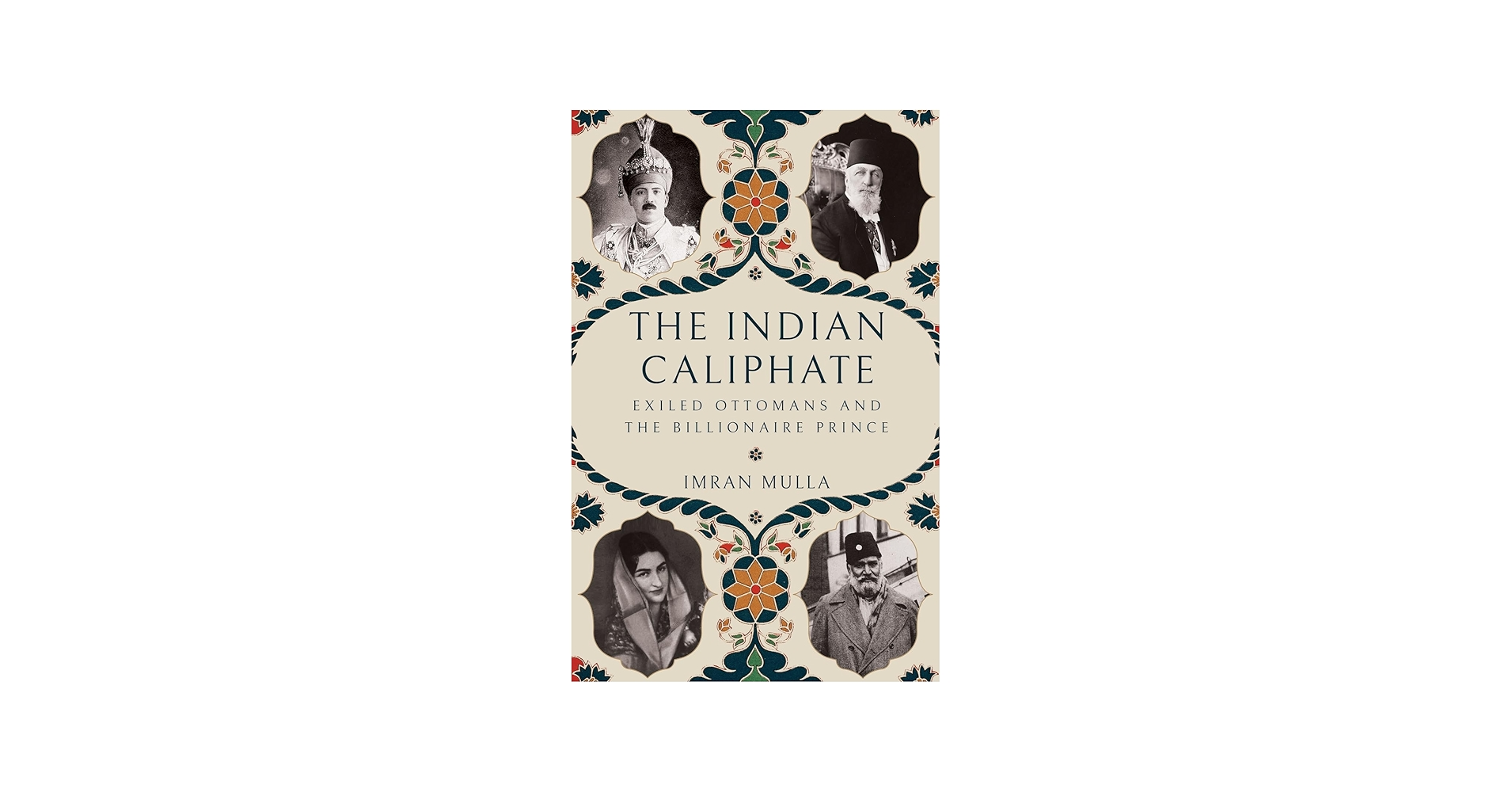
Imran Mulla’s The Indian Caliphate: Exiled Ottomans and the Billionaire Prince is a debut publication, telling the tale of the last Caliph of the Ottoman Empire, and a plan to transfer the seat of the Caliphate from Constantinople to Hyderabad. The book presents itself as an ‘untold history’, a patchwork of ravishing princesses and playboy princes; hidden documents and historic counterfactuals. It joins what appears to be a coming school of Indian revisionism, featuring tempting details of the lost world of the Raj, combining something approaching Empire nostalgia with a contemporary dose of Islamic apologism.
It is a tale of the union of the two most powerful dynasties of the Muslim world in the first half of the twentieth century - and of their demise. The last Caliph of the Ottoman Empire, Abdulmejid II married his daughter to the son of the ‘richest man in the world’, the Nizam of Hyderabad in 1931. The book opens with the tale of Abdulmejid, presented as an attractive but tragic figure, both a devout Muslim and a western-facing moderniser (although Mulla’s epithet ‘The Democrat Prince’ is a stretch).
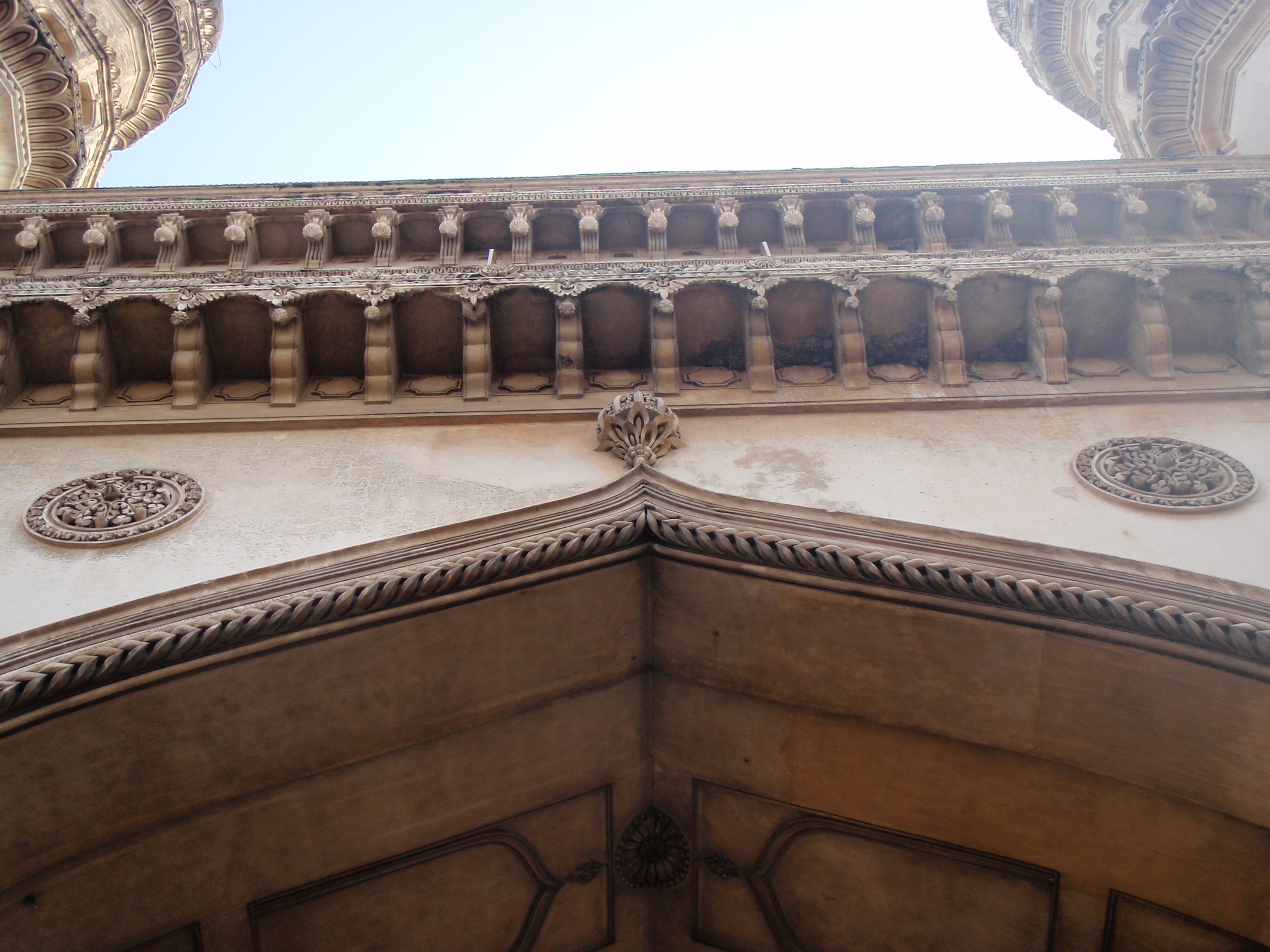
Charminar, Hyderabad
Abdulmejid had spent much of his adult life under something approaching house arrest under the rule the ‘Red Sultan’ Abdulhamid II, who reigned from 1876 until his deposition in 1909. (Imprisoning rival family was something of an Ottoman tradition, less brutal than the previous practice of murdering them.) He comes across as a cultivated figure - a musician, and painter of Orientalist canvasses of harem life ranging from the mildly erotic, to sophisticated salonnières depicted reading Goethe and playing Beethoven trios.
Mulla glosses over the bloodshed of Abdulhamid’s reign, mourning the territorial losses of the Ottomans in Europe during the Balkan Wars, and the resulting ‘ethnic cleansing’ of Muslims, rather than the atrocities committed by Turks, which so enraged Gladstone. And whilst he does refer to the massacres of the Armenians from 1915 (‘the word “genocide” was not yet in usage’1), he does not mention the Hamidian massacres of 1894-6, estimated at up to 300,000 in peacetime, or the slaughter of 20,000 in Adana over four days in 1909. Fearing the potential for Russian inference, Talaat Pasha (as Minister of the Interior) had in fact begun to plan ‘extraordinary measures’ for the removal of Armenians from the six eastern vilayets (provinces) even before the war.
Abdulhamid was deposed as Sultan after the Young Turk revolution brought the Three Pashas to power (Enver, Talaat and Cemal), who took the empire into the Great War on the side of the Central Powers. The Caliph - literally ‘successor’ of the Prophet - was now the titular head of Islam at war with the largest population of Muslims in the world, in British India. The Caliphate had long been little more than a notional title for the Muslim rulers of India, from the Delhi Sultanates to the Mughals (culturally, descendants of the Persian world than orthodox Sunni Islam); now it mattered. The Constantinople ulema authorised jihad in the name of the Caliph against the British Empire.
Aside from the charming, though incidental details of life in the world of Islamic courts of the twentieth century, the most valuable angle that Mulla brings to his history is just how important it was for the Brits to keep Indian Islam on side. In British India, a simplistic reading is that there always was a natural balance to ally with the minority Muslim population to balance the Hindu majority; on-the-ground reality was always more complex. The key princely states were mostly ruled by Muslim dynasties (albeit with a minority Muslim population), and their rulers staunch Imperial allies. (Kashmir inverted this dynamic, though its ruler was just as loyal.) And although Hinduism was certainly not confined to the subcontinent, there was no drive towards pan-Hinduism to influence British policy in the way that Islam could be weaponised for or against the Empire.
London - more than Calcutta - was conscious of the pull of the ummah. Mulla quotes Wilfred Scawen Blunt - poet, Arabist and adviser to Churchill - advocating for the English Crown to ‘make itself in some sort the political head of Islam’2. The current holder appears to have taken note. And Lloyd George declared that ‘We are the greatest Mahomedan power in the world and one fourth of the population of the British Empire is Mahomedan.’3 Fears in London were opportunities in Berlin: the Orientalist banker Baron Max von Oppenheim had the ear of the Kaiser, attempting to sow division through a ‘jihad bureau’ practising Islampolitik.
In practice, external threats to India bound Britain’s Muslim allies closer to the empire - and London to them. It was as pattern to be repeated in 1939. The quasi-independent Princely States were always the most loyal elements of British India; amongst others, the Nizam of Hyderabad supported the war. There was no significant uprising of the Muslims of the subcontinent in support of the Ottoman side, although Mulla does note instances of prisoners captured by the Turks throwing their lot in with their fellow confessionals - a precursor of INA support for the Japanese in the second war4.
Mulla skips over the grim details of the post-Armistice Greek invasion (a Lloyd George project) and the reconquest by the Kemalist forces, now aided by Bolshevik Russia. Abdulhamid had been the last Sultan with any political clout. Abdulmejid’s cousin Mehmed VI Vahideddin was deposed as Sultan in November 1922, after Kemal’s victorious campaign against both the Greeks on the Aegean coast (culminating in the burning of Smyrna) and the denuded Armenian highlands in the east. Kemal abolished the Sultanate, but not the Caliphate; Abdulmejid was ‘elected’ (by the nationalist Ankara parliament and at Kemal’s instigation) a few days later. It didn’t last. The Young Turks had been happy utilise Islam, but Kemal was a secularist as well as a moderniser, and by then in total control of the government of the new Republic. One hoca (scholar) is recorded as saying ‘Pasha, if it your intention to do away with the Holy Book, say so, and we’ll find a way to do it.’5 Abdulmejid was exiled in 1924, taking his family on the Orient Express to glamorous penury in Nice. Kemal’s government cancelled the Caliphate, and in one of the more absurd attempts at modernisation, introduced the Hat Law, banning the traditional fez in favour of Western styles the following year. Fez-wearing holdouts were hanged; Turkey retains the law to this day.
In post-war British India, the convulsions of the Ottomans and the risk to the Caliphate prompted a popular movement against British policy, and even British rule itself. Mulla makes much of the Khilafat movement, as it was known. From 1918, with civil war in the Ottoman heartlands, the aim was to pressure Britain into bringing the Empire’s weight to the retention of the role. Agitation was whipped up by the brothers Shaukat Ali and Mohamed Ali, and backed by the Aga Khan and Gandhi. It’s possible to represent the Khilafat movement as the early stirrings of independence, and it suits Mulla’s narrative to stress its cross-communal character.
It was, in his words ‘spectacular mass politics on action’ - an ambitious description for a crowd of 10,000. He appears surprised that a Khilafat delegation to London met with ‘virulent anti-Ottoman sentiment’, barely more than a year after the war’s end. Mulla berates Arnold Toynbee for ‘condemn[ing] the Empire’; he doesn’t mention that the historian had co-authored the first report on the Armenian Genocide as early as 1916. The Khilafat movement, disorganised and directionless, descended to communal violence, and the authorities soon cracked down on when a police station was burnt (killing 21). Kemal (by then President) used the potential for British interference (and the possibility of sponsoring the Aga Khan in the role) as justification for abolishing the Caliphate. The movement failed, in India and abroad.
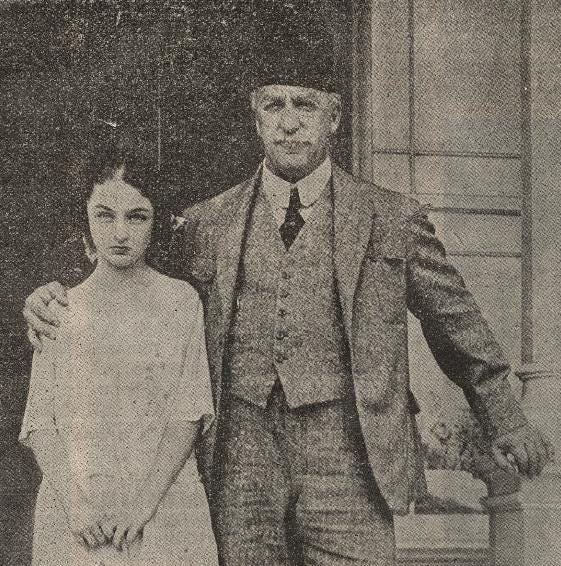
Abdulmejid and Durrushehvar
The seventh Nizam of Hyderabad, Mir Osman Ali Khan, was reputed to be the richest man in the world, and one of the most parsimonious. But he had supported the exiled Abdulmejid and his family since the 1920s. Shaukat Ali (of Khilafat fame) brokered a marriage between the Abdulmejid’s daughter Durrushehvar, and the Nizam’s eldest son Azam Jah, uniting the (abolished) Caliphal Ottoman dynasty with the leading Muslim princely house, the Asaf Jahis of Hyderabad. Azam’s younger brother, Moazzam, also received an Ottoman bride, Niloufer. Neither brother inherited their father’s frugal tastes: Azam had a fondness for polo and sports cars, whilst Moazzam was considered ‘the best dressed man in Europe’, travelling with 250 suits. A dual wedding was held in Nice in November 1931.
It is perhaps remarkable that, with since Caliphate has been in abeyance, no claim had been established - not even by the House of Saud (now protector of Islam’s Holy Places). Mulla’s exploration of his ‘Indian Caliphate’ emerged from uncovering a ‘deed’ from Abdulmajid transferring the Caliphate to Nizam, in trust for the offspring of the marriage of their houses. (Mulla had previously published articles on this6.) Turkish experts (even in Erdogan’s renewed Nationalist-Islamic Turkey) have questioned its authenticity.
The question is: does any of this matter? Dreams of resurrecting the Caliphate in Hyderabad may have been current in the 1930s, and its attraction to both of the royal Muslim houses is obvious. But realpolitik at the end of British India did not allow for the concept of an independent Hyderabad, or (Mulla’s unrealistic dream) a ‘federation’ untainted by Partition. Narendra Singh Sarila has demonstrated that British policy - with the tacit consent of both Nehru and Jinnah - led to the creation of a British-protected Pakistan and an India which did not encompass princely states (a full review is here). India annexed Hyderabad by force in 1948; the British stood down its commanding officers in the Nizam’s army just before, in order to avoid them fighting a fellow Dominion. Mulla simplistically shifts the blame to ‘heavily anti-Muslim’ interior minister Vallabhbhai Patel rather than Nehru (or even the British).
Mulla is worryingly naive for a political journalist. A young Cambridge history graduate (as he tells us more than once), he is a journalist for Middle Eastern Eye, specialising in covering the pro-Palestinian scene in the UK over the two years of war. He has been promoted by Peter Oborne, the Conservative journalist who has journeyed from chief political commentator for the Daily Telegraph to a prominent pro-Islamic voice, redolent of a certain type of establishment Brit familiar from history to the present day.
And there appears to be a strange double-act going on between Mulla and another first-time author, Sam Dalrymple, whose flawed debut Shattered Lands (reviewed here) received much praise. Dalrymple refers to Mulla’s (as yet unpublished) text in his book; Mulla repeats Dalrymple’s fantasies about Britain’s possessions in the Gulf being part of ‘British India’ as being anything more than an administrative fiction, ended as soon as independence came into view and it started to matter. Dalrymple (son of the prolific writer on India, William) has been a frequent promoter of Mulla’s book7.
Mulla shares with Dalrymple a type of revisionism of the Raj, that veers towards a lost vision of cross-communal harmony in something approaching a subcontinental Switzerland. Princes (in this case the Nizam) are opulent but progressive, Muslim but tolerant, and there is nostalgia in their loss. There is a yearning for something like Empire without Colonialism - which starts to look much like imagined Mughals or the Ottomans, but stripped of history or bloody reality.
Mulla has some particularly idealistic views on religion.
The concept of religion first emerged after what are now called the Wars of Religion (1530-1630) in Europe… Increasingly over the next few centuries Christianity became marginalised in society, pushed into a distinct ‘religious’ sphere. Since the process of secularisation in the European context defined what religion was… Islam could only wear the religious label uncomfortably.8
This is a wholly Islamic backwards misreading history, if it hasn’t ceased to be history at all. Meanwhile,
Hindu nationalism with a strong anti-Muslim tenor… emerged from the annals of British colonial discourse, which presented India as a fundamentally Hindu land which had enjoyed a golden age, disrupted by a medieval tragedy in which the natives were crushed by Muslim invaders.9
‘Discourse’ is employed here as a non-word, a stand in for power, with the implication that because the British were in power, they must be liable for anything and everything, including a backlash to a tendency to favour Muslims over Hindus.
Mulla is unhistorical, or downright wrong, on many points in a short book. ‘By early 1914, the Great War was on the horizon’10 (was it?); in 1944 ‘the British expected to pull out of India imminently’11 (they categorically didn’t at that point). ‘Lord Arthur Balfour’ was not ennobled at the time of the 1917 declaration (let alone the elder son of a Duke). Claiming the Khilafat delegation suffered from British ‘Islamophobia’ forces his contemporary agenda onto history. The British Library contains many interesting documents, but this doesn’t make it ‘an enduring product of Empire.’ Most embarrassingly for a book half-about Hyderabad, it was not as he claims the largest of the princely states - that was Jammu & Kashmir.
The Indian Caliphate raises pertinent questions about fall of both the Ottoman Empire and the Raj, but for all the interesting details of princely life, it is too slight as a book. It’s central question - could the Caliphate have been revived in Hyderabad? - is too far removed from historical reality to be anything more than a fantasy: history as magical realism, told with a strong eye on the present. And that present is (inevitably) Palestine. The World Islamic Congress, held in Jerusalem in 1931, was ‘a monumental moment in the history of the Palestinian cause’12, but one that achieved nothing except for words and a call to boycott ‘Zionist goods’.
Mulla is keen to divorce the historical Caliphate from its resonance (to modern ears) of ISIS; whilst refusing to recognise that the Erdogan regime in Istanbul is coming closer to reviving the concept than artistic Ottomans or peaceable Hyderabadis ever could. Turkey’s proxy ISIS fighter Abu Mohammed al-Julani occupies the seat of the Umayyad Caliphate in Damascus. Reborn as Ahmed Hussein al-Sharaa, his suits tailored on Savile Row13 would be fit for the sons of the Nizam, and he is welcomed in Paris and Washington.
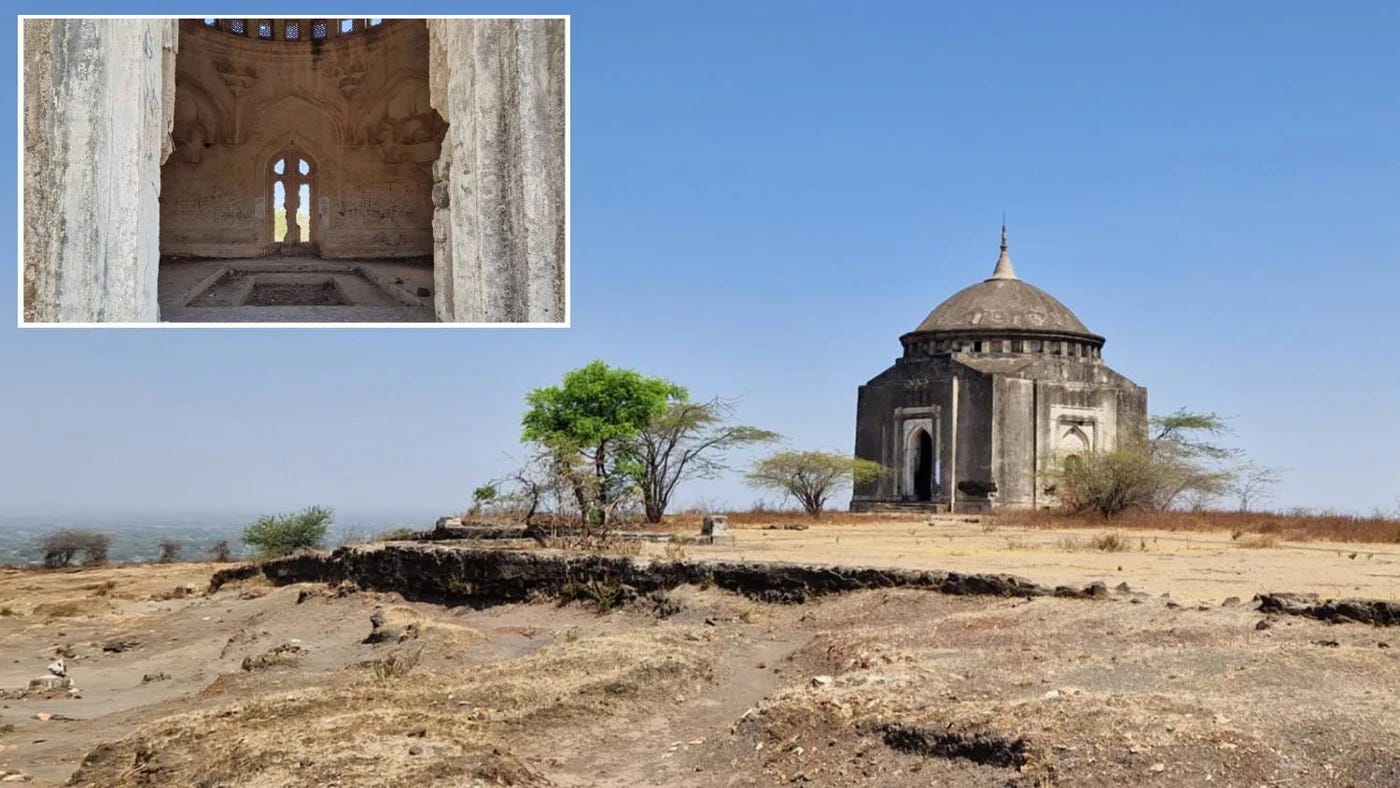
The Empty Tomb (Photo Imran Mulla/MEE)
Abdulmejid died in Paris 1944, but requested to be buried in Hyderabad. The Nizam thought best to clear this with the British, who didn’t object, and a tomb was built in the far north-west of the Nizam’s realm. Khuldabad is the site of the mausoleum of that most Islamic of the Mughal Emperors, Aurangzeb; a few miles from the rock-cut eighth-century temples of Ellora. The tomb is empty - the last Caliph was still interred temporarily in France when Hyderabad fell, and his body was finally buried at Medina.
Hyderabad is today a pleasant city, sitting easily between its Muslim monuments and modern role as one of the hubs of India’s IT boom; a city of biryanis by the Charminar and nightclubs in the Banjara hills. Aurangabad is now politically detached from the Nizam’s realms, part of strongly Hindu Maharashtra state; a dusty place, with an air of resentment. It would receive few visitors were it not a base for Ajanta and Ellora. I doubt the empty tomb of the last Caliph will bring many more.
Mat Brown writes on topics as varied as politics, geopolitics, and culture, on his substack. You can follow him on X @fragmentshore.