
Author: David Banic
There are only a few works that can be said to define a discipline or area of study, and fewer still are the luminaries who write them. Giordano Bruno and the Hermetic Tradition by Frances Yates is one such book, and Yates is one such author. While I had been broadly aware of the significance of both the book and Yate’s research, it was not until a new edition by Gallowglass Brook that I leaped to read it. What unfolded before me was entirely beyond my own expectations. There is a “traditional” narrative in many historical circles that places the scientific work of the Renaissance as the beginning of many modern sciences, where the dark ignorance of the Medieval period is thrown off for advances in medicine, chemistry, and a host of other disciplines. This narrative continues with the assertion that the separation of science from superstitious magic and religious philosophies was accomplished, or at least began in earnest, during the Renaissance. The Renaissance, in this narrative, is represented as a break with tradition and antiquity, rather than a natural development in the history of Western civilization. This novel assertion, nevertheless, undergirds the scientific mythologies of the present day.
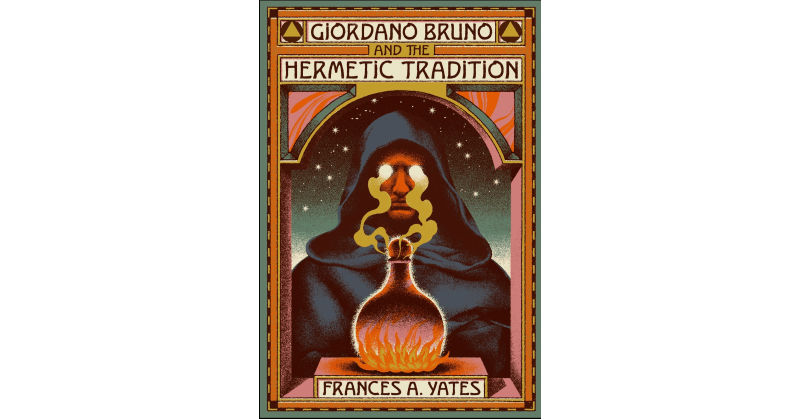
The tome itself offers a comprehensive religious and spiritual landscape of Western European thought, straddling Hermetic and esoteric trends from the Late Medieval period to the dawn of the Enlightenment. Printed in glossy Italian paper, featuring full colour artwork and illustrations, as well as goldfoil and black cloth hardback plates, the team at Gallowglass Press has outdone themselves. Additionally, the original cover art and bordering world builds for the reader, drawing them into the world of Renaissance magic through the use of aesthetics. For those of a more academic bent, this edition also features translated Latin to English titles for each chapter. Beginning with an explanation and historical background for the figure of Hermes Trismegistus, the reader is swept across 22 chapters into the genius mind that belonged to Frances Yates. Yates was a high church Anglican whose imagination was inspired by the Oxford Movement, and who preferred the recovery of Catholic ritual to the insistence on a Protestant dialectic. It is hard to underestimate the importance of her own personal convictions in her work. Afterall, a world in which magic and decadent pagan philosophies seemed to be tolerated and even practiced within the bounds of normative Catholicism offers a richer spiritual landscape than the excesses of Protestant Calvinism.
While the book certainly focuses on Catholic priest and polymath Giordano Bruno, other major figures in the Italian Renaissance are also given due attention. First among these is Pico de Mirandola, the figure who bears the most responsibility for the introduction of Cabala1 into Renaissance magical and humanistic circles. Marsilio Ficino, an advocate of what may be understood as “natural magic,” is also an important figure during this period, and it should be noted that most figures associated with these various intellectual movements also belonged to a movement that aimed at recovering Platonism2. The origin point for a rediscovery of “lost” religious wisdom is the sense among the broader intellectual and artistic elite that Western Christianity had become parochial. There were certain gaps in understanding, certain limitations, and circular reasoning that were promulgated by Scholasticism that fell short of perceived realities. The primary vehicle for this creative resurgence of theology was found in reaching into the mists of human antiquity. The figure of Hermes Trismegistus was the focal point for this movement. Hermes Trismegistus is the Greco-Latin appellation given to the ancient Egyptian god Thoth, and as much for the ancients as for modern writers like Lovecraft, ancient Egypt was the repository for occult wisdom and arcane knowledge.
The earliest corpus of Hermetic writings attributed to Thoth-Hermes centered around questions of alchemy, medicine, and astrology. Hermes Trismegistus (Thrice-Blessed) thus became associated with occult and esoteric knowledge, as well as the patron of letters. It seems that the original Hermeticism arose in the background of late Ptolemaic-Roman Egypt. Mystery cults abounded in this time period, with rationalistic traditions benignly abandoned for the promise of theosis and initiation into ancient mysteries. Egypt has long held a place of prestige in ancient Greek philosophy, being the supposed source of wisdom for philosophers from Pythagoras to Plato to Zalmoxis. Yates suggests that the popularity of Hermetic mystical movements in the Renaissance is in part because of a shared feeling between the men of the 2nd century Medditeranean and Renaissance Italy. That sentiment, namely, is that what is older is holier. The older the source of knowledge, the purer it must be. With the introduction of Byzantine letters into Western Europe, especially in Florence, in the form of the Florentine (Platonic) Academy. Marsilio Ficino was the principal scholar of the Florentine School, and Platonic and by extension Hermetical works soon guided the development of Renaissance thinking. Much of the truth that Renaissance thinkers found in Platonic writing was elevated and almost ritualized in the Hermetic texts. Yates describes that the profound historical error of attributing the fount of all Platonic and even Christian wisdom to the late, likely ahistorical Hermes Trismegistus, birthed one of the most important historico-religious movements in European history.
The implications of having ultimate Christian truth associated with a Hellenized Egyptian god are rather obvious. The rather closed field of theology was burst open, and the intellectual and spiritual horizons of Europe seemed to have no clear limit. Astrological fatalism came into vogue, and the consultation of natural spirits or deities associated with particular stones, elements, and other natural phenomena became acceptable among the avant-garde elite3. There were, of course, objections and various parties within this new spiritual movement. Devout Roman Catholics, like Ficino, did their best to operate under the aegis of Catholic theology and defended certain forms of Platonic magic as something closer to a naturally revealed science. Others, like Cornelius Agrippa, flew too close to the sun, being accused of giving directions on the manipulation of demons and spirits of the air4. Indeed, the spiritual intensity that was a hallmark of the age drove some of its own avowed Kabbalists and Hermetic sages to the breaking point; Pico de Mirandola left the movement and burnt many of his own works.
Frances Yates carefully weaves together the blurring of magical and scientific realms, revealing a stunning and near scandalous vision of Renaissance Europe. The reader who has in his mind a Renaissance of secularism and the triumph of cold-hearted “scientism” will quickly be disabused of this anachronistic notion. Yates writes in an academic, albeit captivating style. The brilliance of her work lies in her astounding ability to interpret primary and secondary source material for the aim of a novel thesis. This novel thesis is that the Renaissance luminary Giordano Bruno was not burned at the stake for his heliocentrism, but rather for his Hermeticism. The book is permeated with the air of an academic who endeavours to calmly upend the idols of scientific history. It is the opinion of the writer that the renewed interest in the various fields of Christian mysticism and Hermetic Platonism is not accidental. The decaying structure and scientific certainty of modernity have left little room to escape or build; the state of the ruins is constantly enforced and managed. What will undoubtedly be required to experience a true Renaissance is a turn toward mysticism, and away from constructed rationalism. There are, indeed, two approaches to reading Giordano Bruno and the Hermetic Tradition. The derisive acolyte of modernity, or the clear-eyed wisdom of the postmodern mind. It is yours to choose the alchemy of the mind, or of the soul.
David Banica is an undergraduate student pursuing his B.A. in History. He has a passion for Christian mysticism and the philosophy of Mircea Eliade. If he’s not arguing with you about Plato, he is reading Plato.
- I have used this spelling instead of “Kabbalah” as both Frances Yates and the figures written about in her book used the “Cabala” spelling. ↩︎
- Frances Yates, Giordano Bruno and the Hermetic Tradition, First. (Gallowglass Books, 2025). Pg. 165 ↩︎
- It should be noted that astrological fatalism was, in essence, a holdover from the late Medieval period. Some Heremetic Renaissance figures, such as Pico de Mirandola, attacked this unenlightened form of parlour magic. Others, like Marsilio Ficino, were forever burdened by the stars. ↩︎
- Frances Yates, Giordano Bruno and the Hermetic Tradition, First. (Gallowglass Books, 2025). Pg. 151 ↩︎
Discover more from Decadent Serpent
Subscribe to get the latest posts sent to your email.
