
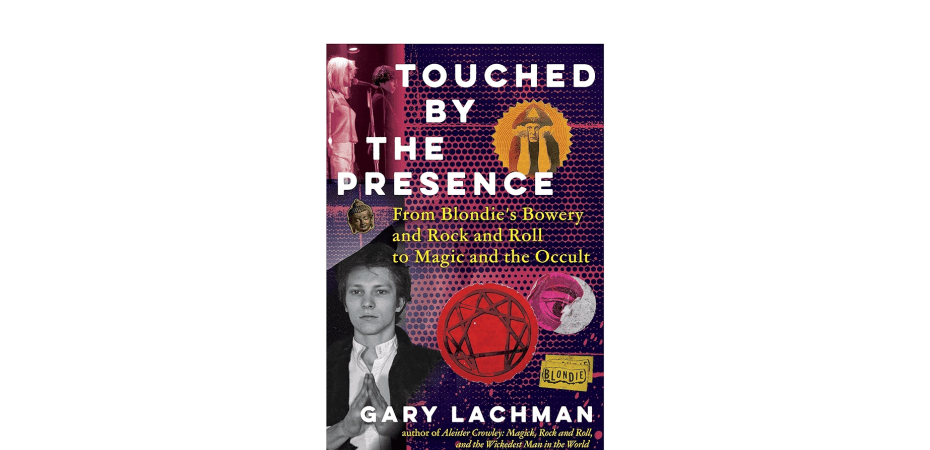
Author: Luke Gilfedder
Rock memoir, spiritual memoir, showbiz memoir—these are genres that induce groans, not least because they are that very thing: genres, generic, thus standardised. Yet Touched by the Presence, Gary ‘Valentine’ Lachman’s memoir of Magic, Rock and Roll, and Becoming Who You Are, belongs to no genre save its own. It is, like its author, an outsider.
Written by the only Rock and Roll Hall of Famer who is also an author on consciousness, counterculture, and Western esotericism, the former Blondie bassist’s memoir traces his journey from rock and roll to individuation—a path that takes him from a turbulent New Jersey childhood, through a period as a near-homeless starveling, then as a New York rock star (or “eccentric satellite,” as he puts it), to the eve of his flight to London to become a full-time writer. That flight from LAX took place on New Year’s Day, 1996—twenty years after a Christmas Lachman spent alone, freezing in the Blondie loft deep in New York’s Bowery, burning Jimi Hendrix posters in the fireplace to keep warm while poring over a borrowed copy of The Birth of Tragedy.
Set midway through the memoir, this image cuts to the heart of Lachman’s relationship to rock and literature—sacrilegious as its symbolism may seem to today’s readers, for whom rock stardom has acquired a quasi-sacred status and who regard the long sixties as the fons et origo of culture. From the outset, however, Lachman makes clear that his first love was literature, and Touched by the Presence delights in relating how that passion collided with his later rock escapades: from meeting two of the “Three Beat Musketeers”, Burroughs and Ginsberg, to becoming Iggy Pop’s ufology expert during 1981’s Party tour, to disabusing David Bowie of the notion that Colin Wilson spent his days in Cornwall painting pentagrams on doors and evoking the spirits of ectoplasmic Nazis.
Until the summer of 1975, when Lachman was playing in a then-unknown rock band and living on the Bowery, he had no conscious interest in the occult tradition that would later define his writing career. He had, nevertheless, been primed for it by his love of reading. Fellow New Jerseyan Bruce Springsteen may have learned more from a three-minute record than he ever learned in school, but Lachman took the less populist route of skipping school to go to the library. A self-confessed “library cormorant”, he soon fell under the spell of Hesse and Jung, whose works first confronted him with the challenge to “become who you are.”
Becoming a writer and philosopher might not have been the most obvious path to individuation for a boy growing up in Bayonne, where there were no bookshops save for the paperback racks at the drugstores. Yet Lachman’s romantic hunger for something more than “the triviality of everydayness” had already been kindled by his love of Silver Age comics—not those of Superman or Batman, but of the lesser-known Cosmic Boy. Why, given that his power was magnetism, was he not called Magnetic Boy, like Marvel’s Magneto?
Wary of asking his parents—who discouraged his bookishness—Lachman was left alone to ponder the word “cosmic,” a question whose answer he has been “looking for ever since.” His fascination with such strange powers would inspire Blondie’s 1978 hit “(I’m Always Touched by Your) Presence, Dear,” a song he wrote in response to the uncanny telepathic rapport he believed he shared with his then-partner, actress Lisa Jane Persky. But that lay in the future; for now, dime-store paperbacks fuelled Lachman’s search for the miraculous, particularly the cosmic horror of H. P. Lovecraft’s stories in Weird Tales.
As Presence is, in Johnny Marr’s words, “not just a memoir, but an education,” Lachman casts a critical eye on his early influences, treating his younger self as he would a subject of one of his philosophical biographies. Significantly, he now finds in Lovecraft’s worldview a “soured romanticism,” a vision akin to T. S. Eliot’s—namely, that humankind cannot bear very much reality—but without the Old Possum’s recourse to religion as consolation in the darkness. In Lovecraft’s uncaring universe, meaning—if it is to be found at all—must be wrested into being; one must summon, as Paul Tillich insists, the “courage to be.”
Such courage was needed in the early years of Blondie, which Lachman recounts in a candid section that reads like Knut Hamsun’s Hunger set to the New York Dolls’ “Jet Boy.” It was, in fact, in the band’s run-down loft in pre-gentrification New York that Lachman’s latent interest in the occult received a quite literal jump start. While tidying his corner of the loft—which doubled as a rehearsal room—he picked up a faulty lamp and suddenly had 110 volts running through him. Frozen, unable to cry out, he was saved by the fortuitous arrival of guitarist Chris Stein, who calmly pulled the plug just as Lachman was about to go under.
Soon after this incident, Lachman began to experience phenomena suggesting there was more to reality than what is perceived by our “senses five.” He later learned that many psychics become aware of their abilities after such accidents—one example being the “telepathic detective” Peter Hurkos, who discovered his gift after falling from a ladder.
It was not, however, the oft-cited works of Crowley or Regardie that set the nineteen-year-old proto-punk rocker on the path to becoming a historian of esoteric culture, but a battered copy of Wilson’s The Occult, borrowed from Tommy Ramone. The Occult harmonised Lachman’s polymathic interests—literature, philosophy, science, history, religion, and art—into a narrative that placed the occult at the centre of human life. Wilson’s eminently readable prose and the persuasive clarity of his ideas revolutionised Lachman’s thinking: the evolution of consciousness, he realised, is what the occult is truly about.
While Lachman’s initiation into the world of consciousness and the occult takes centre stage in these pages, he never loses sight of the unfolding Blondie narrative. Their rise to New Wave stardom provides a heady backdrop to Lachman’s inner transformation: in a matter of months, the band metamorphosed from third-on-the-bill support act to playing Central Park and the Sunset Strip, touring with Iggy Pop (whose keyboardist was an incognito David Bowie), and releasing their eponymous debut album. The Valentine-penned debut single, “X-Offender,” played no small part in this success. Lachman would go on to write more songs for their sophomore LP, Plastic Letters, including “(I’m Always Touched by Your) Presence, Dear”—still the only Top Ten single to feature the word “theosophy” in its lyrics.
Yet after leaving the band on the brink of global fame and relocating to L.A.—the minutiae of which, already covered in 2002’s New York Rocker, are abridged here—Lachman found himself as adrift as he had been before joining Blondie. It was a fitting moment to discover the book that would change his life even more than The Occult—Colin Wilson’s debut, The Outsider.
If The Occult had introduced Lachman to magic, mysticism, and the hidden powers of consciousness, then The Outsider—he says—“introduced me to myself.” Published in 1956, Wilson’s existential study achieved overnight fame for its lucid discussions of Nietzsche, Tolstoy, Van Gogh, Blake, T. E. Lawrence, and a galère of other thinkers and artists familiar to Lachman—all of whom shared a pressing hunger for meaning and purpose in a world bent on denying it to them. Wilson’s ‘outsider’, in short, is someone who instinctively rejects the “triviality of everydayness” but has yet to find something to put in its place.
As Lachman knew all too well from his life in the ‘blank generation’, many outsiders succumbed before their time to drugs, alcohol, or depression. Determined not to be numbered among them, Lachman now looked to Wilson’s portrayal of those who transcended their outsiderness—those able to reach the source of “power, meaning, and purpose” within themselves and not “crack up”. Fortunately, Lachman’s optimistic nature predisposed him to Wilson’s message: even his stage moniker, Valentine—derived from Henry Miller’s middle name—suggested a cheerfulness at odds with the pop nihilism invoked by Richard Hell, Johnny Thunders, Sid Vicious, or Alan Suicide.
Just as the college-dropout, ‘wannabe poet’ turned punk rocker had modelled himself on the likes of Hell and Verlaine, so now—as an aspiring writer—Lachman modelled himself on Colin Wilson, the ‘angry young man’ who was too intelligent to be angry. Wilson would later become Lachman’s mentor and friend—a relationship that began with Lachman’s pilgrimage to Wilson’s Cornish home in 1983, capping a European trip that included visits to Stonehenge, Avebury, and Glastonbury in search of ley lines. Having argued with Bowie, gotten drunk with Iggy Pop, and had Debbie Harry iron his skinny ties, Lachman writes that if he was ever starstruck, it was the night he “got through a bottle or two” with the man whose work had changed his life.
But Lachman’s decision to abandon pop music and become a student of the “melancholy science,” as Adorno called philosophy, meant moving decisively against the zeitgeist. In the years preceding his visit to Wilson, the memoir reads as something of a Sisyphean struggle against this tide—from forming (and disbanding) a Gnostic-inspired band called The Know, to a disenchanting stint in Crowley’s quasi-Masonic Ordo Templi Orientis, to embarking on a last-fling, sex-and-drugs-and-rock-and-roll tour with Iggy Pop that included two infamous nights opening for the Rolling Stones.
No less intense were his late-night drives to a Fourth Way group in the mansions of Hollywood’s Laurel Canyon, which Lachman joined to pursue the teachings of the Armenian mystic G. I. Gurdjieff—a man Wyndham Lewis once dubbed the “Levantine psychic shark.” Lachman’s determination to understand Gurdjieff’s system (the “Work”) led him to an in-depth study of the ideas that have secretly shaped Western consciousness over the past few centuries—a fascination that would later inform his critical biographies of Blavatsky, Steiner, Swedenborg, Jung, Ouspensky, Crowley, and many others.
Before finally completing his Fitzcarraldian journey from rock to metaphysics, Lachman came perilously close to life as an ‘insider’. He enrolled as a mature student at California State University—albeit resisting faddish deconstructionism and the “epistemological bondage” of Foucault—and, despite virtuosic attempts to avoid employment, gained a coveted position as a science writer at the University of California. A well-written life is as rare as a well-spent one, and it is a testament to Lachman that these mature years read no less compellingly than his early punk adventures. Most significant is his account of majoring in philosophy while selling crystals and self-help books at West Hollywood’s famed metaphysical bookshop, the Bodhi Tree. Like the comic-strip heroes of his childhood, Lachman writes that he had to adopt two identities: one, a sharp-minded philosophical critic; the other, if not a New Ager, then someone who took mysticism, the occult, and the esoteric seriously.
As Lachman’s readers will recognise, this duality informs much of his later writing, which combines philosophical rigour with an openness to mystical and esoteric ideas—a synthesis that echoes the broader dialectical evolution of Western consciousness described by Richard Tarnas. In striving to achieve this balance, Lachman followed in the footsteps not only of Wilson but also of Ouspensky, whom he regarded as the archetype of the artist-philosopher: a man who united romantic vision with rigorous intellect.
But none of this would have been possible without Lachman’s decision to abandon his hard-won, well-remunerated life in the California sun—as he had once abandoned rock stardom—and move to London to pursue his writing career full-time. In doing so, he held true to the Gnostic maxim:
“If you bring forth what is within you, what is within you will save you. If you do not bring forth what is within you, what is within you will destroy you.”
“Amor Fati” closes Debbie Harry’s testimonial for the memoir—a reference to an unreleased Blondie track written by Lachman and his avowed life motto. Amor fati, Nietzsche’s “formula for greatness,” denotes love of fate: not merely acceptance of life but affirmation of it, even in its most tragic and uncertain forms. Evelyn Waugh once wrote that “only when one has lost all curiosity about the future has one reached the age to write an autobiography.” Lachman’s memoir concludes in 1996, just after he turned forty, the age at which life proverbially begins. Yet his subsequent twenty-three books on culture, esotericism, and the history and philosophy of consciousness show no diminishment of that curiosity in the face of life’s uncertainty: Lachman’s memoir, to adapt a title of Wilson’s, marks but a voyage to a beginning.
Luke Gilfedder is a writer from Manchester. His first book, ‘Wyndham Lewis: Modernism and the New Radical Right’, was published by Logos Verlag Berlin in 2025. His work has appeared in Islander Magazine, The Jackdaw, Corncrake Magazine, The Brazen Head, The Miskatonian, and The Journal of Wyndham Lewis Studies. His debut novel, Die When I Say When, is forthcoming in 2026.
Discover more from Decadent Serpent
Subscribe to get the latest posts sent to your email.
