
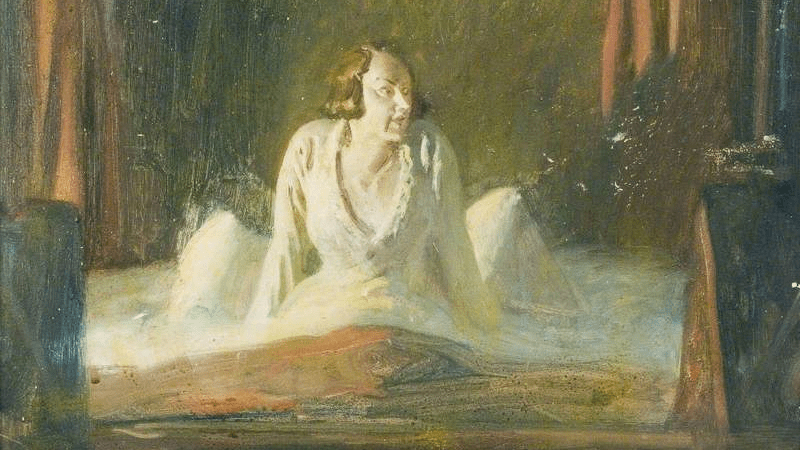
Author: Dinah Kolka
It wasn’t clear how I found myself here – it was a ruined, desolate house at the edge of the forest and the consciousness. A wooden sign was placed in front of it – words written in Cyrillic, a cacophony of symbols that meant nothing. Sometimes, the faces would pass by, hollow, grey, looking in. Sometimes, I would look back at them – lifting my hand to the cold glass of the window. The faces would frown, stop looking, and hasten their step. I no longer knew the date or time; I just felt that I was in the house for what could have been centuries. Dust and cobwebs settled on the furniture, and I wasn’t sure whether it was mine and whether I had the right to clean it. So I let it fester, as the mould grew on the walls and began to develop on the ceiling, almost filling the entire room.
Most days, I simply moved from room to room, like a spectre, watching my black gown dance behind me. I’ve been in the house for so very long. I watched the windows get boarded up one day, but I couldn’t protest, for what right did I have? Each day, the darkness crept up towards me until I became like Lot’s wife – frozen in time and space.
I must have stood there, unshaken, unknown for some time until my mind began to thaw. There was comfort in the stillness of my salt-like endeavour. There was tranquillity in the darkness of the house. But my mind was stronger than my body, and I fell out of my stupor. The wooden floor was hard and slightly moist, and I felt a cold shiver. Was there ever fire crackling in a place like this? Could there ever be warmth and laughter in the emptiness so acute?
I had the urge to leave, and I crawled on all fours to the front door. It was my responsibility to leave – I knew well there was no one ever waiting for me – in the dark, I was alone, and no glimpse of a face came across as I stood there for aeons. I pressed the old-fashioned handle on the door, and it opened with a creak. But it wasn’t the welcoming air of a summer night, or even the cold wind of a winter morning – the stench of the abandoned house remained. I found myself upstairs, in one of the bedrooms of the house. A woman sat at a vanity table, her back turned to me, brushing her long black hair. With each sweep of the brush, more and more hair fell onto the floor until the pile was bigger than the hair on her own head. She turned to me with a smile. She had a striking face, large green eyes, plump cheeks, and a honeyed mouth.
‘Isn’t it funny how they call them vanity tables, dear? As if it’s vain to yearn for symmetry. As if it’s vain to look for the sublime in that which was made in God’s image! We sit at this table, day in, day out, watching the entropy of our own selves. God is cruel.’
As she spoke, her hair continued to fall out until she was brushing her naked skull. Her eyes were no longer full of life – they sagged, and her mouth turned inward. She aged in front of my eyes until bugs came all over her, swarmed over her body, and she fell, lifeless, onto the floor to be devoured by the swarming mass of blackness.
At last, I heard her final whisper: ‘Ashes to ashes, dust to dust’.
I wanted to scream – I did, but the search for the exit pushed the scream back inwards. I wanted to see the jasmine blossom; I yearned for the scent of the summer night. What was once a door leading me downstairs was now bricked up. I walked towards the window and, to my surprise, found another door.
I caressed the handle with hesitation – whatever followed could have been a trap, but there was also a promise. Through the door I found myself in a child’s bedroom, decorated with old, peeling wallpaper, decay festering underneath.
A child was lying in bed, taken with a fever. It was a young girl, holding a toy bear close to her. I came closer and noticed the child was covered with boils – it was suffering and wheezing with each breath. When she noticed me, her glassy eyes moved in my direction without lifting her head. She looked at me like this for some time, and then she proceeded to speak, in a mature, raspy voice:
‘You’re so scared, aren’t you? That which came for me prematurely will come for you, too. It’s a Russian roulette. There is a disease circulating in all of us, the heritage of boils and tumours, swelling underneath, waiting to burst.
Her eyes widened as she saw my terror. I retorted:
‘This has nothing to do with me. I don’t even remember how I found myself here.’
‘If only you could see yourself right now – festering, petrified of what may or may come.’
I could feel my cheeks reddening – the conversation made me uncomfortable. The girl started coughing up blood. I shifted with growing discomfort.
‘You don’t like this – do you? You wish you didn’t have to see or hear. A bliss of unawareness. Well, it’s coming. Its gallop can be heard already. Perhaps it’s near!’
The girl cackled and proceeded to cough more blood until the bed in front of her was moist. She looked at me weakly one last time and smiled, a toothless smile of a hag dressed in a child’s skin. Suddenly, the coughing stopped. Her mouth was slightly ajar, her eyes glassy, distant.
I ran towards the bed in an instinct and shook her. But she was light in my arms, like a doll. I wept, shaken by an unspecified feeling. But my heart was muted – the answers were scattered, and clues were unmade.
I was sick of the horrors; I just wanted the stars. In my mind’s eye, I recalled them – The Plough, The Swan, Cassiopeia. They were all out there, visible on a clear night. But indoors, it was dark, and the windows were boarded up.
I walked around the room. There were no doors I could see. I inspected the walls, fretfully. There were bricks where windows should have been, and there was just a plaster wall where doors belonged. I felt itchy, as if touching the body infected me too. I scratched my arm until I drew blood. Then, a door opened behind me with a sound.
I walked forward with shaky legs – this time I didn’t trust my own eyes. To my surprise, inside, I found a great party. People were dressed smartly – suits and flowing gowns. There was a large table set right in the centre – a suckling pig right in the middle, a variety of fruit around. Burgundy curtains wrapped the space, and people were laughing, their mouths jarring, wide open. Champagne was oozing from their glasses, as the party seemed almost suspended in debauched agony. As I entered, a woman came towards me. She must have been in her 70s, make up plastered over her face, painting her like a caricature. Her wrinkled red lips were smoothed out in a grimace.
‘Well, well, well, we’ve been expecting you. But what on earth are you wearing? Ah, forget it. We’ve been told about you. You’re her, obviously.’
The woman turned to the whole group and started clinking her glass.
‘Attention, attention!’ She smiled a false smile, suggesting treachery.
‘The lady is here, I’m sure you all know her. She’s done unspeakable evils as you recall.’
Everyone looked at me, their faces wide, stretched, hating. Like a wave, each one of them was pointing fingers and laughing. They were laughing until their teeth fell out. They laughed until every drop of alcohol spilled and was sucked up by the carpet underneath. Men’s faces turned red as they gasped for air. Women were holding their bellies as they pointed and exhaled in amusement.
The woman grabbed my hand and led me to the table. I glanced at the suckling pig, but it was missing; the fruit was now moulded and decaying. She stripped my dress and forced me onto the platter. In the avalanche of laughter, she tied me to the table, inserting an apple into my mouth.
‘If only you could yield,’ she caressed my hair as she said this. I wasn’t sure why I let her proceed – I seemed to have been led on by an invisible string, a force that made me falter. People were still pointing and laughing, begging the woman to let them touch me. But she hesitated and looked back at me. These were the eyes I’ve seen before – eyes of neglect and mockery.
She turned back to the crowd and shouted, ‘ours is the suckling pig!’ The crowd responded in unison: ‘ours is the suckling pig!’
She removed the apple and poured hot liquid down my throat. It burned as I was forced to swallow it. I looked up. A figure of crucified Jesus on the ceiling was looking back at me. I closed my eyes and fell into a stupor.
I woke up on dewy grass, with the sun shining in my eyes, oppressively. Trees surrounded me, and the canopy was looming, like witnesses to the crime. I stood up slowly, scanning the forest for cues. Did I finally leave?
It wasn’t a place I fully recognised – it looked like a dream, or perhaps a memory of mine. I noticed a path leading through the forest. I began walking. The trees thickened, and the air was humid. I saw a door at the end of the path – a single red door with a handle I faintly recognised. The frog-shaped knocker came into view as I pressed forward.
Finally, I approached the door – it was right in the middle of a valley, pinecones scattered all over the ground, and small beetles moved on, in search of something unspecified. I hesitated next to the door, trying to look through the visor, hoping to see what was through it.
The vision was blurry, and I could only guess the shapes. I stretched and winced, trying to make out the figures, but there were no clear answers and the fear that the door would lead somewhere I couldn’t control settled in my bones. I could have opened the door, I could have checked – but each time my hand moved towards the handle, I saw the hairless woman. I would move away, in a dance against my own future. I touched the door again. The dying child. I threw myself on the ground, dejected. I lifted my arm once more – recalled the laughter and the suckling pig.
And so I chose to stay there, in front of the door where I sat for centuries. The seasons changed and I waited for the fears to wane. Looking at the door that could have led somewhere, I withered and wasted, wondering instead.
Dinah is the founder of Decadent Serpent and a graduate of Edinburgh Napier University with a BA(Hons) in English Literature. Her work has been featured in publications such as The Salisbury Review and The Mallard. She was also published in the Scottish Book Trust’s 2018 anthology Rebel. In 2023, Dinah self-published her own collection of short stories, The Search and Other Stories.
Discover more from Decadent Serpent
Subscribe to get the latest posts sent to your email.
