
Author: Tyler Hummel
Editor’s Note: It is with apologies that this piece has only been published in January. I can assure the author of the book under review that I did, in fact, receive this piece before the end of 2025 — and that therefore Tyler did indeed honour his promise!
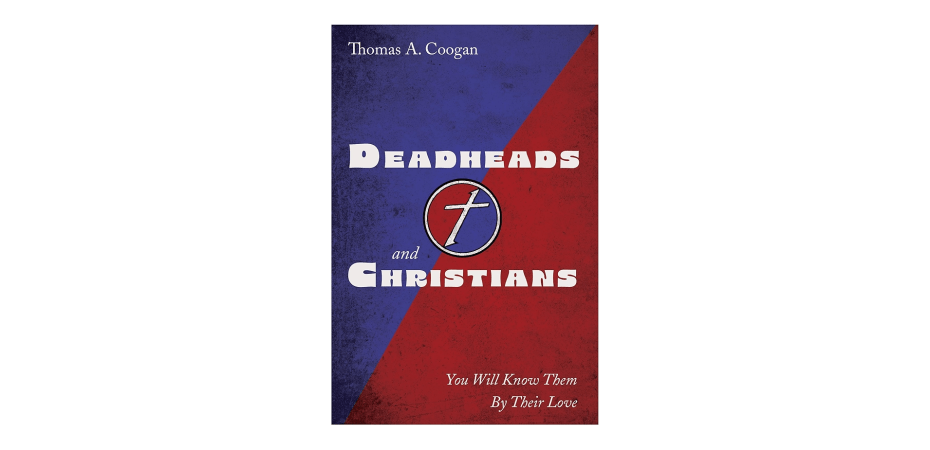
I made a promise to a Presbyterian Deacon earlier this year that I intend to fulfill with this article. I promised him, during an interview for the publication Baptist News, that I would review his new book this year. Down to the wire, I’ve honored my promise!
As I was speaking with him for the article, I got a wonderful introductory course to the history of one of the 20th century’s most enduring musical phenomena, one that my nominally fundamentalist childhood had unsurprisingly avoided. The Grateful Dead, with its successor band Dead & Company and numerous offshoots and cover bands, has one of the most loyal and devoted fan bases in all of music, despite officially disbanding multiple times in recent decades.
Thomas A. Coogan, a 63-year-old deacon from Princeton, New Jersey, has been part of that fanbase since the 1970s. Unsurprisingly, though, he assumed there was very little direct crossover between the two great loves of his life. The kindly, hemp-smoked Deadheads, amidst their “caravan of traveling fans,” seemed to have little in common with American Christianity’s culture of “guns and bigotry politicization.”
This was at least until he sat down to right his first book—Deadheads and Christians: You Will Know Them By Their Love—and suddenly found Christian Deadheads popping up out of the woodwork all around him.
As he studied the movement, he came to believe that there was a curious comparison to be made between the musical movement and the history of the primitive church, as it is described in the Book of Acts. As opposed to the later unified Catholic Church, “the Jesus movement in its early days” was never “anything monolithic” nor “homogeneous.” He argues it spread in the absence of a central authority through the influence of spirit and good news. Similarly, he argues that The Grateful Dead had a parallel tract; growing as a disorganized grassroots movement with its own message. Borrowing from Tertullian, he argues both groups could be visibly identified by the way “they love one another.”
Coogan’s main argument is not original, as he repeatedly acknowledges. The Grateful Dead is a band that had a message of good tidings and love in mind, and it produced a rather unique movement that continues to grow, even following the passing of six key members of the band. Regardless, Dead & Company sold 845,000 tickets in its 2023 tour and sits behind The Beatles and Pink Floyd in terms of the most covered musical acts of all time. Indeed, The Grateful Dead may well have gone mainstream in recent decades, as evidenced by the recent congressional testimony of Federal Reserve Chairman Jerome Powell, in which he declared himself a concert-attending fan; a fact Coogan finds endlessly entertaining.
The idea that their work has religious dimensions, or that its fanbase has a religious-like following, is not unique. However, its call to action is. “The suggestion is not that Deadheads become more like Christians; rather, it is that Christians, as a group, become more like Deadheads.”
The subsequent work is thus a scatterbrained, if brisk and readable, work of cultural analysis, drawing clear parallels between the spiritual ideals of the band and the anti-authoritarian leanings of the Jesus movement, arguing that they “have a great deal in common.” Its structure is strange in that it will haplessly jump from topic to topic with abandon, each chapter its own essay on the structure of the band’s concerts and its unique “symbiosis” with the audience.
In the great Ven Diagram between Christianity and The Grateful Dead, Coogan rightly acknowledges that the overlap between Liberal Protestantism and Deadheads isn’t complete. He rightly points out that many Deadheads hold poor views of organized religion and that “every analogy can be stretched beyond the breaking point.”
However, Deadheads also act like Christians in many ways. They proselytize, signal in-group membership through symbols, discuss their conversion experiences, and debate the meaning of song lyrics, often with quite somber and disillusioned themes about death and failure, “much of which has been espoused by Deadheads as a philosophy of life. Simply stated, that attitude is one that Christians can relate to: finding reason for optimism in a world of calamity.”
That pot smokers, hippies, craft vendors, and Republican politicians can find common ground over such simple sentiments as “be kind” shouldn’t be surprising, but it is curious that a 1970s jamband could create the sort of dimensionality to draw the comparison; lest we forget the Beatles were a bit tactless for declaring themselves “bigger than Jesus.” These are touchy subjects.
Forced or inflated as the comparison may be, Coogan’s reflections are correct that the correlation between Deadheads and Christians exists. His work is nothing less than a wonderful read for the sort of person who fits comfortably in the center of that odd intersection. Although, as Coogan is proud to declare, there are many converts ready to hear that message.
Tyler Hummel is a Wisconsin-based freelance critic and journalist, a member of the Music City Film Critics Association, a regular film and literature contributor at Geeks Under Grace, and was the 2021 College Fix Fellow at Main Street Nashville.
Discover more from Decadent Serpent
Subscribe to get the latest posts sent to your email.
