
Author: Casey Morris
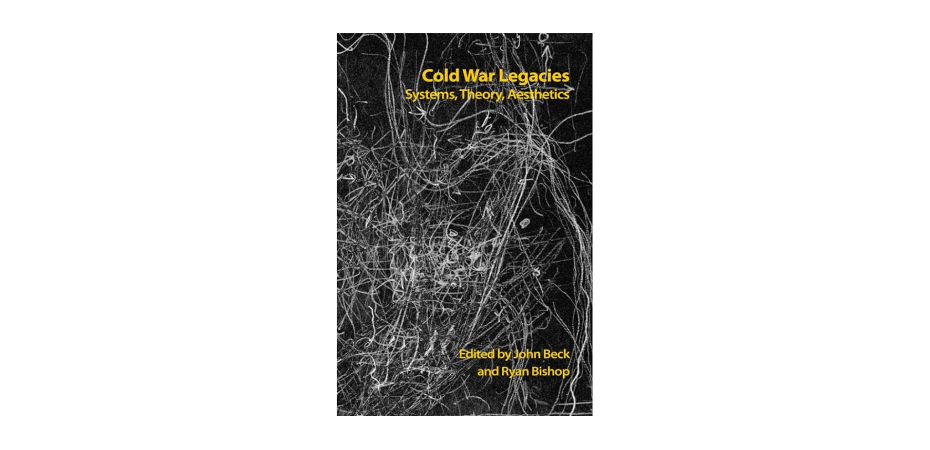
The Cold War haunts the imagination. The tension and paranoia of postwar Europe was inescapable: McCarthyism and red scares, mass surveillance and advanced weapons systems put to use in proxy wars in the Korean peninsula, Vietnam, and Afghanistan, assassinations and instability in the West, the Cuban missile crisis, the space race, nuclear tests in Nevada, the south Pacific, and Semipalatinsk, and Gorbachev’s perestroika, a failed attempt to save the Soviet economy that resulted in the unification of Germany and balkanization of the Yugoslav wars. It was a stressful time. Though tempting to think the fall of the USSR in 1991 marked the end of the Cold War, the truth is murkier. Cold War Legacies argues that the era’s technology, systems, and aesthetics define contemporary culture and life. In essays touching on nuclear science and radioactive waste disposal to postmodern art, this legacy is various and shape-shifting. The book has four sections: Pattern Recognition, The Persistence of the Nuclear, Ubiquitous Surveillance, and Pervasive Meditations. Editors John Beck and Ryan Bishop compile essays from researchers, curators, and artists whose expertise show the Iron Curtain has lifted, but its musty scent and shadow remain.
Pattern Recognition is a systems-based methodology central to Cold War weapons development, nuclear deterrence, and espionage. In the face of mutually assured destruction, systematizing intel practices became a focus of U.S. military technoscience. Its impetus was both existential and geopolitical. Wary of the consequences of fascism and communism, control of the postwar world was less about defending democratic ideals and self-preservation than pursuing a new world-order. In the first chapter, John Beck explores how futures research by the RAND Corporation created a systemic approach to engineer “desirable outcomes.” This was known as the Delphi Method. It relied on “. . . collective, interdisciplinary analysis, kicked-started by individually completed, anonymous questionnaires that are compiled and disseminated by a coordinator.” Data-sets are scoured for trends, the desirable of which receive more cycles of questionnaires and “iterative and controlled feedback.” Consensus is achieved as trends become dominant patterns and the future conditioned. Identified trends in weapons development and Soviet first-strike capability later informed U.S. policies, especially around defense spending and resource allocation. From military technology, the Delphi Method was later used “. . . to assess trends in science, population growth, and the space programme.” It migrated out of the military-industrial context, finding new use in academia, business, politics, and civil planning. Yet for all its prowess, the Delphi Method couldn’t fathom the unthinkable. Beck finds the limit of futures research arrives once its methods become confirmation bias: “Among the ironies of futures research is that however far it moves towards contemplating the impossible, the normative rhetorical and ideological underpinning of the project steers speculation back to an affirmation of the values driving the research.” Affirming the status quo of global capitalism is the conceptual basis for collective and individual optimisation: science, military technology, private industry, and cultural production are ever-refined iterations of Itself. Any future outside the system may require a new language, a refashioning of Wittgenstein’s bounds of the real.
Systems-thinking made its way into data analytics, particularly in the quantitative sciences and corporate industry. Adrian Mackenzie writes how many analytic tools (i.e. algorithms) were first developed by 1950s and 1960s physicists, engineers, and psychologists. A distinguishing feature is their power to reveal patterns in data not obvious to the eye. Another is their definition of pattern, which is meant to “. . . encompass language, images, measurements, and traces of many different kinds.” Discerning patterns means finding relations among different things, from subatomic particles to market transactions. Mackenzie is keen to emphasize the machine learning element in analytics: there isn’t a hands-on approach here as much as input-output in a system that distills patterns into actionable probabilities. This occurs at the behest of algorithms by electronic computation. A specifically Cold War-era contribution appears in three widely used today: Monte Carlo simulation, convex optimisations, and recursive partitioning. Respectively, these algorithms reveal abnormal probability distributions or patterns of clustering/ sparsing in a dataset. Examples of these in application, such as a Monte Carlo simulation of π or a Perceptron iteration diagrammed in pluri-dimensional space, emphasize the move from mathematical forms to actionable data; that is, disaggregated data is ordered in a clearer way, either tabulated or visualized in graphs, charts, scatterplots, or distributions. Generalization of these methods has merged the fields of once purely academic and military data science with the media, business, and technology sectors. Mackenzie calls this the ramifying-effect of Cold War epistemology: “Since their inception in problems of nuclear weapons design, logistics or cybernetics, techniques flow out of the closed-world spaces of the Cold War labs and research facilities.” Navigating synchronisation of operational fields is tenuous, a reality that results less in optimisation than “power matrices of transformation.”
Jussi Parrika’s conversation with London-based visual artist Aura Satz sheds more light on this synchronisation. In installations and audiovisual media, Satz’s work illuminates the intersections of past and present through the lens of history and technology. Her 2013 work Impulsive Synchronisation delves into the parallel development of frequency-hopping techniques in both the military context of World War II and the milieu of mid-century Americana. The technique,coinvented by Hollywood actress Hedy Lamarr and composer George Antheil, originally drew on the latter’s attempt to synchronise pianolas: it “. . . suggested the use of eighty-eight frequencies (the number of keys on a piano), and the use of perforated paper rolls to keep the frequency hops in sync with each other.” In essence, frequency hopping is when radio operators repeatedly change the transmitter frequency to avoid interference. The technique was patented and later used by the U.S. Navy to prevent enemy disruption to radio-guided torpedoes. Satz is most interested in how the novelty of frequency-hopping betrays its origins; an ingenious idea from the Golden Age of Hollywood is less lost in translation than part of a Pynchonesque vision of overlapping operational fields. Mainstream culture, scientific and military technology, and postmodernity buzz and mesh together in frequencies that change but abide. An interesting coda to this would be research into actual instances of Cold War frequency-hopping, such as during the Cuban Missile Crisis.
The Persistence of the Nuclear traces the environmental and sociocultural impact of nuclearization through links to fictional narrative, visual art, and government bureaucracy. James Purdon’s essay challenges the connection between Britain’s nuclear programme and cultural messaging from a decolonizing perspective: new republics in Ireland and India combined with the McMahon Act that severed wartime cooperation with the U.S. steered focus to the Commonwealth. Purdon prods the surface of British nuclear propaganda for its hidden meanings: an expression of imperialist and military continuity alongside a shift of foreign policy from American partnership to Empire amid Indian and Irish independence. The 1952 film Operation Hurricane captures an Empire in flux; crates of tea, that quintessentially British commodity representing both trade and capital, appears just before the Monte Bello test off the coast of Australia. For Purdon, Operation Hurricane and similar films redefine Empire symbols as sacrifices for a secure future, one headed by ICBMs and eons of radiation. And even if apocalyptic novels like Shute’s On the Beach pursue a darker vision of fallout, Purdon believes both ignore the inevitable: a new Britain has emerged, one where collateral damage is the cost to sustain a “. . . legacy of imperial power within the palatable iconography of a nuclear Commonwealth.”
The nuclear teems in the geosphere, a reality borne by radioactive half-life and decay over fathomless timescales. Adam Piette relates the history of radioactive waste disposal to texts by Samuel Beckett and Elizabeth Bowen and to deep repository projects in the UK. It wasn’t long after atomic tests in Nevada and Monte Bello that public opinion turned sour. American geochemist J. Laurence Kulp’s efforts in radiometric dating using carbon-14 and rubidium-87 revealed the extent of fallout, the worst being detection of strontium-90 in the food chain. Media coverage and protests reached a fever pitch, culminating in the Test Ban Treaty of 1963. Two decades later, nuclear waste disposal was a priority of Nirex Limited (Nuclear Industry Radioactive Waste Executive) in 1980s Britain. Plans for sites at Dounreay in the Scottish Highlands and Sellafield in Cumbria were scrapped. Local and political opposition led then-Secretary of State for the Environment John Gummer to reject Nirex’s appeal, citing presented research as “deeply flawed” (especially around groundwater flows). The search for deep repositories likewise figured in 80s cultural production; imagery from Bowen’s The Little Girls and Beckett’s All Strange Away recalls fallout bunkers common in American and British homes at the time. Most importantly, Piette construes this bunker as a mental space, a paranoia mirrored by the deep repositories where temporal and spatial continuity of the nuclear rattles on.
Ele Carpenter probes the nuclear imaginary and its impact upon Cold War visual art. From a discussion of László Moholy – Nagy’s painting Nuclear I, CH, she observes Momentary Monument IV and Atom Suit Project, sculptures by Lara Favaretto and Kenji Yanobe. In each, nuclear science wrestles with its mixed record. The Chernobyl and Fukushima disasters caused more than environmental catastrophe; a loss of object permanence and the naivety of deterrence are expressed in the casts of Favaretto’s sculpture or Yanobe’s radiation suit stored in lead glass. Where systems-thinking and technoscience fail, shadows rise over East and West. This shapes an aesthetic without a clear set of terms: How can the artist grapple with universal assent to “. . . scientific modernity, its specialist knowledge and operating procedures?” What’s the role of scientific or tacit knowledge, even creativity? To answer these, Carpenter shares interviews with specialists in ballistic weapons design and atomic energy. What’s surprising is that such work is driven as much by “scientific modernity” as by tacit knowledge: “. . . a successful outcome relies so heavily on the judgement of skilled workers able to adjust, modify, and sometimes ignore what the mathematics is telling them.” Like the scientist, the role of the artist is to navigate unsure ground. Without a natural order, without knowledge outside of context (i.e. the dichotomy of superpowers), art has equal license to truth as science. The past seethes into the present and future.
Daniel Grausam’s essay, “Alchemical Transformations,” concludes section two with a critique of fiction after 1989. He argues that post-Cold War fiction points not to perpetuation of encrypted messaging nor nuclear war. It offers a transformation, an “alchemical” potentiality that sees “. . . the nuclear and the Cold War as everyday shaping presences on vast swathes of American society.” This is less conspiratorial than sober reality. An example is James Flint’s The Book of Ash, which shows an evolution of the “paranoid systems-novel” inaugurated by Thomas Pynchon’s The Crying of Lot 49. The Book of Ash centers on Cooper, a programmer at an RAF base in Yorkshire in search of Jack Reeves, his estranged artist-father who’s obsessed with creating art out of radioactive waste. The connection to Pynchon comes in character names (e.g. Dr. Metzger) and narrative threads (e.g. Cooper receives a mysterious parcel delivered to RAF Featherbrooks, beginning his labyrinthine quest to find Jack). Yet Grausam is careful to distinguish Flint’s ethos from Pynchon, particularly with the “alchemical” innuendos of Cooper’s journey compared to the paranoia of Oedipa Maas. When Cooper arrives at Salt Mountain (i.e. Flint’s adaptation of Yucca Mountain, a proposed site for storage of America’s radioactive waste), he doesn’t find Jack. An improvised waste repository with a message inscribed in sheet metal reads “‘Reever’s Waste Repository.” If Oedpia Maas’s delusions amount to mere reailty, if Trystero is “just America,” the “paranoid systems-novel” squares with American literature (i.e. the manifest destiny of a future ideal). But that’s not how The Book of Ash ends. Cooper realizes Jack’s message and trail of clues are bigger than reuniting father and son. They’re part of a new order. Like a secret postal system, the nuclear insinuates itself in symbols and coded dicta with no less of a legacy than language (i.e. reality) itself.
Ubiquitous Surveillance is as Cold War as it gets. Several incidents defined Cold War espionage: The doomed U2 spy plane that was shot down over Russia in 1960; the Cambridge Five and execution of the Rosenbergs for sharing top-secret intel with the Soviets in the early 1950s; the British and Americans even dug a tunnel under Berlin in Operation Gold to tap Soviet communications. And lest one forgets the infamous exploits of the Stasi, East Germany’s secret police and Soviet intelligence arm in the decades before unification. In Ken Hollings’ essay, he writes about the social engineering spearheaded by the Nixon administration in the postwar suburban boom, a period of technological and infrastructural growth in America. It saw the rise of grid-controlled telecommunications networks alongside suburban sprawl, the interstate highway system, and technologization of the nuclear family (i.e. portable radios, refrigerators, and powered lawn mowers). Taken together, these form “perverse artificial societies” ripe for surveillance and control: “The Cold War family, isolated and huddled together in their suburban bunkers, had been transformed into an instrumentalised mass of subassemblies.” Hollings argues this lifestyle leads to discontent and marginalization, an ennui that led to security breaches in the Bell and AT&T grids in the 1960s and 1970s. This later fuelled widespread service outages caused by hacktivist collectives such as The Masters of Deception in 1990. Yet Hollings warns the world online today, its digitized and networked presence en masse strips individuals’ agency in lieu of strategic mobilization. Today’s whistleblowers, the Snowdens and Mannings crying wolf, don’t budge the masses. Where will you be when the simulation ends, when servers go offline?
Jussi Parrika approaches Cold War surveillance from the perspective of signals-interception and networking. Signals intelligence has roots in the First World War, which saw exceptional use of wireless cryptography and Morse code. After the fall of the Ottoman Empire, Parrika notes the persistence of the term “ṣifr” in Turkish and Arabic that translates to “zero.” This linguistic residue metonymically represents the nothingness ascribed to wireless communication and “digital culture” today. Despite the ubiquity of signals networking in our lives online, we can’t see, feel, or touch any of it. But for Parrika, the most important legacy of Cold War signals intelligence is the National Security Agency and other entities like MI6. The heroic figures of spy novels and films romanticize a human intelligence structure that is long gone. We enjoy a James Bond movie or books about Bletchley Park because of nostalgic marveling at the past. HUMINT (i.e. human intelligence) was eclipsed by SIGINT (i.e. signals intelligence) largely by 1945, ushering an era of what Friedrich Kittler called “a geopolitical struggle for the waves, but ones that are of the electromagnetic spectrum.” This creates a discrepancy between the logistical architecture of SIGINT, such as NSA headquarters in Fort Meade, Maryland, and the volume of signal traffic and ongoing reconnaissance. Further, a media archaeology emerges, one that tracks the progress of SIGINT through space and time. Public fascination at sites like Teufelsberg or bunkers around Berlin capture the still-true interfacing of signals with human minds, a relationship that continues in the twenty-first century.
In tandem to signal hermeneutics is the surge of metadata collection, a development explained by Mark Coté in his essay “Bulk Surveillance.” In simplest terms, metadata is data about data (i.e. think of the Dewy Decimal system or even the price of a T-Shirt). In the wake of Snowden’s revelations, metadata collection plays a role in the NSA’s and GCHQ’s surveillance practices. They have everything, know everything. But how did we get here? Coté describes two continuities that marked the postwar transition from traditional intelligence techniques to the computational, namely the Stasi and Project Shamrock. Though distinct in their methodology (i.e. the Stasi relied on physical surveillance and network mapping while Shamrock studied microfilm copies of all telegram traffic into and out of the United States), both mutated to the phenomenon now known as “bulk surveillance.” Coté writes: “In 1963, however, there was a computational shift when, in parallel development, both the telegraph company RCA Global and the NSA unveiled new computer systems.” Nascent computer systems such as ENIAC and the Atlas supercomputer heralded this transformation that now datafies and tracks all human activity across the hemispheres. One of Snowden’s most chilling disclosures is the NSA’s system XKeyscore: all user-generated data, search queries, selected results, SMS messages, social media accounts, even bank and medical information are accessible via XKeyscore. Your life online isn’t really yours: “Indeed, there is a fundamental multivalence to our digital infrastructures and data assemblages serving both capital and the security state.” This isn’t a Cold War continuity you can hide from; embodied metadata means everyone is both target and designator, civilian and operative.
Pervasive Meditations completes the arc of legacy to legatee. Outside of surveillance, what Cold War continuities actually shape the present? John W. P. Phillips grounds his answer in communication theory and a plan in Britain to establish radio channels from north to south “. . . with standby to line links to defense services along the way.” In other words, Phillips unpacks the ethical implications of communication systems in postwar Britain designed for military preparedness and prosecution of war. To do so, he first defines communication theory through the concept of the parasite in Michel Serres’ philosophy: any system that includes “. . . as a condition of its operation the possibility of its interruption can be said to be essentially parasitic.” The result are two theories, the mathematical and the existential theories of communication. It’s delineation of the latter that shows how “. . . logic of the parasite connects in a parabolic way to the parasitism of Cold War communications systems.” Cold War communication systems are parasitic because of their disruption to normative information flow; they interrupt and cause repetition in transit. The plan above was none other than the Backbone system implemented in 1956 that would “. . . bypass the major urban centres as a way of raising its chances of survival in the event of nuclear war.” This meant the installation of additional cables, radio networks, and relay stations across Britain. But in practice, such redundancies are less about national security than Cold War logic: Backbone as parasitic becomes clear when, in the context of war, its marshalling of all telecommunication resources (civilian and defensive) subsumes network totality. Collateral damage, this time of telecommunications, leeches more than it destroys. Phillips is vague on whether that’s an acceptable cost of war.
Fabienne Collignon expands the idea of parasitism to what she calls “Insect Technics.” She writes about Safeguard, an anti-missile complex in North Dakota. She describes Safeguard’s target acquisition system, specifically its “logistics of perception.” This perception is not very human-like; Safeguard’s pyramidal array of antennae and radar stations resembles bug-eyes and, in operation, has a wont for deeming targets as vermin to be exterminated. Though now decommissioned, Collignon extends this insect-technic to the swarm of networked activity Safeguard relied on, not unlike subsystems and the division of labor in a beehive. A more recent instantiation appears in the use of drones, whose remote-operated lethality removes the distinction between human and machine. An interpellation occurs, in which the subject (i.e. drone operator) identifies with and through the machine (i.e. the drone) in totalized war; that is, war that circumscribes its embodied and disembodied functionaries skews any objective perception of Itself. More broadly, Collingnon perceives a mixing of operational fields, of insectoid military tech with combatants and innocents in the Cold War milieu. A weird ontology is born, one that metamorphs the rationale of war from “us vs. them” into a self-alienating maelstrom (i.e. “us vs. them vs. it vs. us,” etc). The Cold War dispensation is a diffuse Stockholm syndrome of military technoscience, surveillance systems, and global capitalism. Distinctions of Self or Other are meaningless in a world of mutually-assured destruction and alienation. Its troubling justifications aside, one wonders if the anti-establishment grievance politics fashionable today is but the cusp of a new historical process, a reclamation of Self and Other.
The last two meditations move closer to the present. The first is a conversation between Neal White, an artist and professor at Bournemouth University, and John Beck, one editor of Cold War Legacies. White and Beck discuss a range of topics, most seminally the bureaucratization of artistic practice; cultural institutions codeveloped with the security state in both the US and UK still act as official media for many artists. An example is the Office of Experiments (i.e. OoE), an artist collective founded in 2004 with the aim of increasing collaboration and experimental production. White’s concern is that such organizations pose a threat to artists’ impulse to critique authority; such art “. . . gestures toward criticality but is in fact secretly in love with the enemy.” An example was Gyӧrgy Kepes’ Center for Advanced Visual Studies at MIT. A workaround is what White describes as art integration, particularly in scientific or military settings. Proximity to power structures opens possibilities for new knowledge and less institutionalized practices; White’s visit to the Human Genome Mapping Project, for instance, makes space for “productive antagonism.” Art challenging normative protocol, whether in an academic or institutional context, is good. But what constitutes a challenge? What’s the scope of “integration” beyond picnicking with and faux-niceties of the professional bourgeoisie? White leaves that bit up for interpretation, more a concern of generational zeitgeist than a call to action.
The second meditation is on remote sensors by Ryan Bishop. CENsE (i.e. Central Nervous System of the Earth) is a prototype remote sensing technology currently in development by Hewlett Packard (HP). Drawn from research on Smart Dust at UC Berkeley, CENsE’s goal is to distribute upwards of a trillion remote sensors around the Earth, from the oceans to the atmosphere. The end product is an integrated system that gives “. . . sensory capacities to extant IT infrastructure, so that it will no longer be inert material but active media and sensing devices.” Like the poet, CENsE will have keen senses of sight, touch, smell, and feeling. HP envisions CENsE as providing a wealth of data for various kinds of research, including wildlife monitoring, geophysical and weather patterns, and oil and gas extraction. The last produced a strategic partnership with Shell, in which CENsE will help optimize “energy resource extraction.” This all sounds lofty, even a bit dystopian. What’s the catch? Despite a range of civilian applications, CENsE is linked to longstanding “. . . defense-related sensing networks for battlefield surveillance, treaty monitoring, weapons inspection, movement detection, and so on.” Bishop mentions the International Monitoring System (IMS), a creation of the 1996 Comprehensive Test Ban Treaty that acts as a “global alarm system” for aberrant activity (i.e. seismic, hydroacoustic, radionuclide, etc.). While CENsE, IMS, and other globalized remote sensing systems offer actionable data (i.e. weather patterns), their operation ultimately reverts to a kind of militarized solipsism: nothing exists outside of our perception or projected perception à la remote sensing. We’ve targeted every last cubic millimeter of Earth, including ourselves. What’s next? Bishop seems to draw attention to this conundrum more than to ways out of it.
An achievement in depth and scope, Cold War Legacies affirms what many of us already suspect. The instant gratification, ultraconnectedness, and informational deluge of our time has roots in Cold War technoscience. What’s normal to us, such as Google navigation or network-synched devices, evolved from applied systems-theory and revolutionary technology like the personal computer, GPS, telecommunications, the Internet, and so on. Paranoid fiction, like that of Pynchon or DeLillo, is drawn from the webs of militarized intelligence we usually forget about. What’s equally normal is our interpellation in welcoming ourselves and our roles in the datafied and surveilled status quo. Why another purchase on Prime? What’s to gain from another Instagram story, a LinkedIn promotion, an “encrypted” flirtation on Whatsapp or Signal? Another dopamine hit, sure. But at each juncture, we sow ourselves deeper into the system, into the operational field monitoring and patterning us. If we are data, a quantifiable and probabilistic outcome, are we anything else? Though tempting to dream of a will to power embodied perhaps in revolutionary or anti-establishment politics, the legacy of Cold War technoscience and its iterations (i.e. CENsE, IMS, NATO, etc) are more powerful than that. Perhaps, as steadily as plutonium isotopes decay in deep repositories may the stranglehold of Cold War continuities, of militarized surveillance and deterrence, dissipate in a liberated future.
Sources:
Beck, John and Ryan Bishop, editors. “Cold War Legacies: Systems, Theory, Aesthetics.” Edinburgh University Press. 2016.
Dalkey, Norman and Olaf Helmer. “An Experimental Application of the Delphi Method to the Use of Experts.” The Rand Corporation. 1962. URL: https://www.rand.org/content/dam/rand/pubs/research_memoranda/2009/RM727.1.pdf
“The Sixties: Spies & Espionage.” Full Sail University. 2025. URL: https://fullsail.libguides.com/sixties/espionage
Discover more from Decadent Serpent
Subscribe to get the latest posts sent to your email.
