
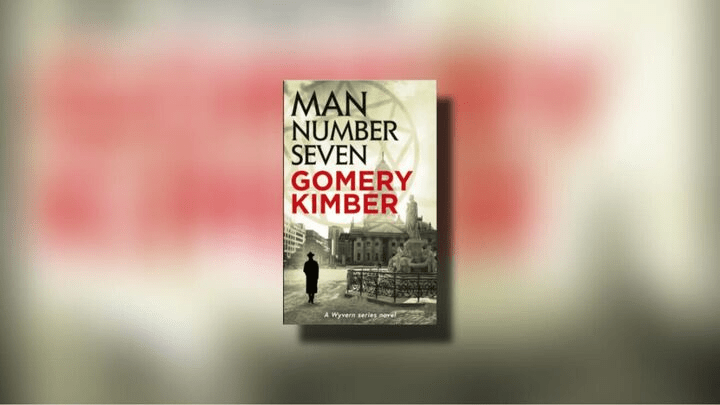
Gomery Kimber is the British author of The Big Shilling series (The Killing House, The War Party, and The Mad Man), the Justin Martello adventures (London Lies Bleeding, Assassin of London, and Gangster U.S.A) and the Wyvern Family Spy saga. His latest novel in the Wyvern series, Man Number Seven, is scheduled for release on January 30, 2026.
He joined Luke Gilfedder for a discussion about his literary influences, his new book, and the future of the novel.
You’ve previously described Colin Wilson as your literary exemplar, but your work also reminds me of a 21st-century Dennis Wheatley: metaphysical thrillers and occult spy stories that succeed as serious literature. For readers new to your fiction, could you tell us about your background and what inspired you to write these types of books?
I wanted to be a writer from about the age of ten. As well as studying English literature at school, I haunted my local public library, which was particularly well stocked. Along with the classics, I loved reading thrillers, science fiction and fantasy. In my teens, I became fascinated by the unknown, subjects quite at odds with everyday life in Manchester, such as the Holy Grail, mysticism, and the meaning of existence; on the mundane level, I’d also include in tandem my interest in ‘parapoltics,’ what actually goes on behind the headlines. It was natural for me to want to combine the two – stories about spies and spirituality (more than one former MI6 and SOE officer, upon retirement, gravitated towards the latter).
When I discovered Colin Wilson’s novels, aged about twenty, I was excited to encounter a fellow spirit. Here was a writer interested, not in the prosaic and horizontal, but in the human potential for self-evolution. As for Wheatley, I regard him in the same way Wilson did Lovecraft, with a mixture of fondness and exasperation. Wilson wrote two Lovecraftian novels, and in the process went far beyond H.P.’s fatalistic view of life. I attempted something similar in The Nazi Alchemist.
You describe your novels as “page-turning fiction, serious ideas”—a motto that could apply equally well to Wilson’s novels. Wilson said that whether he wrote crime novels (Ritual in the Dark, The Glass Cage), detective stories (Necessary Doubt), science fiction (The Mind Parasites), or spy thrillers (The Black Room), he always aimed to raise each form to a level of intellectual seriousness not usually found in the genre, while never losing sight of the need to entertain. Why do you think this balance is so important, and would you agree that the modern literary scene has lost sight of it?
I’ve tried writing straight thrillers, and I can’t do it. Although one can admire someone like Philip Kerr as a talented professional, the straight thriller bores me. I studied screenwriting at film school and tried to write for TV and Hollywood, but found I couldn’t do that either. The stories I wanted to tell were always turned down, and the stories the BBC and film companies wanted I couldn’t bring myself to produce. Tinsel town isn’t interested in intellectual seriousness, and the BBC looks blankly upon scripts about transcendence. But that isn’t to say that the popular form cannot be harnessed for serious purposes. It most certainly can, as Colin’s two dozen or so novels show. Amory Crane has written recently on X about the need for incident in contemporary literature and I couldn’t agree more. The author must romance the reader. Seduction is the key.
My hunch is that most readers today discover Wilson through his non-fiction, whether The Outsider or The Occult. Great as these books are, they can sometimes overshadow his novels, which are much more than just vehicles for his philosophy. What was your first Wilson novel, and which would you recommend to new readers interested in his fiction?
Ritual in the Dark, the first part of the Gerard Sorme trilogy, without a doubt. His first novel, and the first one I read. I’d recommend it as the perfect introduction to Colin’s fiction. Is it too far-fetched to describe it as 1950s London Dostoyevsky? I don’t think so.
How, more generally, would you describe Wilson’s influence on your own novels?
A great influence indeed, particularly when I was younger. But there are differences. Colin might be described as an existentialist and evolutionist, whereas I think of my writing as transcendental—spiritual rather than philosophical. I’ve been interested in military matters since my teens, and the experience of war and warriors is central to my fiction, an area of life in which Colin had little interest; he described his time in the RAF as a combination of boredom and frustration, and his depiction of soldiers in his novels is often negative. He also regarded his writing genre fiction as resulting in ‘an effect approaching parody,’ invoking Brecht’s Verfremdungseffekt, which doesn’t interest me much at all.
Your new book, Man Number Seven—the second instalment in the Wyvern saga—is set for release on January 30th. I had the pleasure of reading the first, The Nazi Alchemist, which I recall reviewing as a “philosophical-occult thriller of epic proportions.” What can returning readers expect from this sequel? And for those new to the series, is it necessary to start with the first book, or can they jump right in with Man Number Seven?
As with all my books, Man Number Seven is a self-contained novel and can be read alone or as part of the series. It was inspired by my radio play, Bad Blood, which was shortlisted for an award by the BBC some years back—it was commissioned, but sadly, not in the end produced. Mike Best is a career MI6 officer who discovers his biological father, Gustav, was a colleague of Andrea Baader and Ulrike Meinhoff. Worse still, Gustav’s father was in the wartime SS and took part in the Ahnenerbe expedition to Tibet in 1938. I won’t give too much away, but many of the characters who appeared in Alchemist, such as Siegmund Lustgarten and Baron Andrea (who is based on Julius Evola), reappear in Man Number Seven, as do their grandchildren, since the action spans a quarter century, from the 1980s to 2012.
Those familiar with the Fourth Way will realise what the title refers to: “Man number seven means a man who has reached the full development possible to man and who possesses everything a man can possess, that is, will, consciousness, permanent and unchangeable I, individuality, immortality, and many other properties which, in our blindness and ignorance, we ascribe to ourselves.” In fact, with the Wyvern novels, I believe I’ve invented a new genre: esoteric noir. If Alchemist was a cross between Colin Wilson and Dennis Wheatley, then Man Number Seven is Philip Kerr meets G.I. Gurdjieff.
In an overcrowded literary scene, you’ve carved out a successful niche as a self-published author. What led you to choose self-publishing over traditional publishing, and do you believe this is the best option for literary ‘outsiders’ today?
My experiences with literary agents, publishers and the BBC led me ineluctably to the conclusion that it is best to be your own boss. True, I do have to write, edit, and proofread my novels, and commission book covers myself, not to mention market my wares, but I am in sole command. There’s no one gatekeeping, no sensitivity readers, no marketing executives suggesting I write a bit more like Stephen King. It’s never been easier to publish your own work, and I get to keep between 35-70% of the list price on Amazon (before tax, I hasten to add). I can understand why the tyro is drawn down the traditional route, but, from what I understand, unless your first novel sells a million, your publisher will do very little to promote your work—so why not have complete control?
You’re an incredibly prolific writer, with Man Number Seven marking your 7th novel. Do you follow a particular writing routine, or have any tips for other writers aiming to be so industrious? Is there a ‘Kimberland’ equivalent to Balzac’s fifty cups of coffee or Schiller’s rotten apples?
I appear to be an incredibly prolific writer. The truth is, I had a backlog of unfinished novels which I have steadily been editing and publishing myself over the past six years. I wrote the first draft of Alchemist nearly twenty years ago. I kept going back to it because it was such a good story, but I could never finish it satisfactorily. It was only when I read Colin Wilson’s autobiography, Dreaming to Some Purpose, in which he says of his friendship with former Army officer, Flax Halliday, ‘if I’d been born middle class, I would probably have turned out like Halliday,’ that my protagonist came fully alive. Colin’s bibliographer and publisher, Colin Stanley, evidently thought so too, because after he’d read the novel, he placed a copy in the Wilson archive at Nottingham University, which is, I have to say, an immense honour.
Having said that, I am industrious most of the time. It was studying screenwriting in my early 30s that turned me into a professional. Structure is key. I outline my stories in three acts on a single sheet of A4 paper. For my shorter novels, such as the Martello books, I aim to write a first draft in six weeks: thirty chapters of two thousand words each, one chapter five days a week. On a good day, I can produce a chapter in about four hours. In the afternoon, I sketch out the following chapter, trying to get an idea of its beginning, middle and end (each chapter should be structured in three acts as well, I’ve found). It’s as simple as that (!). It’s rewriting and getting over the finish line which takes much more time and effort. If you’re not the dogged type, novel writing isn’t for you. As for coffee, I rarely drink more than two cups.
There’s much discussion these days about the dawn of a post-literate society. One consequence—some say benefit—of which will be to turn the novel into an elitist pursuit again. How do you see the future of the novel? Can novelists keep pace with the rapid changes of modern life, or are they destined to fall further behind? You often speak of the importance of writing with a ‘wide-angled vision,’ which I agree is essential for any novelist—but is the objective, vast canvas of the Tolstoyan novel still possible in an age as fragmented and complex as ours? As Mailer once said, it’s hard to embark on a project that may take ten years when daily news can so easily vitiate it…
I’m in the happy position of writing about eternal matters and not the ephemeral. My own view is that contemporary society should be seen from the heights; the writer in the midst of it is liable to be swept away in the maelstrom. If I had the talent and the time, I’d attempt to combine War and Peace with Beelzebub’s Tales to His Grandson. That for me would be the ultimate wide-angle vision. There’s always been talk about which way the novel. I believe the best response is to sit down at your desk and get on with your work.
And as to the future of your own works, what other projects do you have planned for the year ahead?
I hope that 2026 will see the final part of the Big Shilling trilogy published. The Mad Man is inspired by Colin Wilson’s novel, Lingard, in which a psychiatrist uncovers the life story of a serial killer. Something similar happens to my mystic assassin, Rico Hanratty. Professor Iain MacGilchrist’s writing on schizophrenia and the brain has proved indispensable in understanding my protagonist’s predicament, and I’ve enjoyed learning more about the Irish slaves of Barbados, the Rhodesian Light Infantry, and the demi monde of Francis Bacon’s Soho, all of which were alluded to in the first two novels.
I also plan to write a play, working title George and Alexander, for the Great Panathenaea, the drama competition organised by Old Sovereign Publishing and actors Morgan Watkins and Oliver Bennett of The Base (bravo, chaps). I may also be starting another series of novels, England Expects. I’ve written the first draft of The Backlash, which is an investigation of the state we’re in, and considers the ideas Neema Parvini outlines in The Populist Delusion, those of the Anglofuturists, and David Betz’s cri de coeur regarding civil conflict. The novel’s protagonist, when he comes into contact with the circle related to Justin Martello from Assassin of London, finds himself rejecting such profane matters. The final Martello adventure, Live not by Lies, is at the planning stage, and I have an idea for a third Wyvern novel, as yet untitled, set in Italy during the so-called ‘years of lead,’ with characters based on Colin Wilson and Julius Evola playing the central role.
To end on a lighter note, one of my favourite pieces of writing advice is Jean Malaquais’s remark that “you can write about any character but one—a novelist more talented than yourself.” Harsh, but I think true. Is there a particular piece of advice or aphorism you would offer to new writers?
Yes: know thyself.
Discover more from Decadent Serpent
Subscribe to get the latest posts sent to your email.
