
Author: Luke Gilfedder
Harold Bloom once wrote that Poe is an inescapable writer, though not a good one. Bloom’s judgement echoes Colin Wilson’s assessment of that other American horror master, H. P. Lovecraft, whom Wilson dismissed as ‘such a bad writer,’ yet conceded was ‘hard to dismiss’ and possessed ‘something of the same kind of importance as Kafka.’ So powerful was Lovecraft’s influence that Wilson, despite his reservations about this ‘man of dubious genius,’ went on to write his own Lovecraftian science-fiction novel, The Mind Parasites (1967)1, and contributed the story “The Return of the Lloigor” to Arkham House’s Tales of the Cthulhu Mythos (1969)2. But how did a self-declared ‘philosopher of optimism’ from a working-class Midlands background become so captivated by the macabre imaginings of an impoverished gentleman-eccentric from New England?
The answer is fittingly Lovecraftian: in 1959, Wilson stayed at the Dorset home of an old American friend—a centuries-old grey stone farmhouse that seemed torn from the pages of Weird Tales, perched atop a windswept hill above Corfe Castle, with its winding streets, ancient inn, and ruined fortress overlooking the ‘wind-blasted furze’ of Hardy’s Egdon Heath. That night, unable to sleep and with his bedside lamp flickering—the electricity powered by a distantly thumping dynamo—Wilson searched the room for something to read. Aside from old volumes of Punch and The Illustrated London News, the only book he could find was a black-bound 1939 edition of The Outsider and Others by H. P. Lovecraft.
The title naturally caught Wilson’s attention. Only a few years earlier, he had achieved sudden fame with his own book, The Outsider—written while living in a tent on Hampstead Heath—a dense, existential study that, to everyone’s surprise (not least his publisher’s), became a bestseller. Curious, having never heard of Lovecraft before, Wilson opened the yellowed, musty volume. Before falling asleep, he read “The Rats in the Walls,” “In the Vault,” and, of course, “The Outsider”—the story of a lonely, monstrous-looking man who does not realise his own monstrosity until he finally sees himself in a mirror.
Wilson immediately recognised he had discovered a writer of genuine importance. Driving back to Cornwall the next day, he brooded on the nature of horror stories and the imagination that produces them. He ‘brooded to such good purpose’ that, upon arriving home, he began writing The Strength to Dream—a book that devoted several sections to Lovecraft’s work.
The book’s estimate of its subject, however, would undoubtedly infuriate any devoted Lovecraftophile. While Wilson acknowledged Lovecraft as a creative genius and not merely an ‘isolated crank,’ he nevertheless claimed that Lovecraft’s pessimism should not be taken too seriously: it was the pessimism of a ‘fundamentally lonely’ man, suffused with ressentiment—a desire to punish a world that had rejected him. Wilson writes:
His aim was ‘to make the flesh creep’… to implant doubts and horrors in the minds of his readers. If he had been told that one of his readers had died of horror, or been driven to an insane asylum, there can be no doubt that he would have been delighted.3
This attitude, Wilson believed, stemmed from a deeper imperative: Lovecraft’s war against realism and his project to undermine materialism itself. To say Lovecraft was a materialist who hated realism may, however, be more precise, judging by Lovecraft’s own words:
I am so beastly tired of mankind and the world that nothing can interest me unless it contains a couple of murders on each page or deals with the horrors unnameable and unaccountable that leer down from the external universes.
Regardless, Wilson is correct in rejecting the familiar pairing of Lovecraft with Poe, his tragic predecessor. Despite superficial similarities, the two remain fundamentally distinct: Poe’s graveyard romanticism springs from weariness and a yearning for oblivion, while Lovecraft, as Wilson says, waged a ‘lifelong guerrilla campaign against civilisation.’ This is why Lovecraft never set his tales in the remote past; he deliberately dated them close to the time they were written—the terror needed to be tangible, immediate. Yet, while he was willing to make his stories contemporary, Wilson rightly observes that most of Lovecraft’s settings are remote from the civilisation he attacks. “The Lurking Fear”, for instance (which opens with the Poe-esque line, ‘There was thunder in the air the night I went to the deserted mansion atop Tempest Mountain…’), is set in the Catskills, near where Washington Irving placed his own weird tales. In his ‘war’ against the real world, Wilson finds Lovecraft ‘a somewhat hysterical and neurotic combatant’—a nineteenth-century romantic born in the wrong time. Most men of genius, Wilson says, dislike their own age, but the truly great ones impose their own vision upon it. ‘The weak ones,’ he concludes of Lovecraft, ‘turn away into a world of gloomy fantasy.’
With the completion of The Strength to Dream in 1961, Wilson believed he had finished with Lovecraft. Later that year, however, he found himself in Providence, lecturing at Brown University. There, he met the Blake scholar (and Mark Twain doppelgänger) Foster Damon, who took him to see the house where Poe had lived. Yet in this town of clapboard houses, its streets ankle-deep in leaves, Wilson’s imagination was once more seized by that other master of horror—Lovecraft. He visited Lovecraft’s former home on College Street and spent hours in the university library poring over Lovecraft’s letters in manuscript. Here, he first encountered “The Case of Charles Dexter Ward” and “The Shadow Over Innsmouth”. Once again, Wilson had to admit that something in Lovecraft’s work resisted dismissal—something that held his imagination in a curious grip, while the work of writers like Arthur Machen struck him as only ‘mildly interesting’ by comparison.
This ‘something,’ Wilson decided, was Lovecraft’s obsession. It was what made him both a ‘good and bad’ writer, and explains why so few followers in the Lovecraft tradition have achieved comparable imaginative force. August Derleth and Robert Bloch could recreate the Arkham atmosphere and style well enough, yet some essential quality eludes them—as it does Fleming’s imitators in the Bond continuation novels. Despite the number of writers inspired by Lovecraft’s mythical world and style, his work remains unique: written from an inner necessity that his successors could never replicate.
Wilson believed this was especially true of Lovecraft’s post-1926 works, where he developed the ‘mythology’ that gave his subsequent writing such powerful internal consistency. The first notable example is “The Call of Cthulhu,” about which Lovecraft later wrote:
All my stories, unconnected as they may be, are based on the fundamental lore or legend that this world was inhabited at one time by another race who, in practising black magic, lost their foothold and were expelled, yet live on outside, ever ready to take possession of this earth again.4
Lovecraft’s lore evidently owes more to Madame Blavatsky’s Secret Doctrine—with its myths about the downfall of Atlantis and Lemuria—than to Algernon Blackwood, whose quotation about the survival of ‘great powers’ from a remote antiquity serves as Cthulhu’s epigraph. Yet even theosophists, Lovecraft suggests, could only guess at the ‘awesome grandeur of the cosmic cycle’ in which our world and human race form but transient incidents. Hence the narrative’s opening declaration:
The most merciful thing in the world is the inability of the human mind to correlate all its contents.
This, Wilson says, is typical Lovecraftian romantic pessimism, aimed squarely at science. Lovecraft foresees a day when science’s ‘piecing together of dissociated knowledge’ will open up such ‘terrifying vistas of reality’—and of man’s ‘frightful’ position in the universe—that we shall either go mad from the revelation or ‘flee from the deadly light into the peace and safety of a new dark age.’ The narrator’s ‘dread glimpse’ of the strange survivors from these ‘forbidden aeons’ comes through the accidental piecing together of more banal items: an old newspaper clipping or a deceased professor’s notes. Yet their effect on mankind is exactly as Lovecraft predicted. Sensitive artists suffer ‘awful dreams’ of Cthulhu’s ancient civilisation, ‘older than brooding Tyre’; mania and eccentricity spread across the globe—strange cults multiply, voodoo orgies proliferate in Africa and Haiti, a painter unveils a ‘blasphemous Dream Landscape’ at the Paris Spring Salon, people commit suicide, and so on. A New Orleans inspector arrests a gang engaged in black magic orgies in the Louisiana swamps, uncovering evidence of the ‘Great Old Ones who lived ages before there were any men.’ The final section tells of a sailor who lands on an island newly risen from the Pacific, discovering a city of great stone blocks carved in a wild geometry ‘loathsomely redolent’ of archaic Futurism. There, great Cthulhu himself—‘green, sticky spawn of the stars’—emerges. Evil odours ascend from his tomb into the ‘shrunken and gibbous sky.’ Finally, the ‘accursed city’ sinks back into the sea.
Several more of Lovecraft’s ‘Great texts’—“The Dunwich Horror,” “The Whisperer in Darkness,” “The Shadow Out of Time”—use the Cthulhu mythos as backdrop. The theme, Wilson says, is always the same: the idea that, in certain periods, the ‘Old Ones’ from beyond space and time find conditions favourable for influencing Earth (in Wilson’s Return, their influence is suspected in Caerleon, a small Welsh town where murder, cruelty, rape, and perversion flourish—as distinct, of course, from all other Welsh towns). Houellebecq’s reading is more nihilistic: the true meaning of the Cthulhu mythos is that something lurks behind reality’s curtain—something that, at times, allows itself to be perceived. Something vile, yes, with powers far exceeding ours—yet even these vast cosmic forces are merely arrangements of electrons, like us. None of this horror is to any purpose: the universe is simply a furtive arrangement of elementary particles in transition toward chaos, which is all that will ultimately prevail. The human race will disappear—hence why Lovecraft’s heroes die without meaning (as Lang does in Wilson’s Return, his only narrative without an optimistic ending). As Houellebecq observes, death brings no solace in Lovecraft. It offers no closure. Cosmic fear, indifferent to these pitiful vicissitudes, continues to expand—swelling in concentric circles, mounting layer upon layer, until the unnameable is revealed: a universe where our only conceivable fate is to be pulverised and devoured. And such a desolate cosmos, we must recognise absolutely, is our own mental universe.
This, Wilson concludes, is why Lovecraft’s work—even if it ‘fails as literature’—still holds interest as a psychological case history. Here was a man who made no attempt whatsoever to come to terms with life. He loathed modern civilisation, particularly its blithely optimistic faith in progress and science. Greater artists harboured the same animosity—Dostoevsky, Kafka, Eliot—yet used different techniques to undermine human complacency. Dostoevsky emphasised our capacity for suffering and ecstasy; Eliot emphasised human stupidity and futility. Only Kafka’s approach, Wilson says, matched Lovecraft’s in naiveté: both relied simply on presenting the world’s mystery and the uncertainty of human life. Oppressed by the realism of the ordinary, Lovecraft kept passionately insisting that the extraordinary exists—yet rather than writing about heroism, rebels, sex, or supernatural grace, Lovecraft—being a ‘hypochondriac’—forged his terrifying mythos of ‘other worlds’ in a fever of spite.
Wilson again here aligns with Bloom, who makes a similar point about Poe: that despite the literary inadequacy of ‘even his best work,’ no one can deny Poe’s strength and fecundity as a mythmaker. Whatever the gap between style and idea in his tales, as fables, works like “The Fall of the House of Usher” remain canonical and continue to enchant. Mythologically, Poe is necessary because all his work is a hymn to negativity—a countermyth to Emerson’s pragmatic vision of American self-reliance. If Emersonian optimism is the mind of America, then Poe is its ‘hysteria’—a representative of the uncanny unanimity in America’s repressions. If we don’t study him too closely, and instead behold Poe’s oeuvre from a distance, as T. S. Eliot recommended, ‘we see a mass of unique shape and impressive size to which the eye constantly returns.’ Eliot, Bloom concedes, was probably right, in mythopoeic terms.
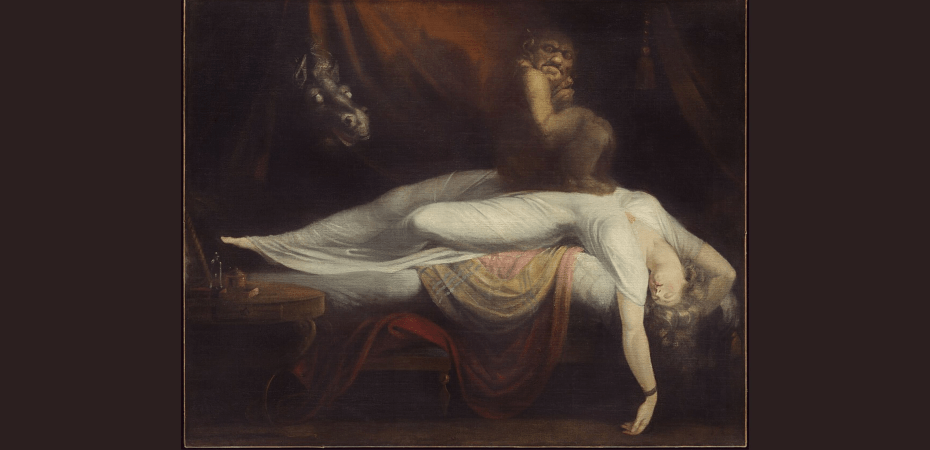
Yet for all his criticism of Lovecraft, Wilson finds him a ‘more impressive’ mythmaker than Poe. Poe’s imagination, Wilson says, was ‘simply obsessed by death.’ He was a ‘gentle romantic, a lover of beautiful pale women and ancient Gothic mansions set among wooded hills’5; Lovecraft, conversely, concerned himself not with death but with terror. In short, Poe is pre-Dracula; Lovecraft is post-Dracula. Poe’s world is the world we all inhabit, seen through eyes eternally aware of ‘the skull beneath the skin.’ Lovecraft’s mythos, however, is a creation of his own, as unique and nightmarish as that of Hieronymus Bosch or Fuseli—befitting his cosmicist vision of a glacial and empty universe, traversed by the ‘feeble light of half-dead stars’. More so than Poe, it is Lovecraft’s works which future generations will recognise as ‘symbolically true.’ Consider the number of writers who have consecrated their careers to continuing the Lovecraft mythos—not only Derleth and Bloch but Lin Carter, Fred Chappell, and Donald Wandrei. As Francis Lacassin points out, nothing comparable has arisen since Homer and the medieval epics: in Lovecraft, we are dealing with a ‘founding mythology.’
All of this, Wilson concedes, amounts to admitting that Lovecraft possessed genius—and explains why Wilson himself could so readily adapt the Lovecraft mythos to his own ‘Outsider’ thesis. In The Mind Parasites, Wilson combined Lovecraft’s preoccupation with strange, unknown forces with his own interest in why the human race suddenly began producing so many ‘outsiders’ after the French Revolution—and why so many of them came to a sticky end. But where Lovecraft’s dark forces were elder gods and ancient races acting upon humanity from without, Wilson’s monsters reside inside the mind. The ‘Old Ones’ in Wilson’s novel—whom he calls the Tsathogguans, borrowing from Clark Ashton Smith’s Hyperborean cycle—are not, like Cthulhu, lying dreaming in sunken R’lyeh, but are mental vampires that have preyed on human consciousness for the past two centuries. They work principally through those who most influence humanity—the great artists and thinkers—and destroy any who suspect and resist their presence (such as the novel’s optimistic Maslovian psychologist, Karel Weissman, or the artists who refuse to preach a ‘gospel of pessimism and life devaluation’). Some, like the Marquis de Sade, become ‘zombies’ of the vampires, slaves whose sole purpose is to add to the mental confusion of the human race. These zombies are allowed by the parasites to live to a ripe old age: compare the fate of the ‘degenerate’ de Sade (who died at 74) with that of the sexual mystic Lawrence, or the ‘life-slanderer’ Schopenhauer with the life-affirmer Nietzsche. Man, Wilson says, is an animal striving to evolve into a god—but it is in the parasites’ interest to keep humanity in this state for as long as possible, feeding off the immense energies generated by our evolutionary struggle.
The presence of the ‘mind parasites’ is Wilson’s allegorical, Lovecraftian response to the question posed in The Outsider: why did so many nineteenth- and early twentieth-century poets and artists die young, go mad, commit suicide, or meet tragic ends? Until around 1780, most art tended to be life-enhancing, like the music of Haydn and Mozart. Rousseau proclaimed that the human mind was about to throw off its chains—a spirit echoed in Blake’s fragment on the French Revolution and in Wordsworth’s line, ‘Bliss was it in that dawn to be alive.’ But by the time Shelley and Byron died in the 1820s, a gloom had descended like a yellow London fog. The full-scale invasion of these ‘vampire bats of the soul’ brought a dramatic change across the Western mind: the bright optimism of early Romantics such as Beethoven, Goethe, and Blake—whom Wilson saw as heralding a new stage in the evolution of consciousness—gave way to a deep pessimism, a despair upon which the mind parasites fed. The optimism that had bubbled up from Jean Paul’s Hesperus was leeched dry—belief in the human spirit’s power to conquer and reach new heights of freedom dissipated. The pessimism latent in works like Young Werther, The Robber, and Hymns to the Night became the reigning spirit of the age. The Industrial Revolution only worsened this malaise, for it made poets and artists feel that if this was all that conquest meant, then they preferred defeat.
Such, Wilson implies, is the case with Lovecraft—and why the ‘recluse of Providence’ is, at heart, a tragic figure. The gruesome and violent in Lovecraft’s mythos were, to a large extent, his means of maintaining psychological equilibrium amid the stifling atmosphere of early twentieth-century Providence. He lived in a kind of jail for much of his life—born in America, one of the worst countries for an outsider, and in a dreary provincial city to boot—attractive enough in its way, yet painfully narrow and dull, reminiscent of Ibsen’s Norway. Nevertheless, Wilson admits, it is a mark of Lovecraft’s genius that, despite these circumstances—and despite poverty, ill health, and frustration—he still created a world of such haunting poetic power. Lovecraft may not have overcome the ‘mind parasites,’ as did Goethe or Beethoven, but more than Hemingway, Faulkner, Poe, or even Kafka, he embodies the quintessential outsider-artist of the twentieth century, suffering with peculiar intensity the miseries that would afflict millions of other ‘outsiders’ in the century to come. Lovecraft’s still-growing popularity attests to Wilson’s insight: today, more than ever, readers adopt the declaration of principles at the start of “Arthur Jermyn” as their own.
Life is a hideous thing, and from the background behind what we know of it peer demoniacal hints of truth which make it sometimes a thousandfold more hideous.
The paradox is that we prefer this universe—hideous as it is—to our own reality. As such, we are, Houellebecq observes, precisely the readers Lovecraft anticipated. We read his tales in the exact same mindset that inspired him to write them. ‘Satan or Nyarlathotep,’ Houellebecq remarks, ‘either will do, but we will not tolerate another moment of realism.’ And truth be told, given his overlong acquaintance with our mundane sins, even the value of Satan’s currency has dropped somewhat. ‘Better Nyarlathotep—ice-cold, evil, and inhuman.’
It is little wonder Wilson described Lovecraft as the perfect example of the ‘escapist imagination,’ whose work represented a powerful, if ‘hysterical’, assault on the real world. Yet, in Wilson’s schema, this rendered him a ‘dubious’ genius only; he lacked the sense of purpose found in Wordsworth, Byron, Shelley, and Goethe, whose works evoke a tremendous sense of power and courage, and inspire glimpses into the meaning of life and human evolution. Lovecraft’s imaginative work, Wilson concludes, was essentially rooted in ‘world-rejection’ and a loathing of materialism. Houellebecq—writing with the benefit of a late-century perspective—seems closer to the truth when he observes that Lovecraft remained ‘steadfast in his materialism and atheism,’ yet foresaw the need for a supreme antidote against all forms of realism. A horror to some purpose, after all—just not the kind Wilson would have endorsed.
References
Bloom, Harold, editor. Bloom’s Modern Critical Interpretations: Edgar Allan Poe’s ‘The Tell-Tale Heart’ and Other Stories—New Edition. Infobase Publishing, 2009. Introduction by Harold Bloom.
Houellebecq, Michel. H.P. Lovecraft: Against the World, Against Life. Translated by Dorna Khazeni, Believer Books, 1 May 2005.
Lachman, Gary. ‘The Outsider and Others: Lovecraft, Wilson and Phenomenological Science Fiction.’ Gary Lachman, 4 Dec. 2023, https://www.gary-lachman.com/post/the-outsider-and-others-lovecraft-wilson-and-phenomenological-science-fiction.
Lovecraft, H. P. ‘The Call of Cthulhu.’ Weird Tales, vol. 11, no. 2, Popular Fiction Publishing Company, 1928.
Lovecraft, H. P. Selected Letters I (1911–1924). Edited by August Derleth and Donald Wandrei, Arkham House, 1964.
Weird Tales, vol. 290, Spring 1988. Wildside Press, 1988.
Wilson, Colin. The Strength to Dream: Literature and the Imagination. Victor Gollancz Ltd, 1962.
Wilson, Colin. The Mind Parasites. Arkham House, 1967.
Endnotes
- The prompt to write The Mind Parasites came from Arkham House’s co-founder, August Derleth, who was also Lovecraft’s literary executor and publisher. Wilson corresponded with Derleth after the publication of The Strength to Dream, and Derleth’s comments encouraged Wilson to moderate his criticisms of Lovecraft in the revised American edition. Derleth, however, still felt the book was unfair to Lovecraft and challenged Wilson accordingly: “If you’re so critical about Lovecraft, why don’t you write a fantasy novel, and see whether it’s any good…” ↩︎
- Wilson contributed a further story, “The Tomb of the Old Ones,” to Robert M. Price’s The Antarktos Cycle (1999). Original novels by Wilson that extend the Lovecraft mythos include The Space Vampires (1976)—upon which the infamous film Lifeforce is based—and The Philosopher’s Stone (1969). ↩︎
- Wilson speculates that if Lovecraft had lived another year, he would have ‘envied Orson Welles’ for the nationwide panic sparked by the 1938 War of the Worlds broadcast, when people fled the cities fearing a Martian invasion. ↩︎
- There is some contention as to whether this quote is directly from Lovecraft or a paraphrase by August Derleth. See pages 6–8 of Weird Tales, Spring 1988. ↩︎
- There is some contention as to whether this quote is directly from Lovecraft or a paraphrase by August Derleth. See pages 6–8 of Weird Tales, Spring 1988. ↩︎
Discover more from Decadent Serpent
Subscribe to get the latest posts sent to your email.
