The following excerpt is from Chapter 19 of the upcoming novel ‘Die When I Say When.’ When Falin and his next suspected victim, Sir Rafael Mordkine, leave Saxain Manor unattended for the night, Quinn and Brogue sneak into the baronet’s old hunting lodge, searching for evidence to prove Falin is Cheshire’s so-called ‘Silver Killer’.
The Cadillac veered right and downhill, its wheels rustling along the ferny track. Silhouetted trees shot branches in a sombre tunnel over their heads, and there was an oppressive feeling of nearness to the big reservoir lying invisibly behind the woodland on their left. Brogue got out at the five-bar gate, opened it, got back in, and drove at a crawl along the dark avenue of oaks into the demesne of Saxain. Spectral glimpses of turrets flashed through the dense branches, the valley moonlight gleaming on their stone walls like a fresh coat of paint. At length, the rutted strip of road opened onto the silvery clearing, and they came to a crunching stop before Saxain’s shut iron gates.
Brogue set the brake, punched open the glove compartment and offered Quinn a hip flask. Quinn waved it away.
“Suit yourself,” Brogue said and took a belt instead.
They got out of the Cadillac, eyeing the tall sentient turrets looming beyond the black bodyguard of willows, every ivied stone illumined in the wet starlight. But no light shone from the teeth-like windows that ran along the castle’s brow—the manor was the very image of power: dark, isolated, impenetrable.
Quinn crossed first over the swishing moor-grass, his head bent against the marrow-freezing wind. He slipped beneath the shadow of the wall, Brogue following with his deep limp ten paces behind. Above the turrets, like a wing ripped from the body of a grouse, a ruff of cloud raced swiftly toward the moon. With its dying breath, the moonlight picked out the tumbledown wall by the stable: Quinn scaled it, dropped into the brambles below, and opened the gate for Brogue.
They crept across the black velvet of the grass—the cloud’s shadow following on tiptoe—and stole silently beneath the rows of dark windows set under the overhanging gables. A mossed path led around the corner turret to the porch, where red ivy snaked up the steps and clung like a hand to the stone feet of Meleager and Diana, whose eyes gazed out at the black ridgelines of what, in England, are mountains. The carriage lamps flickered and hissed, the weathercock moaned low, and Quinn began to wish he had accepted Brogue’s scotch.
Brogue punctured his tension by urinating all over a piece of the side wall. In the middle, he said:
“Roseblade, you will never know how close I feel to Jesus Christ when I take a good piss like this.”
“I never knew you were still a practising Catholic.”
He finished, turned, and thumped Quinn on the shoulder.
“With sins like mine, how dare I not be?”
Brogue wiped the grin from his face and turned to the porch steps. He limped up them, and as he did so, the cloud veiled the moon, immerging the oaken door in darkness. His skeleton key twisted in the lock. But there was a bolt.
“Bugger. Here, take this.”
He handed Quinn his cane and kicked the lock with his good leg. Something cracked, and the door gave a few inches. A dusting of dry snow blew across the doormat, and a leaf burst into a flutter. Then it was still, too still, as if it feared getting caught in its act of rebellion. Brogue waited for a reaction. When none came, he stepped inside, picked up a shard of jagged metal from the tiles, and laid it with mock-courtesy on the countertop. He beckoned Quinn.
“Come on in, it’s empty as an author’s pocket.”
Quinn followed, his nerves wriggling like a clothsack of worms. A barrel-vaulted corridor stretched into the gloom, lined with dummies in armour that resembled stuffed bears holding trays and braced by black beams from which hung glass chandeliers in dust covers. Brogue muttered:
“Nice gaff, eh?”
With each step, the house grew larger, more silent, and more like a hammer-horror set. Brogue examined every nook and cranny as a police dog sniffs through a new abode. The sleuthhound found nothing. The gunrooms were dusty, the clock room stilled, and the piano room last used for reciting the top ten madrigals.
“Sandy was right,” said Brogue gruntingly, “this place is a museum. You can almost smell ole Jerusalem in it.”
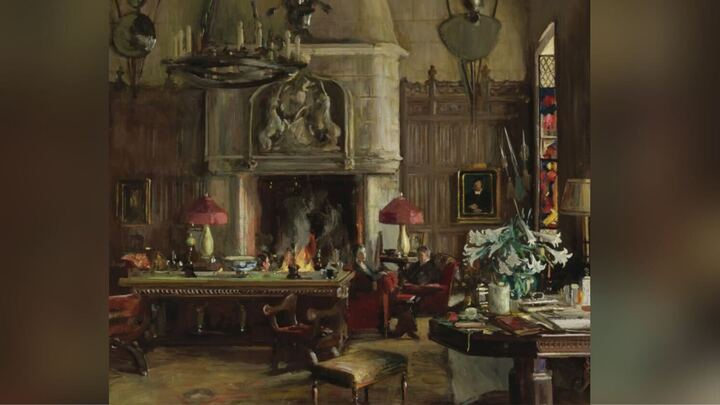
They followed the black game of corridors until they emerged in an immense Gothic chamber, velvet-dark and panelled in knotty oak, hung with stag antlers, hunting horns, and rusty fowling pieces. Its vaultings were as vast as a ship’s hull, and beneath those huge baulks of ancient oak stood a grand imperial staircase—the kind a vampire count might suddenly descend from in a film. Even in daylight, this hall must have remained entirely independent of the outer world. It felt as if they stood in a bottle from which the wine had long been poured, but which, at these hours, the fumes still lingered.
“We should try upstairs,” Quinn said, “then get the hell out of here. It’s too easy—something’s not right.”
“Kid, we’re housebreaking. If everything was right, we’d be in jail.”
They tiptoed up the steps, their creeping shadows like a great terrifying poster cut out on the melodramatic staircase, the silence thick as the pile on the deep carpet. A balustraded gallery ran along the top of the old hall, with ancestral portraits set between damask-hung windows, each face-royal bearing an uncanny resemblance to the next: from Sir Rafael in his Cambridge blazer to his Ghetto Vecchio grandsires in their silken doublets, velvet hose, scarlet cloaks, and copatain hats. Yet these generations of super-subtle Venetians—lovers of war, magnificent buildings, and of the luxuries of the Occident and Orient combined—all somehow bore the same air of a decaying roué; the same dyed ringlets and parchment skins, the same firm sardonic mouths and melancholy caprine eyes. If the faces of the masses changed through the centuries—reflecting how a nation’s physiognomy mutates in time—then it seemed, Quinn thought as they crept along the long gallery, that the faces of the aristocracy merely altered with the fashions, chameleon-like.
“You try that end room,” Brogue said, unnerved, as only Quinn could tell, by the new load of gravel just dumped into his voice, “I’ll try in here.”
The jowled overseer disappeared through a door with a beefy swerve. Quinn soft-footed down the dark gallery, his light footfall echoing with a lonely sound. He pulled open a heavy door which stood ajar and found himself in a mould-smelling turret room. A rosewood escritoire—such as ladies were wont to use when they had nothing to write—stood before a cracked window, lit by the dim glow of a lamp’s green-glass shade. Through the leaded panes, rain-streaked moonlight shone onto the shelves encircling the walls, illumining the defenceless spines of books huddled there in tight ranks. Looking closer, Quinn noticed the dust lay like blown smoke over the leather firesides and French Chiffoniers, whose tops were laden with the fruits of an old man’s knick-knackatory: medals, photographs, golf link trophies, satsuma china, plenty of cloisonné, and various trinkets of travel in ivory and ebony.
Realising this must be Mordkine’s study, he crossed to the bookcase and ran his fingers along the vellum spines: De Quincey, Cazotte, Kubin, Poe and Baudelaire… Yet there were also mildewed tomes from the middle-aged world: Tuberville’s Booke of Faulconrie, Gascoigne’s Noble Arte of Venerie, Gaston Phoebus’s Livre de chasse—not to mention the nameless filemot herbals, armorials, nigromancies and arithmologies from the ancient past.
With mounting alarm, Quinn rifled through the books along the topmost shelf, brushing aside the spidery shadows cast by the sick branches of the willow. Some of these he had read—Hippocrates’ Aphorisms and Galen’s Ars parva—but others he knew merely by reputation or not at all: Albertus Magnus, Raimundus Lullus, Agrippa von Nettesheim, Michele Scotto… He blew grey pollen from the shagreen spine of one, which he tilted forward from the rest with his index finger.
“I doubt you’ll be needing spells here, kid,” came a voice with a sneering grunt. “Ghosts will come without an invitation.”
A tap-tapping accompanied these words, and Brogue limped in, his cane rapping hollowly on the parquet floor.
“I’m not looking for spells. I’m looking for clues,” Quinn said, thumbing through the Gospel of Thomas in the original Greek. As he reclasped it and returned it to the shelf, coughing away the annalistic must, his hand hit upon a rectangular object—about the size of an Alderley housewife’s jewellery box. “Wait, I might have something.”
He lifted it out, blowing off the yellowish dust left by the disintegration of even older books and papers. Quaerite et invenietis. Inside, he found a bag of sealing solution, a dropper, a tamping tool, and an ejection pusher. The dropper held a slight ammonia smell, reminiscent of cat urine. Brogue stooped over Quinn’s shoulder, his eyes like blowlamps.
“It’s a capsule-making kit. Drugs, eh? Well, who’d have thought it?” He grinned at Quinn, stroking his ginger jowl-stubble with sardonic surprise. “Now let’s find how sharp Occam’s razor really is… what’s meladdo filling ‘em with….”
Quinn turned to the low-lit island of the escritoire. The lamp’s unswitched-off light, beneath its green glass dome, revealed a pharmacopoeia lay open at an underlined page. He said: “Maybe this’ll tell us—” but Brogue lurched on as if he wasn’t even there, let alone as if Quinn had just spoken. He flung open a connecting door and wagged a hand for Quinn to follow. Quinn thought: Should I just put a pencil behind my ear and look like an office boy, too?
Luke Gilfedder is a writer from Manchester, set to launch his debut novel, The Venatio, in 2025. Previously, he worked as a playwright, with scripts produced at The Royal Exchange Manchester, the Lyric Hammersmith, and in London’s West End. He has recently completed a PhD on the life and work of Wyndham Lewis.