
Author: Tyler Hummel
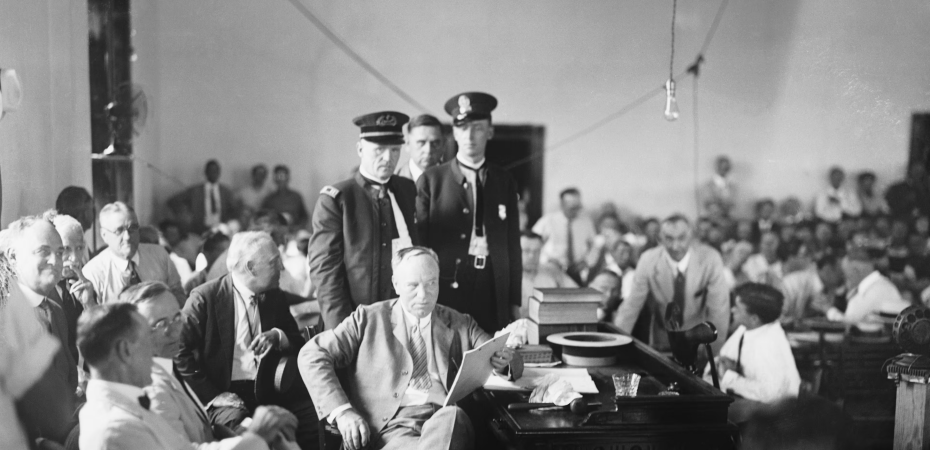
I don’t know why I thought otherwise, but I was a bit surprised this past month to see that the small town of Dayton, Tennessee, was empty at 9 am on a Thursday. The small town’s famous public square was largely empty of people and cars. Maybe it was because I drove 14 hours the day before, but I was modestly surprised to see the famous site of the Scopes Monkey Trial nominally empty on the second day of its centennial celebration.
Thankfully, this proved immediately wrong. I met a young man named Peter from Indiana who traveled here for the concurrent Origins 2025 creationism conference at Bryan College. Subsequently, more than 70 people gathered together in attendance for the Scopes Symposium at the historic courthouse, and it would only grow busier from there. Within the next few days, hundreds, if not thousands of people would descend on the town’s festivities to celebrate a century of one of the weirdest trials in American history.
For the past summer, the internet has been replete with reflections about the Scopes Monkey Trial, from The New York Times reflecting on how Democrats ought to consider its implications on the 2028 election, to Christianity Today using it to argue that Christians need to disengage from the culture wars.
For the 100th anniversary of “the trial of the century,” many have reflected on what it meant that the state of Tennessee once had the power to fine a substitute public school teacher for teaching evolution, and that it had the democratic mandate to do so. It’s been compared to Republican attempts to “book burn” pro-CRT and pro-LGBT novels from high school libraries, to Christian Nationalists attempting to hoist their visions upon the nation.
Having had the chance to visit the town where it happened during the centennial, it is worth considering the nature of the place in these reflections. This event wasn’t ethereal. It happened in time and space, and its descendants, who call Rhea County home, care about the truth. One ought consider the implications of that history without the biases of modern people trying to frame the trial for their own agendas. Dayton has already the indignity of having been dismissed as “homo boobiens” in the past by prominent journalists, and they deeply desire to tell the story on their own terms.
Dayton is a modest little town located less than an hour north of Chattanooga. It’s never been a huge city, but its reputation for hosting the famous has kept it on the map. At the time of Scopes, it was a former mining town in severe decline. Nowadays, its a modest vacation town just off the highway. Like any rural American town, its downtown is a mix of open rental plots and gentrified small businesses. Unsurprisingly for the deep south, almost every street corner is peppered with small Protestant churches—usually Baptist, Methodist, or Pentecostal (the local Episcopal/Anglican parish having closed in recent years).
Geographically, the city sits in the shadow of Bryan College, which is perched upon a small mountain that overlooks the downtown region from across the Tennessee River. Founded in the aftermath of the trial, the vibrant campus, home to roughly 800 evangelical students, remains in many ways the town’s monument to its own story. Named for the late Secretary of State and trial prosecutor William Jennings Bryan, its a sturdy fundamentalist fortress overlooking a town that doesn’t entirely agree with what the moral of its own story is, but is nonetheless proud of that history.
The school is relatively modest, growing through its recently expanded online offerings brought in by a new admin from Liberty University, but it’s seen tremendous growth in just the past few decades, nearly doubling its student body, and proudly proclaiming the motto “Christ above all” on all its signage.
As Bryan College VP David Holcomb told me on a campus tour, there is no consensus view about the role Scopes plays in the town. There are people who love it for the tourists it brings in, and there are people who love it for the politics. They’re quite honest about the fact that the trial was meant to be attention grabbing from the outset, and it worked. It’s now a core part of the town’s identity, alongside playing host to some of the best bass fishing lakes in the country.
From the Buttram Cemetery to the courthouse, Dayton was littered with local historians from the historical society eager to tell the story throughout the duration of my stay. The celebration itself was surprisingly muted, with few concession stands other than a mobile Chick-Fil-A truck. The only booths selling merchandise were a fundamentalist magazine and a romance novelist selling Darwin-themed books in the lobby.
It was hardly a carnival atmosphere, instead focusing on crowding people toward the courthouse and nearby businesses for major events like its science symposium, antique auto show, and live reenactment of the trial transcript inside the courthouse. In this regard, it was an unusually stern celebration, but the group that had shown up for the festival wasn’t one for carnivals nonetheless. These were self-described “Scopes nerds”; dozens of academics and history buffs who had traveled from as far as Berkley and the Bronx to celebrate this strange event firsthand.
Among this group was the renowned anthropologist Eugenie Scott, well known for having coined the term “Gish Gallop” in her past debates against creationists. As she told me, Dayton was amongst the most “localized” of recent conferences about Scopes, with similar conferences in Nashville and Chattanooga that month being more “universal”.
“The Scopes Trial is just such a good story,” she said. “There’s so many little funny things that happened and quirky aspects to the history, that its just enormously enjoyable. But its also significant for the present day as well. There are lessons we can learn from the Scopes Trial. It is not irrelevant ot things going on in the country today.”
I also spoke with SUNY Maritime history lecturer David B. Allen, who told me about his own experience nearly being disciplined, as a 27-year-old first-time teacher, for teaching evolution at a rural Illinois high school in 1985. He wasn’t punished, but says he was instructed by his superintendent to teach both evolution and creationism in lessons and exams.
“I teach history and I love to be in the place where a historic event happened, reading a book where it happened,” he said. “My stepson got a photo of me reading this big biography of Clarence Darrow at the Clarence Darrow desk in the courtroom, and a whole bunch of other places. I think the trial is critical to American culture.”
The heavyweight thinkers on display at the symposium reflected many of the most prominent thinkers on the issues of creation and evolution in the country. Scholars from UW-Madison, University of Akron, and the prominent Scopes historian Edward Larson were noted lecturers, speaking to the history of Protestant Fundamentalism, the growth of evolutionary theory since the trial, and its impact on the century.
Thankfully, the preceedings weren’t as stern. The town itself had dressed well for the occasion. The nearby ArtCrafters store was selling handknitted chimpanzees, while the popular craft brewery Monkey Town Brewers was serving “Evolutionary Theory” themed Hazy IPAs to a thirsty crowd just two blocks from the courthouse, with the walls of their restaurant being lined with monkey statues and 1920s newspapers that covered the trial.
Dayton is an equally puckish town as much as much as it is trying to seriously engage with the history of the trial. The town was decorated in dozens of images of monkeys, often wearing straw hats, with their images being displayed on mugs, souvenirs, and signs that played up the “monkey trial” aspect of their legend. As serious as the historians wanted to be, they were self-aware of the event’s absurdity enough to have a sense of humor about it.
It didn’t take long to find a bit of the fundamentalist flavor in the town. One of the only buildings that wasn’t participating in the festivities was First Methodist, where Bryan famously prayed for the final time before dying of a stroke in his sleep a few days after the trial. Likely because it’s an active private school, the building’s sanctuary was locked and unavailable to view as part of the walking tours.
Checking its website, it’s apparent that the church is currently attempting to break away from the United Methodist church as part of the wider denominational schism between liberals and conservatives in that storied American denomination, citing same-sex marriage as the issue it wishes to dissociate over. As one of the largest churches in downtown Dayton, it appeared to be sitting at the heart of the town’s active spiritual life of the town, emblematic of the outstanding force of evangelical Christianity that is still potent in the south.
Talking with the attendees, there was a wide range of opinions among the history buffs that chose the make the lengthy journey to rural Tennessee, that ranged from fundamentalist creationists to atheist evolutionists. Many attendees were Christians who subscribed to some version of theistic evolution or old-earth creationism.
The event even brought out many descendants of the trial’s participants. Two of William Jennings Bryan’s great-grandchildren, Bill and Allen Forsyth, were among the town’s honored guests, who were respectively invited from New Mexico and Utah to attend the event. I also had the chance to speak with Jill Noga, a Rhea County native related to jurist R.D. West and school superintendent Walter White, and whose teenage son had a role in Destiny in Dayton. She described this year as “really special to be involved with it 100 years to the day.”
Bill was similarly enthusiastic about being able to walk in his great-grandfather’s footsteps after a lifetime researching the history and hearing stories from his mother and grandfather.
“The thing that’s always meant the most to me is telling people that my great-grandfather ran for president. If his name comes up I go, “that’s my great-grandfather!” Being in the family, there’s always alittle bit of guilt when your grandparents or parents die and you think you’ve never really talked to them enough about this or that, especially with my mother and grandfather. I never picked his memory about all he witnessed. He was right there at the prosecution table during the trial.”
Being able to attend Scopes 100 after months researching the history, reading Bryan’s memoirs, and watching the commentary unfold over months made being in the room where it happened all the more of a potent experience. As Noga put it to me, “you could really feel the vibe and sentimentality.” The hype and enthusiasm was real for this small group of enthusiasts, as well as the locals who poured in to support the reenactment and local businesses.
More importantly though, it was a reminder of the humanity at the heart of our culture war battles that is often forgotten. The story of Scopes is the story of Dayton. Sadly, Dayton’s story has been driven by cynical agendas for a century. The journalist H.L. Mencken and the film Inherit The Wind infamously slammed the town as hive of ignorant boobs, marching through the streets and calling for the death of anyone that disagreed with them. Menchken’s name brought out more contention among the historians and locals in Dayton than evolution or creationism. Conversely, fundamentalist Christians saw in it an opportunity to create a fortress that could withstand the onslaught of the outside world.
The real story of Dayton has nothing to do with Darwinian evolution or book burnings. It isn’t a hive of ignorance. It is, as it was before, a savvy town filled with smart people who know how to read the room.
The Scopes Monkey Trial may have been one of the largest trials in American history from a media representation perspective, but it was never about the things it was about. Few things are in the aggregate. Like most things in the 20th century, it was a story of opportunity and those who watched their ideas fly wildly out of control.
It sparked the largest schism in American religious history between fundamentalist and modernist Protestants, and forever changed the way Americans look at religion in the public Square, unfortunately causing a cascade of legal disasters that bullied Christianity out of classical education. And now, it’s remembered as a mythological battle for the soul of modernity, but it was also a story of wild egotists destroying themselves in the name of their truth.
If Dayton has anything to teach us, it is that truth matters even we often don’t fully grasp it. Everybody that came to Dayton for Scopes 100 was passionate and happy. Everybody walks away happy. They were collegial and enjoyed the great debate and beer. The joy of sharing in this moment was palpable for all the Scopes Nerds who made the pilgrimage, but that commonality and joy is all too hard to find outside the rolling hills of Dayton. Most of us should be so lucky as to walk away from our debates happy.
Tyler Hummel is a Wisconsin-based freelance critic and journalist, a member of the Music City Film Critics Association, a regular film and literature contributor at Geeks Under Grace, and was the 2021 College Fix Fellow at Main Street Nashville.
Discover more from Decadent Serpent
Subscribe to get the latest posts sent to your email.
