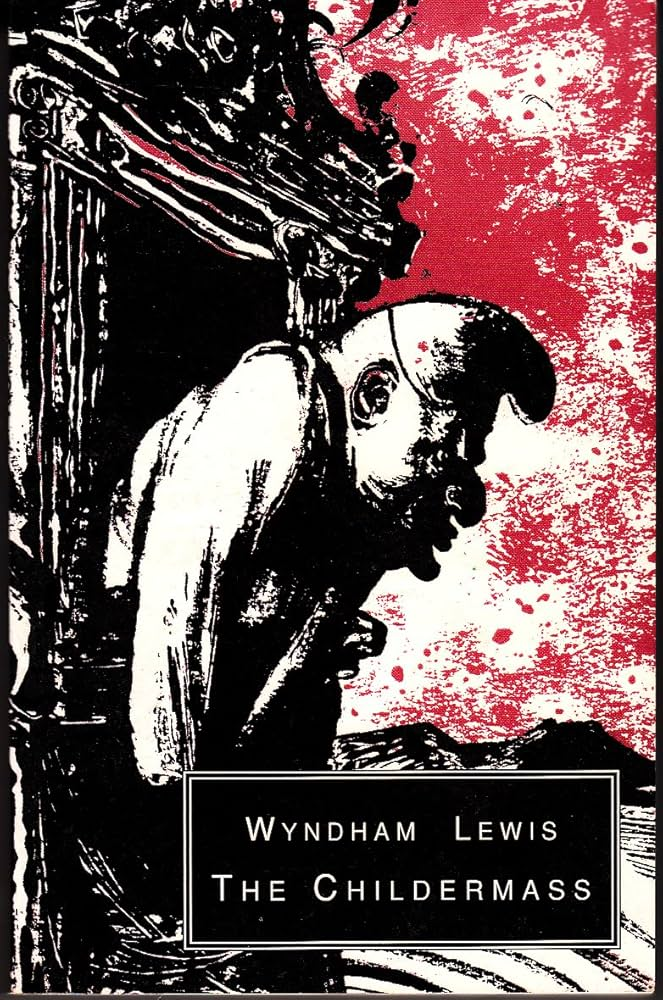
The following excerpt is adapted from Chapter Six of Luke Gilfedder’s “Wyndham Lewis: Modernism and the New Radical Right” (Logos Verlag Berlin, 2025), which discusses Wyndham Lewis’s Dantean science-fiction trilogy, The Human Age.
Spanning three decades—beginning with ‘The Childermass’ in 1928 and concluding with ‘Monstre Gai’ and ‘Malign Fiesta’ in the late 1950s—The Human Age examines Modernism’s uneasy relationship with power. It focuses particularly on the moral dilemmas faced by the modernist intellectual, embodied in the trilogy by the suspiciously Joyce-like protagonist James Pullman.
…Monstre Gai ends amid violent political anarchy as the “Angelic masters” reclaim Third City from its corrupt dignitary, the Bailiff. Despite Pullman’s growing disenchantment with the “good old Bailey”, his choices have “implicated” him with the gay monster; as the Bailiff says, “I will have to fly; the best thing you can do will be to fly with me.”1 To Pullman’s chagrin, the city he is transported to is not Heaven but the Bailiff’s native city in Hell, Matapolis. This Hell is not that existential hell man carries within—nor the trifling superstition that Pullman’s “false soul-conductor” dismissed it as (just a “very miniature bit of Birmingham painted over to resemble Le Havre”)—but the genuine, condign Hell dedicated to deceased sinners.
Pullman’s final transition to Hell (reversing the structure of the Divine Comedy) sharpens the moral dilemmas of Third City. As Lewis told Hugh Kenner, the “same situation” repeats in Malign Fiesta, only “more tragically”. Instead of dealing with a petty Capone who claims good and evil have become passé, Pullman is drawn to the still more compromising patronage of the Devil. The Bailiff, as Lewis explained, was “not Divine’” but his parallel figure in Malign Fiesta is Divine, though “Diabolic.” Pullman is placed “within a yard or two” of the very ‘incarnation of Evil’, the “spirit only second to God.”
Malign Fiesta is the most affecting book of Lewis’s trilogy: Pullman is more surely implicated in evil, yet more desirous to escape from it. In Third City, there appeared a real choice between the ‘monstre gai’ and the Padishah; in Matapolis, the only power is the Devil, to whom Pullman sees “no alternative” but “death”. His dilemma is more straightforward yet more terrible: he can survive only by becoming the Machiavellian counsellor to Satan in his strategising against Heaven, namely, his intent to merge the Human and the Angelic and thus sever man from God. Pullman acknowledges his helplessness, recognising he is “absolutely in the power” of this violent creature. Even the Bailiff admits himself a “pitiable worm” before “lord Sammael”, whose “limitless power” is “absolute and immeasurable.”
Indeed, the now ex-Bailiff has fallen from Sammael’s graces for fostering “sexual vice” and “lawless debauch” in Third City, acting on the mistaken assumption that in doing so he was fulfilling the Devil’s work”. Sammael turns out not to be the “arch-enemy of the moral” but a “very strict” puritan, and—with satirical relish—makes the Bailiff weep “like a schoolboy” when told he should “hang by the neck” in Tenth Piazza for having filled Third City with the “imbecilic, the vapid, the homosexual” and propagated the “lowest vices, the blackest crimes of the descendants of Adam and Eve”.2
The Moralist with a Knife
One of the most immediate differences between Monstre Gai’s ‘Third City’and Malign Fiesta is how strikingly Sammael’s ‘puritanical’ locale reflects the traits of its governor. Instead of the “charming little burg” the Bailiff promised, we find a sullen, frozen realm full of “punishment-minded citizens.” Despite updated references to the Attleean welfare state of post-war Britain, in writing Monstre Gai, Lewis needed no insight greater than that he possessed when he wrote 1928’s The Childermass; Third City typified any ‘low-brow’ twentieth-century urban environment, accountable for within the terms of1927’s The Art of Being Ruled. Yet the horrors of the Second World War exceeded the bounds of Lewis’s original social analyses, and Malign Fiesta strives to translate this new, violent material into fiction—we read, for instance, of a “Punishment Centre” (Dis), of “sheds” where new “batches of Sinners” are “paraded and marched” and a “fully-fledged Secret Service” with “political police”. Sammael is both the “historic arch-demon” and a modern totalitarian leader, with his puritanical Hell representing the traditional medieval Inferno of “demons with pricking pitchforks” and twentieth-century extermination camps where sadistically frivolous medical experiments were conducted with scientific detachment. This “Nazified Hell”, as the Bailiff notes, “possesses all the Inquisition machinery, plus a fine variety of Hitlerian gadgets”. The reference to Hitler is not incidental; Hitler, like Sammael, was a “fanatical moralist.”3
Pullman rightly fears the fate he and Satters will face from this “moralist with a knife”, especially after his “Dantesque tour” of Sammael’s punishment facility. He meets the “Mengele-like” Hachilah, who expects Pullman to admire his ingenuity in recreating, with modern surgical techniques, a series of Dantean tableaux vivants using the suspended bodies of mutilated sinners.4 Hachilah explains that this “vast” hospital, whose cells are a “caricature of Dante’s Inferno”, is engaged in the “Surgery of Morals”. “Overwhelmed” by these and other instances of Sammael’s “unsurpassable horror”, Pullman realises he faces “the same” turning point as in Third City, where he “ought to have severed his connection with that monstre gai.” Yet he “repeats the same mistakes all over again, feeling his only option is to make himself useful to the “new kind of monster,” just as he had with the Mussoliniesque Bailiff. Pullman becomes a “learned captive” to Sammael’s “Roman Emperor,” assisting Satan in his plot to undermine the divine by interbreeding angels with mankind to inaugurate a ‘Human Age’.
The Janus-Faced Sammael
This leads us to the central paradox in Malign Fiesta, namelythat Sammael, the “greatest of archangels”, with his renowned “hatred of man”, seeks to forsake his traditional role as divine punisher and become a new kind of demiurge, one dedicated to making angels more corporeal and human. But why would Sammael, who loathes mankind, seek to contaminate angelic perfection with a “human admixture”? Surely, by marrying dark angels to female sinners, he would only replace a divine order of beings with an imperfect one antitheticalto his puritanical predilections—fashioning, in short, a breed of “quasi-divine hybrid(s)” or “angelic mongrels”?
One solution to this ‘two Sammaels’ problem is to deny the antimony outright: Sammael despises humanity and God— he merely has a two-pronged attack. Despite his ‘historical’ opposition to Man, Sammael is willing to humanise his angels (and himself) to establish a new pseudo-Heaven in Hell and hence eternally separate man from God—and God from His creations. This will not only constrict humanity further in darkness but also undermine God’s survival as an ‘Almighty’ Absolute. To achieve this dual aim, Sammael must modernise Hell, converting it into a desacralised modernity where the differences between fallen angels and mankind are erased through interbreeding. When this interbreeding has repopulated Hell—and Heaven itself—the Human Age will be achieved, God defeated, and Sammael will have inherited the whole. In this sense, Sammael is not as ‘enlightened’ or utopian as he seems, but still the archdemon of old, conforming to his description in The Anatomie of Sorcerie (1612), which states: “Satan’s chiefest drift and maine point… is the inlargement of his owne kingdome’ by acquiring more damned souls.”
Sammael’s ‘Revolutionary’ Human Age
While Pullman is morally aware of his complicity with this ‘first’ Sammael, God’s ancient adversary, his rational intellect is irresistibly drawn to the ambitions of the later Sammael, the ‘progressive’ Satan, the “Stalin” who “suddenly aspired to establish a Sans-Souci.” Sammael presents his vision of transforming himself from the supernatural into the natural as an idealistic, democratic, and enlightened objective—one that a traditionalist God would oppose since it abolishes the Devil’s role as the “official Opponent” and deprives the supernaturals of their “outdated” angel status.
Pullman agrees there is “lethargy in that vast stability”, and his humanistic rationale empathises with the “great revolution” Sammael plans to “explode among men and angels”, and his ambition to “combine the advantages” of “angelic stability” and “human mercurialism.” As such, Pullman thinks not only of self-preservation in becoming Sammael’s “counsellor” but also of the advantages this scheme might bring to mankind. He imagines that in the proposed ‘mingling’, a “little immortality” might be surrendered to tomorrow’s “Newtons and the Plancks”, who could establish a “superb Human Age” upon a “suitable planet,” a tabula rasa world where “all the high activities could blossom.” The history of such a planet would match the history that RenéHarding dreamed of writing in Self Condemned: one focused solely on the creative works of creative men.
Pullman’s allegiance with Satan thus presents an even deeper satire on Enlightenment and modernist values than Monstre Gai. As director of Sammael’s scheme, Pullman—like Lewis’s theoretically omnipotent Caliph from 1919’s The Caliph’s Design—is placed in a position to “wipe everything out” and fashion a world “nearer to the heart’s desire”, a “new world of reason”. He proposes building a “university for angels” to persuade these mechanically perfect “idlers” to “work at book learning,” and an “adult university” is indeed founded in Angeltown, where Pullman, naturally, becomes its director.
Pullman thus becomes a kind of Voltaire to Sammael’s Frederick the Great, a fact he is subliminally cognisant of (aside from the allusion to ‘Sans-Souci’, “Frederick the Great’s drummers” are invoked on page 501).5 He embraces his position, creating “propaganda” to expedite Sammael’s proposal to end “what men know as Heaven” and build a “true one” in its place. Pullman proposes inaugurating this scheme with a Fiesta, one which introduces Angeltowners to the humanistic, Enlightenment culture they are to henceforth participate in.
The Malign Fiesta
The ‘cultural’ aspects of Pullman’s “jittercracking” fiesta, however, are hardly the art of the ‘dissident high culture’ envisaged by the avant-garde elite, but the products of the degenerate mass culture that the New Right and the high modernists (the ‘reactionary angels’) condemn. The Fiesta degenerates into a symbol of ‘decadent’ post-Enlightenment modernity, an “ironic apotheosis of the banal”. Factories mass produce masks, postiche noses, and all the machinery of carnival; “truckfuls of women” are imported from the revolutionary angel settlements; there are jazz concerts, cowboys with “firearms and spectacular knives” singing “toughly and sentimentally of the corral”, and orchestras oozing out “swoony slush”—we meet Swiss yodellers, castanet-whirling Spanish dancers, and Irish and Scottish dance troupes jiving with “reckless savagery” to the “music of the Magyars.” The scene embodies Plato and Tocqueville’s views on egalitarianism leading to materialism, Guénon’s perspective of ‘progress’ as a regress into the abyss of matter, corporeality, and mechanicalness, and Dugin’s notion of modernity as the ‘reign of quantity,’ characterised by the archetypal forces of the Titans and the Great Mother (Cybele), where the gods retreat and “matter” takes “possession of humanity”.6
This dissolute mélange, however, belies the true intention of the Fiesta, which is to use the festivities as a general aphrodisiac inciting the angels to mate with human women.7 Sammael is to play the part of “the leading tempter” (although he will not “go through with it himself”) and dance the rumba with his ‘fiancée’, a “young American octaroon of surpassing beauty”. She is to “roll her hips in the most inflammatory way”, to “ignite” the “rusty machine” of the “angels’ genitals… extinct for so many thousands of years”, and commence the inauguration of the Human Age.
A Satanic Kermesse
The Fiesta climaxes after midnight with an “angel Kermess” a term pointedly recalling Lewis’s Kermesse drawing of 1912. The Lewis scholar, Paul Edwards, describes this drawing as a “Dionysiac, futurist dance of creation” influenced by the Breton peasant fêtes Lewis observed in his youth. The 1912 painting had transfixed the wild energy of Dionysian rapture into a geometric rigidity, reconciling the tension between Henri Bergson’s ‘vital’ humanism and the geometric severity of anti-humanist primitive art. No such Apollonian-Dionysian balance is achieved in Malign Fiesta, however, and the ‘Satanic Kermess’ unravels in an orgy of drunkenness, sex, and violence. This accords with Aleksander Dugin’s concept of the “black logos” of Cybele as the “logos of modernity”, existing below the light-dark dualism of Apollo-Dionysus, where “only matter is absolute.”8
Indeed, walking home through Angelsway, Pullman encounters “a group of six angels,” one of whom was “quite visibly” in the act of “possessing a little female figure”. He sees “chains of drunks… stretched across the sidewalk” and one “extremely large angel” gouging out the eyes of a small one, only to be himself stabbed to death by a “bellowing crowd” (“democracy by gangs”, Pullman quips). Leaving the scene, Pullman looks back to see a vulture circling over the street where the corpse has been abandoned, “suspicious of the shining handle of the dagger” sticking out of its chest, “sculptured to represent a serpent rampant.” Significantly, for Dugin, the modern state is a “serpent” organised from below to “destroy everything” that is Absolute, unified and “sacred,” just as modernity represents the “victory of the titans, of Cybele, of the serpent over God”.9
For Edwards, this image stands as Lewis’s final word on the unravelling of the Enlightenment project and the modernism that emerged in its wake. The elimination of a transcendent Absolute and the relocation of its values within the stream of nature led to the debasement of mass culture and violent efforts to reattain, through nature, values that “have their grounds elsewhere.” As such, the Fiesta is the consummation of Lewis’s critiques of Western culture discussed throughout this book—the fetishisation of revolution, irrational vitalism, and deceptive forms of democracy. It represents Guenon’s “dark age”, Evola’s “kali yuga”, Burke’s “saturnalia of destruction,” and Lewis’s “Moloch of Modern Ideas.” Above all, Sammael’s scheme encompasses everything Lewis opposed in 1927’s Time and Western Man, which argued for the “stable” personality as a way to preserve the Subject that progressive ideologies were dismantling into a “bundle of faggots”— just as Sammael intends by ‘liquefying’ the angels:
…their immortality will dissolve into mortality, their vast individual shapes will be cut up into thousands of facsimiles of themselves. There would be everywhere a swarming of ephemeral units in place of a world of larger and more stable things.
As Michael Nath points out, Sammael’s scheme represents nothing less than an implementation of the ‘time-philosophy’ of Alfred North Whitehead and Samuel Alexander: in short, Sammael is the “hypostasis” of Lewis’s despised “Time-Cult”, and his ‘revolution’ entails the dissolution of the Subject, which Lewis saw as fatal to art.10 Compare Sammael’s words to Lewis’s of 1927:
Dispersal and transformation of a space-phenomenon into a time-phenomenon throughout everything that is the trick of this doctrine…. A crowd of hurrying shapes, a temporal collectivity, is to be put in the place of the single object of what it hostilely indicates as the “spatialising” mind.
The culmination of this doctrine, according to Lewis, is that the ‘human’—as idealised in humanism—is itself subjected to a similar critique to that which abolished the divine: our personalities will be dissolved into a swarm of “ephemerids” without higher-level cohesion. The Fiesta represents this in mass culture: society’s dissolution into Bergsonian fragments and its scattering into “Democritan atoms”. In sum, Pullman has been intellectually drawn into a project that embodies the opposite of Lewis’s traditionalist critique: Sammael’s scheme values the human and the natural over remote and transcendent authorities, privileges the “religion of impermanence” over eternity and space, and, to adapt Dugin’s words from Political Platonism, emphasises “matter and sense experience” over “sacrality, hierarchy, [and] appeal to God and the spirit.”
Pullman mentally repudiates this scheme at the Gala Luncheon celebrating the Fiesta; listening to Sammael’s “dazzling oration,” he realises the extent of the evil he has been complicit in by reducing Angeltown to a ‘comic Hollywood’, a “satanic parody of Los Angeles”:
In Sammael’s heart there was no great purpose, but the old, cold pride. He was resolved to explode the supernatural, ultimately to make an end of God. (Lewis, 1955, p. 511)
Pullman is “smitten with a revelation” that Sammael’s ‘Enlightened’ project was “merely a defiance of god” and that to save his skin, he had been “actively assisting at the annihilation of the Divine.”
Full citations and references are available in “Wyndham Lewis: Modernism and the New Radical Right,” pp. 295–369.