

Author: Adam Gorecki
The tranquillity of musical consumption can serve as an anaesthetic as much as it can be a stimulant. Observe next time you step out of your door for your commute. How many others are engulfed by the audible world of earphones? How many do you think feel immersed by it? How many others are numbed by it?
As I sit outside during a peaceful evening and I begin to write on this subject, I suddenly find it amusing how we are so capable of utilising music to serve as a ‘fast-forward’ in our everyday lives.
For a brief moment, it makes no sense. In all honesty, it seems to me that for the most part when we play our music during our daily wanderings, it’s like we’re not even there at all. In which case, where do we go? The hopeful answer would be that we lose ourselves into the world that the music is offering to us. However, on average I’d say this is only relevant maybe a morbid 15% of the time, and perhaps 20-25% to those who have a deeper interest in music. I think for a lot of us, the sad truth is that we disappear once we find a playlist that we’re comfortable with. You could go as far to say that sometimes a good song can serve as a drug. A stimulant high on the first few listens which merges into a sterile chase for sparks throughout the 100th and 200th listens. Let’s not pretend we haven’t rewound a song because we weren’t fully attentive to it the first time or the second time or even the tenth.
It’s the curse that streaming services offer us nowadays. It serves us on a platter the power to oversaturate our favourite songs beyond the point of appreciation.
But as I keep asking, in these moments of overwhelming consumption, where do we go? Or, more importantly, where should we be?
The easy answer to the latter is present. More importantly, being attentive toward the thoughts and feelings that lay before us. It’s how we process and find out more about ourselves. More often than not, it’s the avoidance of these thoughts that can subconsciously motivate us to hide in our earphones. Many will argue that it’s the avoidance of boredom. I’d argue that boredom is simply unappreciated tranquillity. Although predominantly used as a tool for artistic indulgence, music has the ability to invade our subconscious with noise and disguise unwanted thoughts. However, once we learn that we are not our thoughts, we become here to merely observe them as a third party. Now our thoughts can present themselves as terrifying, obscure, questionable, laughable, dark, beautiful and mostly unfathomably untrue, but they’re there to be witnessed. It’s human. Our thoughts and feelings are our creative intuitions and they must be heard and embraced, but not overanalysed. That is where authentic art comes from. That is what authentic art is.
I think a lot of how we feel and who we are lays deep beneath the bed of the art we expose ourselves to.
In the past few weeks, I’ve managed to launch my own radio show with Epsom Hospital Radio where I’ve began to explore this very topic. Each week, I’ll invite a guest who is encouraged to provide and discuss ten of their favourite songs for us to play. I allow lots of space for casual, relaxed conversation around the topic, much like overhearing a few people at the local pub discuss their favourite records. I encourage honesty, authenticity and an open mind.
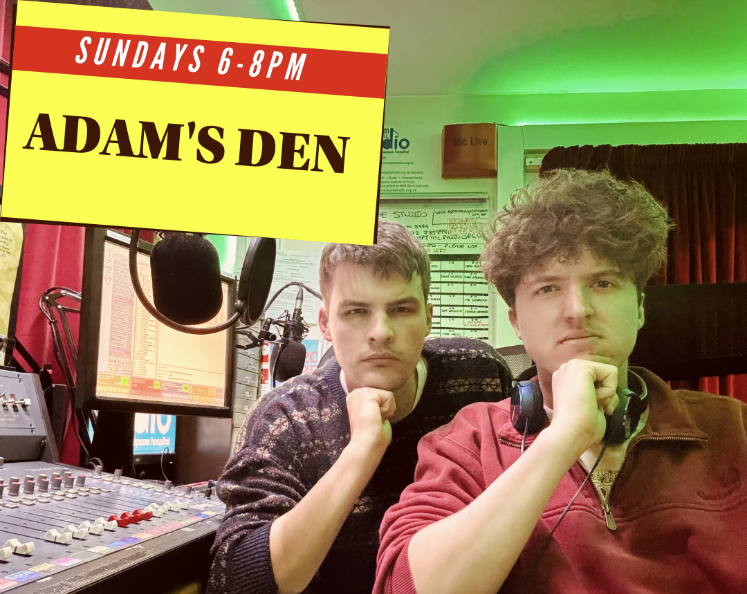
Streaming services are great for replaying the songs we already know and love, but radio still offers a more curated way to discover new genres, artists, and conversations (if the show is any good). Ultimately, we still need radio to retain a more humanitarian relationship with music, and with people for that matter.
On my show, I take a lot of inspiration from Desert Island Discs, and encourage people to sit back and think about why we love the songs that we love? Not just because it ‘sounds good’ or ‘it’s a vibe’ — but really? Why? Play it a few times and think about how you feel and try to put it into words.
Does it take you back to a particular time in your life?
Does it unlock a particular internalised character?
Is it produced in a way that you find impressive?
Where does it take you?
Where do you go?
The ability to break things down into words and statements is what separates the subconscious with the conscious, meaning we don’t just feel things passively, we actually put our thoughts and ideas into structured sentences. It’s presence in the making. This precisely why I wanted to start a music column — it’s therapy.
For the most part, music engages our dopamine-serotonin-endorphin system, weaving together pleasure, memory, and social bonding into a chemical cocktail that makes us feel good. Moreover, a key word that I love using in my articles is ‘resonating’ — a scientific term that typically revolves around particles vibrating and picking up each other’s frequencies. When it comes to music, it’s all just vibrations anyway. Frequencies influence not only how we experience sound, but also how we connect with others, and amazing songs bring people together in resonance, like particles. If you don’t believe me, look at Live Aid. But I feel that there’s potential for there to be a lot more than that.
A 1993 study for the journal, Nature, concluded that students who listened to around 10 minutes of Mozart’s sonata for two pianos in D major performed better on spatial reasoning tests compared to those who sat in silence or listened to relaxation instructions. This sparked the pop culture theory that listening to 20 minutes of music a day is a great way to ‘boost your brain’. Now I don’t think this means that our casual air pod fuelled commute to work constitutes as brain training, neither do I feel that this includes listening to our favourite songs on repeat. I do, however, see reason in suggesting that attentively and presently interpreting a wide pallet of sophisticated musical pieces can do a lot of good for our own wellbeing. Whether this be carefully tracking the beats, rhythms and rhymes or internally harmonising with a chord progression or melody; there is potential in the ability to unlock a new level of awareness when attentively listening to the music we know and love.
It’s a good way of navigating why we love what we love, and what about ourselves can resonate with the things that we do. This doesn’t mean you overly analyse the music or write incessant paragraphs about it (I mean who does that?!), it just means acknowledging that it’s there and that you’re feeling it.
For example, before writing this piece, I sat and listened to Aphex Twin’s ‘Selected Ambient Works 85-92’, I now proceed to write this article with the album in my headphones. The album is entirely instrumental, complex and rhythmically charged; and for some strange reason, I’m able to think and write incredibly clearly. In an attempt to avoid sounding dramatic, I feel like I’m in a different state, somewhere else, deeply focused. In theory, I’m not sure I could write a lot of paragraphs about Aphex Twin’s album, but in a way I already am. This piece is a product of the music that I attentively listened to and then passively wrote to. So, when I ask where music is capable of taking you, it can quite easily be this strange stream of consciousness that I’ve written out here, before you.
Ultimately, music will sharpen our focus by masking distractions, regulating our energy levels, and boosting dopamine. The right soundtrack can potentially help us enter a flow state, where concentration comes naturally, especially with instrumental or ambient tracks that don’t compete with language-processing – and that’s great! What I ask of you, however, is to not disappear. Don’t zone out. Don’t fall into numbness or unawareness. Stay right here and feel every bit of what you’re feeling, whether it be ugly or beautiful. As I said prior, music can be a tool to either enhance or numb your own senses.
“Sharpen your perception — so you always clearly understand what it is that happens to you and in you, the cause and purpose of each event.” – Marcus Aurelius, Meditations – Book 6, Section 30
We live in an age where short-term attention spans, instant boredom and a thirst for quick dopamine boosts are major cogs that currently power the entertainment industry. Now more than ever, the content presented to us on our phones is designed to take us away from where we are, we’re all guilty of it, but I truly believe that music can be a part of the solution as opposed to being a part of the problem. There’s an unfathomable amount of inspiration screaming at you every day to be acknowledged, yet our heads are down and we’re not even there to feel it. But there’s always a choice between allowing yourself to absorb something, or allowing it to absorb you. So, all I ask is that you actively engage with the effects that the musical work produces.
As The Doobie Brothers wisely once said, Listen To The Music.
Radio – https://www.mixcloud.com/adamsden/
Adam Gorecki is a London-based writer, maker, and photographer with a broad love for anything that catches his curiosity, particularly music. Graduating with a Level 4 Diploma in Copywriting from The College of Media and Publishing, he sees music as a complex social study and is fascinated by how brilliant ideas can be brought to life.
Discover more from Decadent Serpent
Subscribe to get the latest posts sent to your email.
