
Author: Adam Gorecki
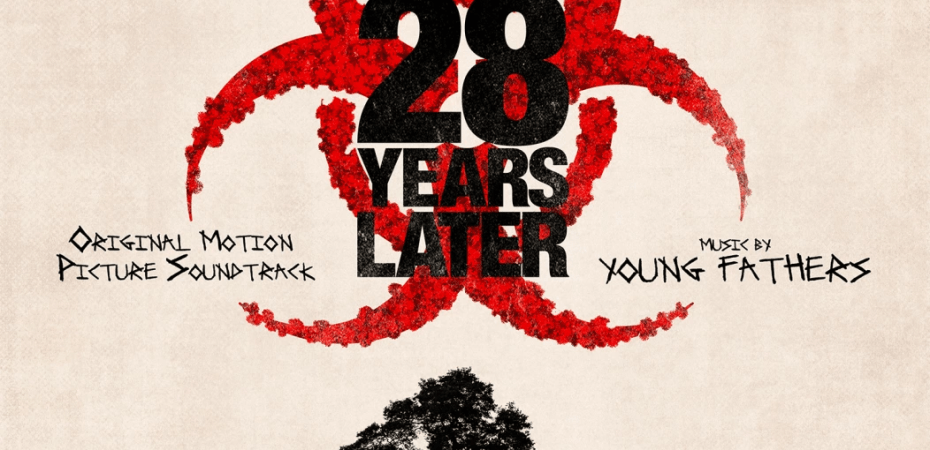
It’s worth mentioning that I’m still yet to have the pleasure of sitting down to watch 28 Years Later. I was always a fan of the first film, but my main source of excitement stemmed from the announcement of Edinburgh legends, Young Fathers, taking on the motion picture’s entire soundtrack as a conceptual piece. So, I write purely from the perspective of a mere a consumer of music, as oppose to relating it towards the context of the film.
What Young Fathers capture within the soundtrack of Danny Boyle’s long anticipated zombie sequel is the delicate blend of a dooming sunset during the ‘end of all days’. Do we tragically anticipate what insidious darkness lurks within the shadows, or do we lavish in the picturesque demise of the sun’s final descent?
I’ve always refused to acknowledge Young Fathers as a ‘hip-hop’ formation rather than appreciate them as a technicolour war cry that screams down the wire of rhythmic soundwaves. Hip-hop is an understatement and quite frankly a disrespect to the versatile and genre-bending skillset that the band acquires. Their 2023 project, ‘Heavy Heavy’, was capable of indulging the listener into a blood thumping, rhythmic yet angelical sonic experience. Furthermore, their previous collaboration with Danny Boyle’s 2017 sequel to Trainspotting demonstrated that the group was up to the challenge on taking on an entire array of emotions and rhythms with their very first full-length movie soundtrack. But seeing the band take on horrorcore was something that particularly excited me.
The soundtrack itself successfully achieves the unearthly and sickening feeling of a zombie apocalypse, and depicts the lack of humanity and the abandonment of God. The challenge that Young Fathers take on is making the leap from being alternative album conceptualists to being soundtrack craftsmen. The obscurity of their work has shown from the very start. It’s unidentifiable, yet is capable of effortlessly resonating with the listener, presenting itself as music you have felt as if you’ve always known yet never heard. The purity of Young Fathers’ unorthodox yet original methods are instantly recognisable. Director, Danny Boyle, told Rolling Stone Magazine that:
It was a huge risk because they’d never done a movie before and it’s that thing with any pop group, are you gonna trust the whole movie to them? But you go yeah! Yeah! Sony didn’t know the first thing about them, but they were wonderful. We had a wonderful back and forth and I went up to Edinburgh to their studio, which is a shed. It literally isn’t even a garage – it’s a shed, and they produce extraordinary stuff there. It was very beautiful. There’s some of the stuff you’d expect from them in there, which gives a very different flavour to the film.
The entire project was composed and produced by Young Fathers, recorded at AIR Studios in London, with orchestral parts conducted and orchestrated by Rosie Danvers and recorded with a 66‑piece orchestra; mixed by James Trevacus, edited by Rachel Park. The album is a concoction of cinematic orchestral writing with visceral electronic textures, ferocious drumbeats, field‑recorded foley, and distorted, manipulated vocal chops. Notably tracks like ‘Causeway’ and ‘Remember’ invoke orchestral drama layered atop the trio’s signature style.
The opening track, ‘Promised Land’, introduces us to a utopia, a glistening sunrise on a crippling horizon. The group reassemble their trademarked stacked vocal layering which creates an ominous aura from the outset. We’re thrown into low humming, grainy synth pads, distant reverb-heavy percussion which blends into a levitating riff. The track introduces the film solidly, offering captivation, hope, and an eery iridescence.
Moving forward, we’re thrown into ‘Lowly’. A track that articulates a mournful harmony through upbeat piano riffs and wailing vocals. The flow appears cheery, giddy, and well enthused, but the contextual tone is woeful and soul consuming. Overall, resulting in a catchy and electrifying track with high replay value and stands out as one of my favourites.
On the track ‘Boots’, YF supply a darker tone of horrorcore and unearthly anticipation. The track is an eery rendition built around the work of Rudyard Kipling’s 1903 poem of the same name. The low detuned groans of the track ever-so slowly creep and crescendo toward a distorted and disturbing industrial decay. Percussive hits mimic the repetitive marching of boots, but according to the poem’s theme. Each beat feels like a step toward an inevitable doom. Scraping strings and metallic textures turn your stomach. As the track builds, we’re left feeling unwelcome and feel twisted in our own nature.
Moreover, from a more instrumental perspective, the song ‘Rise’ is a slow-burning, emotionally charged track that builds with haunting minimalism. The chopping of samples and smashing snares are unfamiliar within the realms of film soundtracks, and with that can support a sense of discomfort and distortion. Moreover, we hear sparse, mantra-like phrases that are looped and layered in harmonies. Young Fathers use their signature blend of guttural low tones and plaintive falsetto — all heavily processed with reverb and delay.
The project as a whole is soulfully disfigured and deformed in the most flattering of manners. In a harmony of harsh, raw, and colourful production methods, Young Fathers approach the canvas with an obscurely shaped pallet and an electric whisk for mixing. The beat and tempos for most tracks will smother you will suspense, with methods such as vocal samplings and deep breathes replacing standard percussion strategies. The songs stand individually as if each one of them had been found derelict in a far-off abandoned church or ruin, holding mystery, weariness, and complexity. The benefit of allowing an indie/alternative group to take on a horror soundtrack is that you can almost guarantee that the approach will be completely unlike anything a traditional composure could provide. With that, you can expect it to embody the essence of the film rather than merely serve it as a background compliance. You become able to fully experience this sense of vulnerability being scowled over by perversion. Although unsure of where the untrodden path can take us during this suspenseful run of tracks, the peaks and troughs of this project offer an experiential extravaganza that stands out from most other horrorcore soundtracks. 28 Years Later doesn’t play by the rules. It strives to resonate with our survival instincts, our own internal distortions and our crave for thrill. I highly recommend a listen through with no external distractions.
Adam Gorecki is a London-based writer, maker, and photographer with a broad love for anything that catches his curiosity, particularly music. Graduating with a Level 4 Diploma in Copywriting from The College of Media and Publishing, he sees music as a complex social study and is fascinated by how brilliant ideas can be brought to life.
Discover more from Decadent Serpent
Subscribe to get the latest posts sent to your email.
