
Author: Tyler Hummel
It is remarkable how much 20th-century history is remembered, not through history books, but through the moralistic Broadway stage plays of the 1950s. Our memories of McCarthyism exist now almost entirely through Arthur Miller’s The Crucible. Similarly, our recollections of one of America’s most spectacular and absurd trials are now largely shaped through Inherit The Wind—which even at its time of release was criticized for historical slander and narrowness.
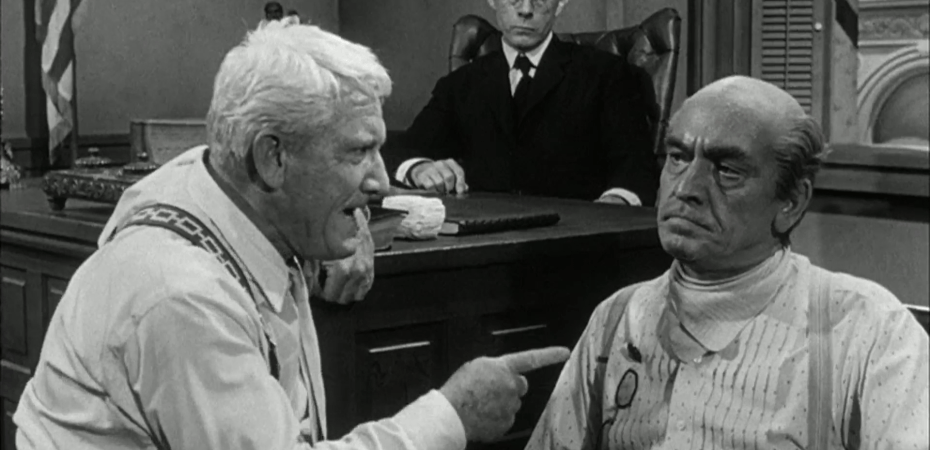
As a result, the infamous “Scopes Monkey Trial” is now more mythology than history. This is not to say that the play and its various film adaptations claim to be history. In the stage play’s prologue, writers Jerome Lawrence and Robert E. Lee claim their play “does not pretend to be journalism” but is “an exodus entirely its own.” Regardless, this is not how it’s been received, as the 1960 film adaptation, starring Gene Kelly, Dick York, and Spencer Tracey, is regularly screened in American schools as part of history lessons about the 1920s.
In July 1925, hundreds of journalists descended upon a tiny Tennessee community called Dayton, where a public school teacher had agreed to challenge the state’s new law against the teaching of Darwinian Evolution in public schools. The trial rapidly became a media circus, with celebrity lawyers, journalists, and politicians like U.S. Secretary of State William Jennings Bryan and Baltimore Sun journalist H.L. Mencken blowing up a tiny free speech case into a public debate about the schism between fundamentalist Christians and modern science. The creationists easily won on the legal question—fining John Scopes $100—but the defendants walked away with a quiet moral victory, feeling that their questions and media coverage had made their enemies look foolish.
Given that July 10th marks the 100th anniversary of the opening of the Scopes Trial, it is fascinating to revisit the play in our more skeptical age, both because the issues of science and religion remain contentious, and because the modernist moral presuppositions are similarly under assault by the rise of post-liberalism (Marxism, Neo-Reaction, Neo-Fascism, Catholic Integralism, etc.).
As historian Edward J. Larson writes in his book on the Scopes Trial, the play and movie versions of Inherit the Wind were initially poorly received, with critics arguing that its portrayal of then-recent history “fatally diminished” the history, “unjustly caricatures the fundamentalists as vicious and narrow-minded hypocrites,” and “idealizes their opponents.”
This historical illiteracy is present throughout the story of the film. At its face, the film inoculates against these accusations by renaming the town and characters. Dayton becomes Hillsboro. John Scopes, William Jennings Bryan, Clarence Darrow, and H.L. Mencken are respectively changed to Bertram Cates, Matthew Harrison Brady, Henry Drummond, and E.K. Hornbeck. It condenses months’ worth of events down into a few days, changes details, and fictionalizes character motivations. But setting aside small dramatic license quibbles, like Mencken’s absence from the final days of the trial, Bryan’s fictional friendship with Darrow, Bryan’s sudden death in the courtroom, or the invention of a love interest for Scopes, the lampshade barely hides the thinness of the caricatures.
It’s obvious that the film’s central target is McCarthyism, with its dire atmosphere and Kafkaesque legal proceedings using the absurdity of the actual event to expose the horrors of political persecution. At its face, though, this is a fundamental misrepresentation of the real event’s tone. The actual Scopes Trial was a farce; a joke that everybody was in on. Scopes never faced more than a misdemeanour charge with a $100 fine, which the prosecution offered to pay on his behalf. Larson describes the tone of the event as a carnival, while the film presents it as a ridiculous death march.
The movie proves entirely slanderous to the real-life town of Dayton, misrepresenting the quiet southern hamlet, whose citizens were recorded being quite kind to the journalists and defenders, as provincial masses of hateful witch hunters, fanatically chanting Gimme The Old Time Religion and marching through the public square with torches, singing how they want to hang their enemies on a sour apple tree. It’s hard not to take Drummund’s words seriously when he angrily accuses Hillsboro of being “an insult to the world.”
Brady and Drummond get the most screen-time as the respective prosecutors and defenders of the case. Naturally, their characterization reflects the biases of the screenwriters. Drummond is proudly declared “the most agile legal mind of the 20th century,” a clever, tolerant, and intelligent man who merely came to Hillsboro to “defend [the] right to be different,” while Brady is depicted as a gluttonous, fanatical, egotist whose climactic death at the trial’s conclusion was caused by stress at being unable to defend his ideas.
The real William Jennings Bryan was a far more well-rounded figure, whose arguments in the Scopes Trial were more nuanced. He argued that Darwinism was creating a culture of bigotry, eugenics, and dehumanization (an argument partially vindicated two decades later in the Second World War). Above all, he truly believed in democracy and the right of the people of Tennessee to write their laws as they see fit. If Darwinism was unpopular, he believed wholeheartedly that they had the mandate to challenge its teaching in schools, lest scientists become “a pretty little oligarchy to put in control of the education of all the children”. And while he was wrong in many of his factual claims, wrongly claiming that contemporary scientists were turning against Darwin, he never sneered at the validity of science.
And as his memoirs make clear, he wasn’t emotionally shattered by the proceedings, arguing that he “agreed that care must be taken at this point that no religious zeal should invade this sacred [public] space and become intolerance.” In his last days of life, Bryan believed it was possible to be both a good secular politician and a strident moralist while respecting the separation of church and state—a reflection of his Progressive Era optimism.
The film’s depiction of Darrow and Mencken excises most of their negative traits: their disdain for organized religion, their sympathy for eugenicism, and their bigotry towards the Southern folk, whom the latter infamously dismissed as “Homo boobiens”. Both men were thoroughgoing egotists with axes to grind and went into the trial attempting to win an optics battle, whereas Drummond is a dignified idealist. The film gives him most of its longest and most sanctimonious soliloquies.
“I am simply trying to stop the clock stoppers from dropping a bunch of medieval nonsense into the US Constitution,” says Drummond. “Soon, you may burn books and newspapers. And then you may turn Catholic against Protestant, and Protestant against Protestant, and try to hoist your own religion upon the mind of man. If you can do one, you can do the other, because fanaticism and ignorance is forever busy and need feeding. And soon, their banners flying and drums beating, we’ll be marching backward through the glorious ages of the 16th century where bigots burned the man who dared bring enlightenment and intelligence to the human mind.”
However, Gene Kelly’s portrayal of Hornbeck does a good job of capturing the spirit of Mencken, offering most of the movie’s most sardonic quips like “Those are the boobs that make our laws. It’s the democratic process!” and describing himself as the worst kind of sinner and infidel: “I wrote for a newspaper!”
If Inherit the Wind were merely another moralistic Liberal-Hollywood drama like Gentlemen’s Agreement or 12 Angry Men, these wouldn’t be issues so much as an authentic expression of the filmmakers. As a standalone film, it’s quite poetic and polemically powerful. Its screenplay sizzles with the verbosity of an Aaron Sorkin movie. It almost feels like the prototype for the kind of smug, self-assured, masturbatory dialogue that he would later popularize with The West Wing and The Newsroom.
Even its title is a clever subversion of a Bible verse, subtly suggesting that Brady’s foolishness would bring ruin to his fundamentalist ideals.
The film thus concludes that to be an American is to have the right to be wrong, with Hammond idealistically clutching a Bible and a copy of Darwin under his arm as he leaves the courtroom with a sense he’s done right by justice. Hammond condemns Hornbeck as an irreverent nihilist who holds nothing dear in the world, and Brady’s death is treated like a horrific tragedy—the hollowing out of a great statesman and progressive thinker into a fanatical shell of a man.
Unfortunately, this is all in service to historical revisionism; an idea of progress which holds in “a child’s power to master the multiplication table there is more sanctity than all your shouted amens and holy holys and hosannahs. An idea is a greater monument than a cathedral.” The film’s classically liberal idealism lionizes ideologies that have created our technocratic, oligarchic modern societies, at the expense of a more nuanced historical truth.
It’s propaganda for modernity. As trial correspondent Joseph Wood Krutch put it in 1967, the film’s influence has eclipsed the actual trial, and it has become “more of a part of the folklore of liberalism than of history.”
Tyler Hummel is a Wisconsin-based freelance critic and journalist, a member of the Music City Film Critics Association, a regular film and literature contributor at Geeks Under Grace, and was the 2021 College Fix Fellow at Main Street Nashville.
Discover more from Decadent Serpent
Subscribe to get the latest posts sent to your email.
