
Author: Tyler Hummel
In his classic 1949 memoir To Hell and Back, the American war hero Audie Murphy — the most decorated U.S. soldier in World War II — reflects on his experiences in Europe as a kind of psychological chasm, a descent into Hell from which one usually never expects to escape alive. Life becomes a game of survival with little hope for the future, to which the survivors must gradually “learn to live again” in its aftermath, as the inevitability of death opens into the possibility of life.
This unflinching attitude is rarely seen in the films of that era. Even the 1955 film adaptation of Murphy’s books, which Murphy starred in as himself, is far more celebratory of his feats. This reflects a culture of romantic celebration in the aftermath of the war. The 1950s were a good time for America, and its war movies celebrated the country’s rise to superpower as a mythic, meaningful struggle, wherein America rode in like the cavalry to save Europe.
This meaning is the root of all the great war films of this era, from 1940s propaganda like Wake Island and The Battle of Coral Sea to later war flicks like The Sands of Iwo Jima and The Longest Day. Suffering and death are always contextualized as meaningful, necessary steps to save the world from the tyranny of Nazism. The horrors are real, but they are worth the sacrifice. As Murphy beautifully puts it, “I may be branded by war, but I won’t be defeated by it.”
By the 1970s, though, this sense of civilizational integrity was thoroughly drained from contemporary war cinema. The counterculture and the Vietnam War had thoroughly zapped the public’s interest in patriotic pro-war films. John Wayne’s last major attempt at such a film became 1968’s The Green Berets, simultaneously the only mainstream pro-Vietnam movie and one of his worst films. 1970s war films, like Patton, A Bridge Too Far, Kelly’s Heroes, and Cross of Iron, reflected a war-weary culture of cynicism, where the public knew all too well the brutality of war and didn’t offer their war heroes much reverence.
Coming at the very tail end of the decade, Samuel Fuller’s The Big Red One is a fascinating war film to examine in this context. A noted genre director of low-budget flicks like Forty Guns and The Naked Kiss, his experience as both a Jewish-American and a World War II veteran highly informs his vision of the war. Arguably, though, his sensibility is more in line with the great Vietnam War epics of his time: crafting a World War II film that feels like a Vietnam movie.
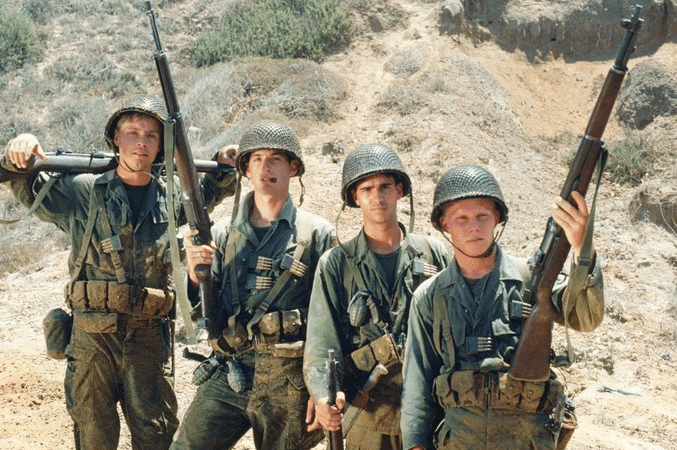
In the opening scene, a WWI veteran (Lee Marvin) stabs a German soldier and takes a part of his uniform as a souvenir, only to discover the armistice was declared four hours ago, and he had just murdered an innocent soldier in cold blood. He has transgressed from justified killing to unjustified murder. Decades later, this sergeant now leads a squad of four soldiers across the European theater of the war in the same infantry division, miraculously guiding and protecting this small group even as their division is repeatedly crushed and killed through deadly engagements in North Africa, Sicily, France, Belgium, and Czechoslovakia, over three years.
As producer Richard Schickel aptly summarizes the film, its principal themes are those of killing and survival. It first asks what the difference between killing and murder is to a soldier, before positing that such a distinction wouldn’t mean much to an average soldier who doesn’t have at least some ideological reason to fight. Survival then, is all that remains of his true motivation, as the great ideologies of war mean little in a foxhole.
“War reduces everyone and everything caught up in it to a state of irrationality and a state in which one has to hold onto sanity with both hands and grip it hard,” as Schickel says in the commentary of the Reconstruction cut.
Given the societal changes in the decades since the war, The Big Red One is far weirder and more graphic in its language and depictions of sexuality. Instead of being clean-shaven and moral, these infantrymen sit around in their free time drinking schnapps and talking about what they want to do to women. Few, if any, WWII films had depicted the crude but accurate practice of soldiers applying condoms to their weapons to protect them from saltwater exposure, let alone depicting any form of sexuality among U.S. servicemen that isn’t in the context of a romantic relationship.
Maybe the film’s most interesting aspects comes from the fact that it gives us one of the few non-Star Wars performances of Mark Hamill’s career, casting him as Private Griff, a cocky and skilled soldier who freezes in his first battle and struggles with the act of killing enemy soldiers, slowly being driven to the breaking point by the evils he is faced with. Hamill’s performance here is one of the strangest in his career, both sexually charged, unhinged, and uncomfortable in light of his comparatively spotless role as Luke Skywalker.
Opposing our unusual heroes is the terrifying Feldwebel Schroeder, a Nazi officer leading an opposing squad of German soldiers who appears repeatedly throughout the film as a mirror to our lead characters. The film draws numerous parallels between Schroeder and the sergeant’s men, from their struggle to survive to their mutual questioning of the difference between murder and killing, to which Marvin and Schroeder both give the same answer: “you can’t kill animals”. Although in the latter’s case, this proves a far more terrifying response, as he repeatedly proves himself a fully committed Nazi that kills his comrades for insufficient zeal.
The film’s episodic structure can leave it feeling a bit unfocused, with the exact purpose of each scene feeling a bit unclear in the moment as these soldiers wander their way, bored and terrified, across Europe. As Schickel points out, though, this would’ve been accurate to Fuller’s personal experiences with war. The soldier experiences war in a haze of confusion, unpredictability, and frustration, with long hours of boredom broken by bursts of violence. Fuller’s great strength thus proves to be his ability to contrast these episodes of humor and death against each other for a jarring effect or maximum irony.
Ironically, the movie does ultimately come around to a slightly traditional cathartic ending. After our heroes liberate the Falkenau concentration camp, they find themselves face to face with the true evils of the war. As Schickel argues, this ending recontextualizes the film that precedes it and turns it into a quiet redemption story, arguably even pushing away the idea that the film could be interpreted as an anti-war film when the cause they were fighting for actually was the right thing to do all along. Some amount of good is able to emerge from the horrors, despite these characters not being able to feel or understand what they were fighting for.
There are certainly shortfalls to this sort of filmmaking approach. The film’s extremely low budget results in a film mostly shot in close-ups to hide the small cast and spurious extras, resulting in one of the worst filmed Normandy sequences in film history (although that’s hardly a fair comparison). It feels like a very cramped and small film, unfocused in the moment, underpopulated, and generally only meaningful in hindsight. Its tone is strange and uncomfortable at the best of times, to the point where my grandfather leaned over to me and said, “This movie is weird!”
Even so, it remains engaging and interesting throughout its lengthy duration. It’s evocative, if not coherent. It speaks to an underlying truth about the war, and to the cynicism of the decade that produced it. As I noted in my first screening, it struck me that the characters who most believe in their cause are the most evil ones, while those just trying to survive are ultimately vindicated. That certainly reflects a decade where patriotism was regularly depicted as old-fashioned and imperialistic.
In the decades that followed, Hollywood cinema would return to engaging in the optimistic, patriotic filmmaking of the 1950s, as World War II became mythologized as “the good war,” coinciding with most veterans of that war having hit retirement age and beginning to open up about their experiences for the first time to curious young family members. As I’ve previously written, the films that followed would embrace the myth-making of their predecessors, lionizing the pain of our forefathers in a way that was both sincere and honest about the brutality of war.
This leaves The Big Red One feeling like an outlier in its genre. It’s every bit as cynical and war-weary as Apocalypse Now and Full Metal Jacket, and it puts you through the wringer to reach any amount of emotional catharsis. It’s a strange bridge between the civilizationally edifying war propaganda of the 1950s and the authentic lived experiences of soldiers caught in the meat grinder, who didn’t know at the time that they’d be welcomed home as heroes. It can’t bring itself to condemn World War II, but it doesn’t want to lionize it. Fuller may not have been defeated by war, but was certainly branded by it.
Tyler is a Wisconsin-based freelance critic and journalist, a member of the Music City Film Critics Association, a regular film and literature contributor at Geeks Under Grace, and was the 2021 College Fix Fellow at Main Street Nashville.
Discover more from Decadent Serpent
Subscribe to get the latest posts sent to your email.
