
Author: David Bănică
Among certain circles of historians of religions, Mircea Eliade is well-known. Born in 1907 in the Kingdom of Romania, the young Eliade began a literary career early on, marked by a distinct feeling of weakness and insufficiency compared to his colleagues. His scholarly interests led him to become fluent in French, Persian, Italian, and written Sanskrit, among others. After being sponsored by an Indian maharaja to come and study Indian philosophy, Eliade’s academic career began in earnest, with his Ph.d. thesis being widely translated. He was deeply influenced by his years spent studying Indian metaphysics, and these years in India provided a backdrop for his later ideas concerning religion. The revealed aim of Eliades’ work became the recovery of “cosmic” spirituality in the West. The West here is used as a monolithic designation for Western civilization, a civilization that, as Eliade saw it, mistakenly abolished the need for God. Yet Elaide was no Orientalist; he did not see in the Eastern religions or metaphysical schools an alternative with which to abolish an authentic European spirituality. Rather, he viewed the East — through his comparative studies of world religions and cults — as an example with which to remind Europe of its metaphysical traditions. In his seminal work The Myth of the Eternal Return, Eliade characterizes his work thus:
The essential theme of my investigation bears on the image of himself formed by the man of the archaic societies and on the place that he assumes in the Cosmos.
The images of man mirrored in the cosmos, the symbols, are what Eliade studied first and foremost. While some might be turned away by his works of comparative religion and ethnography by seemingly dry analysis, the conclusions that Eliade reaches are worth the dive. The cosmic meaning of the Christian temple and its relation to the World Tree, Australian initiation rites, and the ecstatic experiences of Buryat shamans are all cross evaluated for their essential qualities, their symbols, and for their meanings. All of this is done not to advance any Romantic or Enlightenment thesis of the “noble savage”, but to insist on the deep metaphysical realities behind the religions followed by men. From his story ‘The Bridge’:
You were in a natural mode there, in a sense you were unconscious, because you hadn’t begun to ask the question. But what are we to do, we who ask ourselves the question, and who therefore can no longer reintegrate the pure spontaneity, the natural mode of being? We who have lost the unconscious bliss of children and the uneducated? We know we must cross the bridge. I repeat, we know, and we also know what this could mean: to cross it and be unable to return.
Part of Eliade’s project was to build a discipline, the history of religion, that understands religion on its own terms. Religion, for Eliade, cannot be interpreted as a mere societal function or as a by-product of economic anxieties. Thus, politically and philosophically, Eliade positioned himself against the humanist trends in Kantian philosophy, as well as the Marxist schools of thought that had ravaged his home country of Romania in the aftermath of the Second World War. Generally speaking, the position of the ascendent and virile intellectual class in Romania was decidedly “right-wing”, and due to communist crusades against former fascists and adjacent figures, Mircea Eliade was forced into exile in France. He was speedily rehabilitated into intellectual spheres, and went on to have an impressive academic career in the States, lecturing and writing at the University of Chicago.
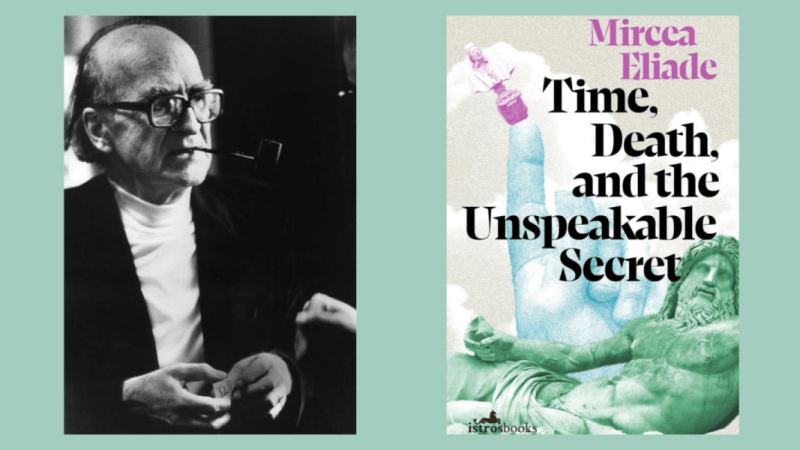
It is from this period, starting in 1959, that the stories in Time, Death and the Unspeakable Secret, a selection of six of his finest, are drawn. Newly translated by Mac Linscott Ricketts, these stories provide a look into the metaphysics and symbols that Mircea Eliade wanted to communicate, and it is from here that the book draws its essential beauty. For the hopes and fears of that bright generation that lived between the two World Wars, the lust for life and the creation of beauty, a mythical Golden Age before a great fall, this is what you are being invited to contemplate.
In ‘A Fourteen-Year-Old Photograph’, for example, the various arguments and schools of thought that are critical of belief in the metaphysical are personified in equally boorish and arrogant personalities. Perhaps the only short story in this collection that is easier to apprehend, we find our main character, Dumitru, anxiously looking to find more information on a mystical personality (faith-healer) that had healed his wife through just looking at a picture of her. In the course of his search, our Dumitru finds this faith healer, now going under the assumed name of Dugay, at a pub. Dumitru eagerly tries to get Dugay to remember this life-changing encounter, while Dugay ignores Dumitru’s pleading to wax poetic on the nature of God:
I could say, without a trace of impiety, that God has died, simple because he’s no longer with us, he’s no longer accessible. He has withdrawn, hidden himself somewhere. That ‘somewhere’ doesn’t belong to our world; it’s what philosophers call the transcendent.
Joined by a band of highly educated pub-crawlers, each representing a school of religious critique, Dumitru pleads his case with one and then another. Each understands him through a theoretical lens, and not through the lens of a man explaining a miracle. Lucio, a clear stand-in for the Hegelian “school” of thought, chimes in:
How do you make culture with the archaic interjections and vocabulary of a Danubian parish? And then, how can you be saved if you don’t have access to the Universal Spirit, if you don’t possess a universal language?
The miracle of healing is not taken to be just what it is, but it must be understood through the lens and perspective of every science and sociology that man has found expedient to develop. Beyond the insistence of the pub intelligentsia on interpreting Dumitru through theories and schools of thought, their interaction reeks with the arrogance of an intellectual class faced with real belief. What is more real, the miracle or the school that forms to understand it? Which matters more, the mystery or its interpreter? The dismay, disdain, and incredulity displayed by this group is exactly what Eliade lived to fight. Ultimately, Mircea Eliade did not fight the war of words and thoughts out of hatred for the peoples or ideas of the West, but in order to save them and re-sanctify them.
While ‘A Fourteen-Year-Old Photograph’ introduces us to a bit of time-bending, ‘At The Gypsies’’ knocks the reader on their feet. One does not remember if they are who they truly think they are, or if they have just woken up from a plum-brandy-soaked dream. Here, literary terms and even the sentences of our protagonist, Gavrilescu, become muddled and contain double meanings. He, Gavrilescu, is only a simple piano teacher, and attempting to reach a client’s house as he does every day at the same time, on the usual train. Or has he just woken up? Has his real life been spent in a hot tent, tended to by gypsy women and their matriarch? Was his wife left behind in Germany simply a convoluted dream, a sign of oncoming madness and decline?
Much like the symbolism and metaphysical meaning that suffused Mircea Eliade’s genius, everything in this hot and confused short story is meant to impart a form of symbolically charged reality to the reader. The world in which Mircea Eliade lives, that of revolving dharmic wheels and the rhythmic beating of the shamanic drum in the northern wastes of Scandinavia, their archaic rhythms intend to break into the world of a “modern” Romanian cityscape. Are they really breaking in? Or have they always been there, and are just coming home…
The Greek girl crept close to him and began to talk. She spoke quickly, in a whisper, shaking her head now and then, or putting her fingers to her mouth, but Gavrilescu was unable to understand her. He listened to her, smiling, looking about him absently, whispering at intervals, ‘It would have been so beautiful…’ He kept hearing the Gypsy’s foot tapping the carpet with a dull sound, subterranean, until the strange wild rhythm seemed beyond his power to endure, and then, with an effort, he rushed to the piano and began to play.
Here we see Eliade at his best, blending his own ideas surrounding the sacred and the profane. Which gypsy-girl is Gavrilescu speaking to at this moment? Perhaps he has had too much coffee, and he means to say that the Greek girl is the Jewish girl; perhaps it was the other way around. Regardless, even mentioning the existence of these faerie-like apparitions induces scowls and offended murmurs from the general population. One might imagine the effect that a pillar of the community would have, when, upon having discovered the existence of the supernatural world, he begins to vanish back and forth between that sacred world and our profane world. Which world is more real?
Asking whether or not Eliade’s characters live in reality or an illusion is certainly not an appropriate question. It is perhaps better to examine the modern man, who can communicate with machine consciousness and generate artificial wisdom, and ask if he can actually live in reality? The characters in Eliade’s short fiction are scions of down-trodden artistic families, sensitive soul-searchers that explore the mysteries of the Vedas clad in crimson-red, and with a sabre in hand. “You understand what I mean: spiritually, he’s already detached. For him, now, only the spirit counts. His tragedy is of a spiritual order. But, as you can imagine, this has brought about a radical change in his manner of living.” If only so many of us were as daring, as willing to face ourselves, as Onofrei and Gologan are attempting to cross the bridge of reality and unreality in ‘The Bridge’. For if the previous stories communicated some of Eliade’s deep desire to impart symbolism to his audience, then ‘The Bridge’ is indeed a summary of the man’s own philosophy:
But it is this world above all that interests me, because only here are the camouflage mysteries found, and, this being so, only here in an incarnate existence do we have any chance of their being revealed to us. But if we accept on principle that mysteries are camouflaged in beings and objects, we must also accept this particular case: that the bridge at Cernavodă might camouflage a mystery. Symbolism tells you that the bridge signifies a passage to something else, to another world, to another mode of being. But symbolism can’t guarantee in advance what kind of other world you will integrate or what other mode of being you will attain.
Much to the credit of Istros Books they have also included short summaries on both Eliade’s life and what is being communicated in his stories. Frequent references to these short summaries will prove invaluable to even the veteran Eliade reader. For the discerning reader, the technical details are incredibly aesthetically satisfying. For the effect of these stories might not be dissimilar from sitting at a hot train station, slowly losing your mind, and wondering if your fellow travellers are even real. But I will cease from interpreting them any further. Instead, I will let Eliade speak for himself, on his own terms, and in his own symbols.
Time, Death and the Unspeakable Secret by Mircea Eliade is out now, published by Istros Books and priced at £13.99. You can purchase it here.
David Bănică is an undergraduate student pursuing his B.A. in History. He has a passion for Christian mysticism and the philosophy of Mircea Eliade.
Discover more from Decadent Serpent
Subscribe to get the latest posts sent to your email.
