
Author: Amory Crane
(Note: This essay was written toward the end of last year, and is reprinted here for the very simple and, I hope, understandable reason that I was otherwise engaged this week in work on my novel. I trust readers will forgive this lapse, as time spent on creation rather than on pure critique is, as I’m sure they know, quite scarce in our time).
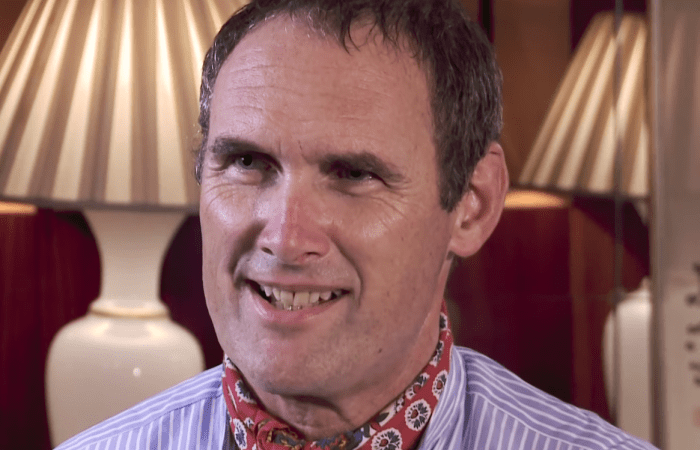
It is probably the case that A. A. Gill is little thought of now. Though he died only eight years ago — and what an eight years it’s been — he is perhaps chiefly remembered as three things: as a gourmand, as a critic of acerbic, even bluntly rude wit, and as a prominent dyslexic, which meant he filed all his copy by dictation. A man of impeccable taste, he strove to apply it beyond only the dinner table. With Saville Row suits lined with Hermès scarves, hat tilted over a cocked brow, his rakish cravat flowing from between an open collar, and a jaunty cigarette lingering between, I suspect, assiduously manicured fingers; it could be said with justice that he kept the spirit of the boulevardier alive into the beginning of this crass and etiolated century. Viewed now some will no doubt say, with a wistful sigh, lips pursed with tedium, ‘there’s no one like him anymore.’ Indeed, they’re right. But even the regretful probably remember him as a mere glittering gem between the staid tedium of the surrounding newspaper. His columns were a surprise, a glistening bubble that would float and catch the sun with a sparkling iridescence before popping, a signal that the quotidian was calling.
It was of course Oscar Wilde who said ‘It is only shallow people who do not judge by appearances. The true mystery of the world is the visible, not the invisible’ and of Gill this would no doubt appear to some as a fitting tribute to the man before consigning him to forgetfulness again. But we should be wary of bon mot, precisely because people have a tendency to use them more as full stops than the beginnings of thought. For Gill wrote of food and travel with not only taste, but reverence, the latter now forgotten behind his many criticisms. He was an observer not of man’s soul, but of his surfaces, and in this he understood that our obsession with signalling and commodity was not a simple jettisoning of ‘depth’ as some would have it, but its resulting fruits.
I am often reminded of his denigration of modern diets, not so much as fads, as a cynical means of fleecing the vast, the desperate, and the newly engaged, but as a fundamental misunderstanding of that most significant change that has occurred with our relation to food. For it is not what we eat, he makes clear, but how we eat that matters, a point made clear in these ten steps:
- Always eat sitting at a table that is set for a meal. This sets up an anchor and a ritual.
- Always eat with a knife and fork. Old fashioned manners. Eating with fingers just won’t do especially out of cartons (see rule 8)
- Whenever possible eat in company. Eating is a centuries old way of communicating and bonding with other humans.
- Never eat standing up and certainly not in the street and this includes take away coffee.
- Never eat with a screen in the same room, that refers to TVs, computers etc. How many of us would admit to doing this one.
- Eat meals at fixed times. This creates routine and teaches the body to eat at certain times and therefore we will not be so prone to snacking.
- Keep meals varied thus engaging the taste buds and the senses
- Never eat from plastic, paper or cardboard
- Never eat in a car. Crumbs all over the car and it’s not safe.
- Enjoy your food.
On reading that one need not begin a tally. For how many of those rules do we break in our daily lives? The answer is enough to inspire shame. But there is more than merely table manners at work here — or there is more to table manners than we would like to think. For wrapped up, encoded in our etiquette, are not just vague ideas of what is polite, but a means of passing on shared wisdom. Our most thoughtless acts are more often than not the product neither of ignorance or snobbishness, but generations of trial, error, and compromise. How we hold our knife and fork, when we eat our meals, and with whom we eat them — these are not frivolous questions. And it is no coincidence that as we continue to eat alone or with the sole company of our screens, not at tables, though perhaps at work desks, that we find our waists expand as our souls wither. Yes, perhaps it is absurd to say that our table etiquette is the cause for all of our modern predicaments. But how absurd?
How many other forms of behaviour, taught thoughtlessly for decades, centuries, have fallen undefended to the ceaseless task of the rational eye, asking: ‘what purpose does that serve? Of what relevance is it?’ Of course, these acts are taught not through explanation but through shared action and repetition, and can no longer survive destruction as a Church can in a Godless age. We pass these on like bric-a-brac, heirlooms from one generation to another, and by the time they reach us we have long forgotten the significance of the object itself and find it instead in the very act of passing it on. This is what manners are — and how many others have we been denied? I recall being taught when I was very young to remove my hat indoors, to stand when a lady entered a room. What purpose these serve I had no idea. I must have asked a thousand times. But in reading Gill I must have obliquely understood that in asking I was a product of the very world that treats Rationalism as a fetishised practice.
Michael Oakeshott, in his essay ‘Rational Conduct’ makes this observation:
‘Social life – the life of human beings – is to know that some directions of the activity of desiring are approved and others disapproved, that some are right and others are wrong. That there may be principles, or even rules, which may be seen to underlie this approval and disapproval, is not improbable; the searching intellect will always find principles. But this approval and disapproval does not spring from these principles or from knowledge of them. They are merely abridgements, abstract definitions, of the coherence which approvals and disapprovals themselves exhibit. Nor may approval or disapproval be thought of as an additional activity, governed by an independently predetermined end to be achieved. An independently predetermined end has no more place in moral activity than it has in scientific. Approval and disapproval, that is, is not a separate activity which supervenes upon the activity of desiring, introducing norms of conduct from some external source; they are inseparable from the activity of desiring itself. Approval and disapproval are only an abstract and imperfect way of describing our unbroken knowledge of how to manage activity of desiring; of how to behave. In short, moral judgement is not something we pronounce either before, or after, but in our moral activity.’
In other words, this modern propensity to do away with the needless or irrelevant in favour of the simple and proscriptive, of ends instead of acts, is founded on a fundamental misapprehension. To list the attributes one must aspire to — to be respectful, to be polite, to be good — is merely to describe the incidental effects of those very things you have done away with. How often do we hear modern commentators and politicians speak of ‘values’ without rolling our eyes? What are these ineffable things? The truth is the fabric of any society is far more diffuse than its legislation. In the very week of the opening of Parliament one can already hear people pondering on the purpose of such things as Black Rod and Woolsack. We must fear such questions. For what Gill understood, whether in these terms or not, was that we reveal ourselves in our most thoughtless acts; and sadly, in bringing the light of thought to these very actions we have uprooted them while still desiring their fruit.
If we take even that most famous of all the proscriptive lists, the ten commandments, we find a similar problem. No doubt, Thou shalt not kill is a very fine rule, but it may well do less good than teaching children not to raise their voices in anger. For bad manners, after all, lead to murder, as Stendhal pointed out. But nevertheless there is left a paradox. Did not Gill just produce a list himself? His own gastronomic Decalogue? Indeed he did, and in doing so I like to think, with a flash of teeth in his sardonic grin, he makes one last salient point: manners, like fine churches, like fine schools, like our most prized family heirlooms, are very easy to destroy; but they are near impossible to revive.
Amory Crane is Editor-in-Chief at Decadent Serpent. He covers such topics as Art, Literature, and the more broadly Cultural, reporting straight from the chamber of what Shelley once called the ‘unacknowledged legislators of the world’. You can follow him @LaughingCav1 on X or on Substack. He also writes fiction.
Discover more from Decadent Serpent
Subscribe to get the latest posts sent to your email.
