
Author: George Marsden
You can now listen to the audio version of this article here:
There’s a popular idea that, on the solstices, ancient Celts would gather for certain rites performed by druids with sickles, mistletoe, and fire. As with most popular ideas, this is nonsense; the purpose of this article will be to convince you why.
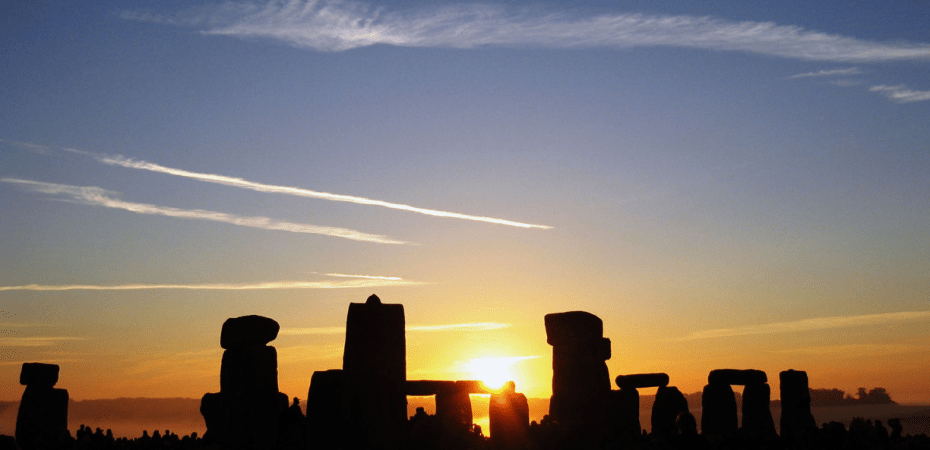
These Celts, like all peoples, had a religion (or religions): Tacitus and Julius Caesar (among others) tell us that those religions were officiated by a priestly class called the druids. We choose to believe them. But the content of that religion we can only guess; of its rituals we are even less certain. What we do know, though, is that they built neither Stonehenge nor any of the other megaliths. Given the fact that some of these structures are so arranged as to make the solstices the most dramatic time to visit them, we may infer that their builders found midsummer and midwinter significant. But Celts the megalith builders were not; nor can the stones convey to us the full significance that any date might have held. Thus, the annual June gathering of Druids at Stonehenge cannot be called a revived ritual for the simple reason that we have no evidence of anyone doing the same before modern times. There is one Druid among them who claims to be the reincarnated soul of King Arthur, but I don’t know of any good means of corroborating his testimony.
As it happens, the source of this nonsense is a Welshman; in which case, it’s only right that another one tries to clear up the confusion. Modern ideas about Druidism have their roots in the works of eighteenth-century poet and stonemason Iolo Morganwg, a man who would have been immortalised as one the geniuses of the age if he wasn’t also a serial literary forger. Among his inventions is a calendar purporting to be the one used by the Druids to mark out their ritual year; midway through which is the holy day of Alban Hefin, the ancient Welsh midsummer. That there were Welsh people before Iolo who had heard of this holiday, let alone Druids who officiated on it, is a total invention. Alongside this calendar, Iolo also tried passing his own poems as lost works from Dafydd ap Gwilym, the greatest court poet of the Welsh middle-ages, while claiming that his philosophical works reflected the lost wisdom of the Druids. Fortunately for his posthumous reputation, the poems are now recognised as some of the best works of eighteenth-century formal Welsh poetry (a curious feature of this poetry is that any given pre-20th century example of it could have been written anytime in a roughly seven hundred year span), while his confected druidry formed the basis of the ethos and ceremony of the modern Eisteddfod.
But the calendar remains a black mark. No doubt there were a few confused souls in white robes and garlands at Stonehenge last night, certain that their vigil honoured the ancestral spirituality of these islands. But not only does the monument pre-date the Iron Age heyday of the Druids (a hint to the true believers: what do you think those sickles were made from?), but there isn’t even much evidence that the ancient Britons/Welsh considered midsummer a significant day. Even as late as Dafydd ap Gwilym in the fourteenth century, it’s Calan Mai (the Welsh May Day) that figures most prominently as the summer’s most notable festival. For this holiday he sings (in my translation):
God knows how timely
Is the start of May’s gentle growth;
Green stalks grow endlessly
On the First Day of the tender, pure May.
While I have yet to come across a single reference to either Midsummer or St John’s Eve (the Christianised Midsummer, falling on the 24th of June) anywhere in his work.
Indeed, it doesn’t seem as if the summer solstice was marked by the Celtic peoples at all before they took up the aforementioned celebration associated with St John the Baptist. As Professor Ronald Hutton points out, the most significant festivals in the traditional Gaelic Calander were Imbolc (1st of February), Beltane (May Day), Lunasa (1st of August), and Samhain (1st of November), suggesting that the appearance of summer solstice celebrations in Ireland and Gaelic Scotland either came about through contact with Germanic peoples, or are simply part of the wider festivity associated with the 24th of June. Ditto for the Welsh.
Now, involving as it does the lighting of bonfires and falling on the date of the Roman summer solstice, the Eve of St John the Baptist is evidently a Christianised pagan festival; an ancient celebration of the warmer months’ zenith gets a religious content through its association with a figure from the Gospels. But a Christianised Celtic festival it certainly isn’t. A saints’ day might have taken the place of something with spiritual significance for the pre-Christian Romans, Teutons, and Slavs (as my colleague Dinah pointed out yesterday); for the Celtic inhabitants of the British Isles, however, it seems that solstice celebrations have always come attached to the Christian liturgy.
The point of the preceding is to demolish the idea that, by marking Midsummer we (in Britain, at least) somehow embrace a buried tradition that sunk beneath the weight of a nefarious element in our civilization. Despite the solstices being to Celticism what St Patrick’s Day is to Irishness, there really are no grounds to believing that they had any significance for the Iron Age inhabitants of the British Isles, and a spirituality based on the assertion that it did is a lie. However, this observation is an opportunity to clear the ground for one that isn’t. Is it not enough to know that, as with various peoples across the Northern Hemisphere, the feeling that these hours represent the apogee of the sun’s blessings — that their effect is evident in the fat and green trees, fields, and hedgerows — and that their brilliance must wane, strikes us as it must have struck them, and will continue to strike whoever lives here for as long as the Earth turns on its axis? I certainly hope it can be, whether you’re the returned King Arthur or not.
George Marsden is a graduate of Glasgow University, where he read English and Classics. His writing has appeared in IM-1776, The Mallard, and Sublation Magazine, among other outlets. As song writing is the only form of modern poetic expression with a mass audience, George thinks it merits special critical attention. He also aims to counter the nefarious influence that Oasis have had on British culture. Read his work here.
Discover more from Decadent Serpent
Subscribe to get the latest posts sent to your email.
