
Author: George Marsden
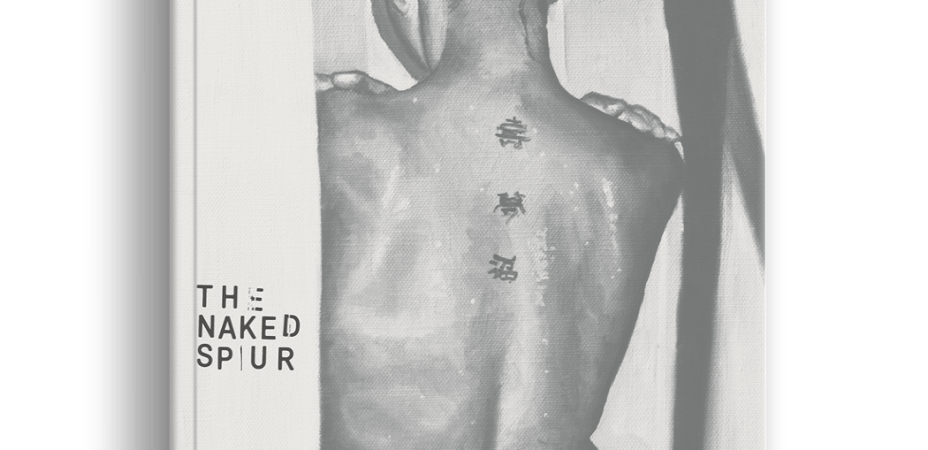
The Naked Spur by Alexander Adams (published May 23rd by Exeter House) appears to have been drawn from life. Like his author before him, protagonist A. is an artist living in London in the early noughties. A. attends showings, shops around artists’ suppliers, manages the indignities of clerical work and the extortionate rents of art studios, and, most importantly, gets on with the work of being a painter. His paintings, however, seldom sell and attract little critical attention. Too skint for a steady supply of nude models, A. paints nudes and anatomical studies from the images he finds in porn magazines. It isn’t easy trying to get the art world interested in painted pornography, it seems, so A. must battle on through rejection and disappointment.
Eventually he decides he’s wasting his time at the day job, which he drops around halfway through the story. He can fully concentrate on art, at last, but not without a sharp consequence for his finances. However, a friend in the film business is at hand with an attractive offer: A. paints erotic nudes—what if he painted on commission for couples looking to preserve their photographic “nudes” (in the 2010s sense of the term) on canvas? The plan is named after a cowboy film: The Naked Spur. A. can paint and make serious money at the same time. As the plans drag on and on without a single commission being taken, A.’s savings dwindle and he’s forced into some unfortunate habits in order to get a few quid in his hands; the novel ends without us finding out if the plan ever comes to anything, or if A. is a victim of either his film friend’s mendacity or inability to commit. I expect Mr Adams intends on writing a sequel to resolve the story. He certainly has more of his own life to cover.
An adjective that will surely occur to many of The Naked Spur’s readers is Houellebecqian. As with Houellebecq’s novels, the narrative style is matter-of-fact and piles on details such as the names of streets and railway stations. There’s sex, of course, but where Houellebecq can sometimes slip into prurience, Adams succeeds in writing sex and intimacy without over-egging or sounding cartoonish. Another similarity are the descriptions of the kinds of urban life particular to the 21st century which form the novel’s background noise; of that welter of people from the four corners of the earth crammed into cities simultaneously ancient and modern, all doing what they can to get by in the circumstances.
I think this style of narrative suits Adam’s writing perfectly. As one might expect given his career as a painter, Adams’s visual imagination is his greatest strength, and one which allows him to leaven matter-of-factness with true poetry. Comparing the City at night to a hard woman’s face made gentle by sleep is lovely and memorable. “Twin Peruvian men sat, still and unspeaking”, which comes at the end a description of passengers on a train, transforms the whole scene into something out of Hogarth. (Why Peruvian? Why twins? It’s hard to express why it works other than it has a certain magic.)
But there’s a rub. While a pictorial approach to novel writing seems to have an enriching effect, nevertheless it has its limits, and Adams would have been well advised to rein it in. The tendency to end a chapter on a potent image as a flourish is tempting in a novel like this because the chapters are mostly very short; to make up for an idea or theme being developed over a few pages, a concentrated moment is summoned to jack up a sense of significance. In themselves, these moments can be very fine. But arriving as often as they do, they generate an awkward rhythm because they are invariably introduced by declarative sentences: “Eastward, the red tips of the Millenium Dome marked an ellipse” and “Around him a dog paced, whining” are, indeed, serviceable images in their place, but when thrown at us at the rate done here they send the prose rocking back and forth.
Some other elements should also have been cut back to avoid unnecessary repetition. Around half-way through every new scene that depicts either commuting, or the specific act of loosening the bristles of used paintbrushes, it starts to read like filler. The conversations about the plan that becomes ‘The Naked Spur’ often seem to cover the same ground; or, at the very least, I don’t think we need to hear twice about Mack’s ruse to sell some of A.’s already completed paintings. And we definitely only need it said once that the wives of prospective buyers of A.’s art are unlikely to agree to putting up paintings of “fannies”.
And this is where I can’t help seeing another problem. Paintings of vulvas are, of course, a well-known feature of obvious feminist art; is Adams satirising its pretensions by conjuring an origin for this style of painting in the very un-feminist world of readers’ wives magazines? If so, I’m afraid the idea is a little underdeveloped. A. appears to suffer rejection for the kind of work that, as far as my gallery experiences seem to indicate, has been fashionable for at least the last quarter century: why not mention this? If an answer to that question can be found in this novel then I’m afraid it’s far too subtle for a layman of the visual arts to identify.
Of course, I’m at risk of reading intentions into Adams’s novel that might not be there. But as the book is billed as a satire of the art-world I think I am licensed in my attempts to go looking for signs of it—especially as there are so few. Early scenes depicting the crowd at gallery shows and the hollow merits of the critic Nicholas Nicobar and buyer Barry Janus are admirable but serve only to offset A.’s isolation: they disappear from the narrative before anything thoroughly devastating can be said about or done to these characters. In the second half of the novel the “art-world” as such doesn’t even really appear, except towards the end.
A few other curious decisions include two chapters dealing with A.’s retrieval of a skeleton from an attic and then disposing of it in the Thames. Is it a real skeleton or a model? We don’t know. What’s A. up to? Ditto. When he’s nearly observed chucking it into the water near Cutty Sark station I assumed the plot was taking an unexpected, but welcome, turn — yet nothing comes of it. We do allow, of course, for the possibility of a sequel; in which case, the inclusion of these chapters might well be justified. As it stands, however, they are a vagrant interlude.
Further examples of this include a chapter narrating A. cooking what appears to be a vegetarian chilli. It comes shortly after his decision to leave his office job, when we might expect something that indicates a thought or emotion on the matter. The only thing indicated by this chapter, however, is that A. intends on eating a vegetarian chilli. While it is immediately preceded by a scene in the park that might tell us all we need to know about A.’s emotional state at that time, this only serves to emphasise this chapter’s pointlessness. It says nothing. We expect that A. makes his own dinner like we also expect Frodo to have taken a few hundred al-fresco comfort breaks on the road to Mordor; it does nothing for either tale to include these details. Press me to divine a possible justification for this chapter, and I would say that Adams is attempting to draw our attention to the similarity between painting oils and cooking. In turn, this justification prompts a question: so what?
I wonder if the fault here is Adams’s sticking closer to the matter of his autobiography than the case really warrants. If these details loom large in the unreconstructed story of his life, it makes sense that they would end up in the novelisation. This would also appear to be true of his decision to introduce certain characters, even when their purpose is less than obvious. A.’s Ethiopian housemate, Ibrahim, is an instance of this. Ibrahim calls himself a writer but spends most of his time drinking and smoking green; I gather his speeches on Ethiopia and East Africa are meant to be irritating (I suppose they would be, in person) but they do form interesting interludes in themselves. More’s the pity, then, that Adams makes little dramatic use of him. He neither influences A.’s decisions nor what happens to him, nor does his own volatility ever come to much of a head. And although unstable because intoxicated, Ibrahim is largely pleasant. As he doesn’t make A.’s life any more difficult than it is, he can’t count towards his sense of failure.
So what’s he doing here? I suppose he serves as a warning to artists of all kinds of those perennial false muses, drink and drugs (A. gives up alcohol in the book); but I think that’s rather weak. Instead, my suspicion is that Adams knew people like Ibrahim and thought they deserved a place in the story because of it. If this were straight autobiography, this simple lifting would be fine. But unlike the people we encounter in autobiographies, characters in novels require a dramatic rather than a merely historic justification. What I mean is that their appearance must conform to the iron discipline of the plot, and not rely solely on the grounds that “they really existed” for admittance. Unfortunately, Ibrahim does not fulfil the first condition, even if I cannot be certain that he meets the second.
These are all faults that a more critical reader with even the slimmest of experiences judging fiction would have identified and counselled Adams to amend in a re-write. Unfortunately, I can’t help but think that Exeter House have let him down here. There are typos that suggest not even an attentive reader went over the manuscript before putting it in print; given the fact that A. was a proofreader at his office job, you would have thought some special care would have been taken in this department. Editing can be a thankless task. However, I do hope Alexander Adams finds a better one for the future.
And I do hope that there is a future for Alexander Adams as novelist. For when the writing is good in The Naked Spur he demonstrates some worthy merits. I hinted above that he shows some impressive restraint writing about sex: this isn’t easy to do, especially in a debut work. He can also be funny, and usually in an admirably understated way. Modern fiction could benefit from the example of an author with such a strong pictorial imagination and The Naked Spur often shows the reader the how and why. If Adams were to take more care of structure he could be a very important writer indeed.
The Naked Spur by Alexander Adams is out now, published by Exeter House (an imprint of Imperium Press) and priced at £15.99/$20. You can purchase it here.
George Marsden is a graduate of Glasgow University, where he read English and Classics. His writing has appeared in IM-1776, The Mallard, and Sublation Magazine, among other outlets. As song writing is the only form of modern poetic expression with a mass audience, George thinks it merits special critical attention. He also aims to counter the nefarious influence that Oasis have had on British culture. Read his work here.
Discover more from Decadent Serpent
Subscribe to get the latest posts sent to your email.
