
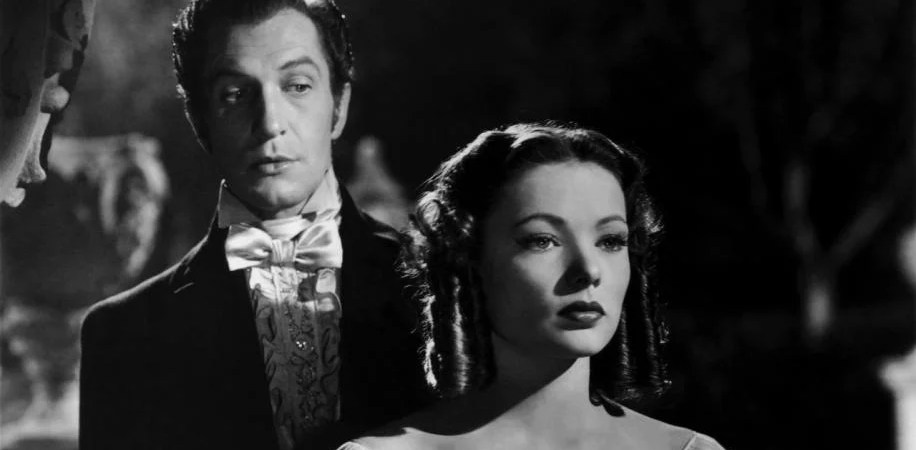
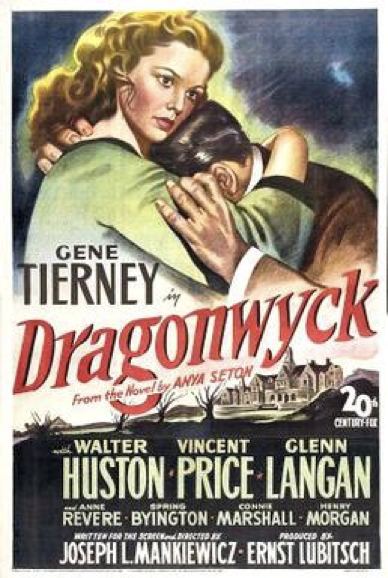
Dragonwyck is a 1946 American period drama film by Twentieth Century-Fox. It was directed by Joseph L. Mankiewicz, and produced by Darryl F. Zanuck and Ernst Lubitsch (uncredited), from a screenplay by Mankiewicz, based on the novel of the same name. The music score was by Alfred Newman, and the cinematography by Arthur C. Miller.
Set in 1844 Greenwich, Connecticut, Miranda Wells, a farm girl raised by humble Christian parents, is allowed to travel to Nicholas Van Ryn’s manor — Dragonwyck in Hudson, New York — in order to be a companion to his daughter. He is a distant cousin and a wealthy patroon; a patroon being a large landholder in what was then a Dutch settled area of the North-Eastern United States.
Servants claim the Van Ryn bloodline is cursed as only they can hear a harpsichord played by an ancestral ghost whenever misfortune befalls the family.
Nicholas tells Miranda he was unhappy that his wife, Johanna, was unable to bear him a son after Katrine’s birth left her unable to have more children. He also admits having romantic feelings for Miranda. She reciprocates his feelings, but returns to Greenwich. Two months later, Nicholas arrives and proposes marriage. Miranda’s parents reluctantly consent. Nicholas is thrilled when Miranda becomes pregnant soon after the wedding, but they quarrel over her simple faith in a God as the semi-feudal system of patroon landownership and tenancy crumbles around him. When their infant son dies immediately after being baptised, a heartbroken and embittered Nicholas isolates himself in the attic and becomes a drug addict. Peg O’Malley, Miranda’s loyal maid, fears for Miranda’s life and calls upon Dr. Turner for help.
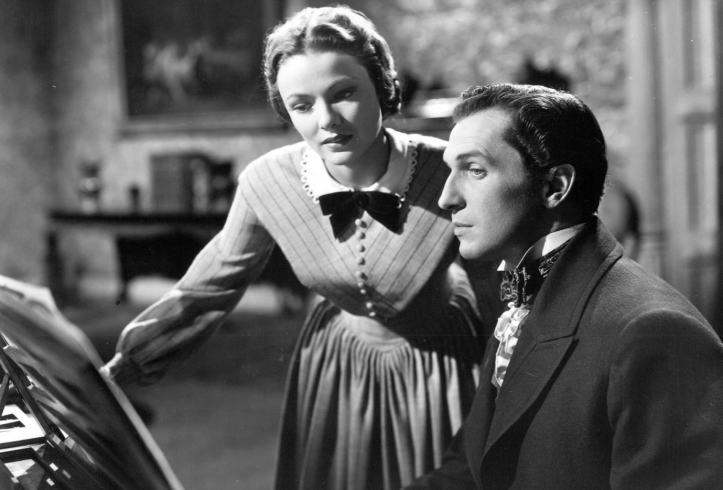
The film is interesting in how it does not present the Christian beliefs of Miranda’s family as a joke, or as a symbol of being backwards and uneducated. Miranda’s childhood beliefs are, however, not something she always follows or lives up to, and the viewer is often left considering if maybe her ‘backwards’ parents are right all along.
The result is that the film is actually quite sophisticated. ‘Period drama’ can mean a lot of things, and this film seems more of a study of selfishness in its many forms and the consequences it brings rather than just a pretty setting, big gowns, and hot actors.
- Gene Tierney as Miranda Wells
- Vincent Price as Nicholas van Ryn
- Walter Huston as Ephraim Wells
- Glenn Langan as Dr. Jeff Turner
- Anne Revere as Abigail Wells
- Spring Byington as Magda
- Connie Marshall as Katrine Van Ryn
- Harry Morgan as Bleecker (credited as Henry Morgan)
- Jessica Tandy as Peggy
- Vivienne Osborne as Johanna Van Ryn
- Trudy Marshall as Elizabeth Van Borden
- Larry Steers as Servant (uncredited)
- Grady Sutton as Hotel Clerk (uncredited)
Bosley Crowther of The New York Times said: “… Twentieth Century-Fox has fashioned a grand and gloomy mansion as the scene, and has inhabited it with a haughty master of aristocratic Dutch descent. … Vincent Price gives a picturesque performance as the regal and godless patroon, using his face and his carriage to demonstrate insolence, that’s all. Clean shaven and elegantly tailored, he still makes a formidable Bluebeard, and his moments of suave diabolism are about the best in the film. Gene Tierney is fairly ornamental in the role of the tortured child bride, but she plainly creates no more character than the meagre script provides. Of the several lesser characters, Walter Huston is most credible as the forthright, God-fearing father of the cardboard heroine.”
The novel of the same name: Dragonwyck, was written by American author Anya Seton which was first published in 1944. It is the fictional story of the life of Miranda Wells and her marriage to Nicholas Van Ryn, set against the historical background of the Patroon system, Anti-Rent Wars, the Astor Place Riots, and steamboat racing on the Hudson River.
Despite having adult themes of infant death, adultery, and other such things, the film would no doubt get a PG rating today, due to everyone keeping their clothes on and doing no more than kissing passionately on one or two occasions. It is, moreover, filmed in black and white.
You can watch it below:
Shieldmaiden is the editor of Corncrake magazine, which publishes classic and contemporary short stories in English literature. She is also a writer of fantasy, both in short and long form. In her spare time, she paints landscapes, sews clothing and quilts, and collects vintage-style brass instruments.
Discover more from Decadent Serpent
Subscribe to get the latest posts sent to your email.
