
Author: Eva McFarlane
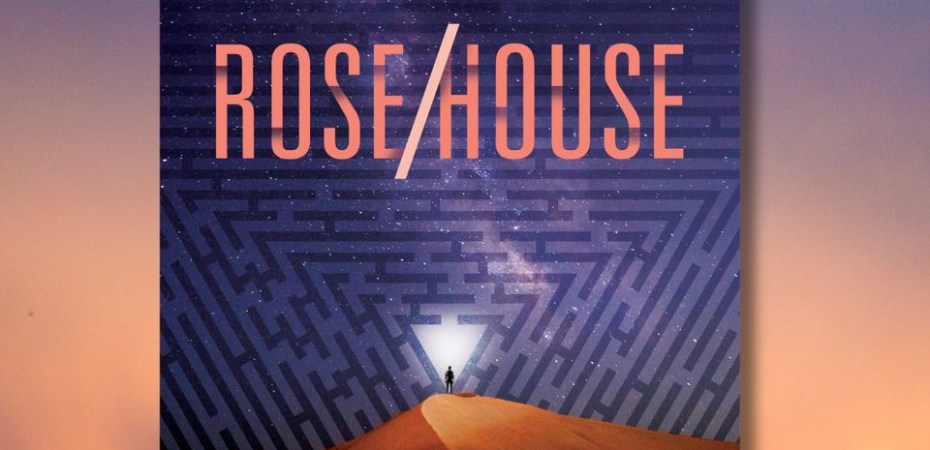
In Arkady Martine’s Rose/House novella published on the 13th of March, 2025, there is a house “Curled like the petals of a gypsum crystal,” which goes by Rose House. This early description of the AI building instantly drew me in with its sophisticated, flowery imagery that paints a clear, haunting description. Within this sci-fi, near future murder mystery tale, we explore the aftermath of a dead body being reported in Rose House, the house of Basit Deniau, an architect who had been dead a year prior to the events of the story. The house reports the body to China Lake Precinct where Detective Maritza Smith picks up the eerie call, though due to the instructions of the architect, Basit Deniau, the police are denied access to the house, and, more importantly, the body. But luckily, there is one person who has access to the house— the protégé of the architect, Dr Selene Gisil. Maritza needs Gisil’s help to get her into Rose house, but once inside, what will she uncover?
Undoubtedly, Arkady Martine’s writing has garnered great success, having been the Hugo Award-winning author of A Memory Called Empire and A Desolation of Peace. With such success already under her belt, I went into this novella with very high hopes. After reading that Rose/House is like ‘AI meets The Haunting of Hill House in Rose/House’, I was immediately intrigued, being a lover of The Haunting of Hill House myself, I was eager to read a more sci-fi/AI inspired piece. Now, after completing the novella, I can safely say that I was not disappointed. Although I am not a typical sci-fi lover, I found that Martine’s writing style, with its lyrical imagery was enough to draw me in. I must also say that I love the idea of the house being described as a ‘haunt’ as with it being the ghost itself, it creates an interesting image of technology and the future advancements we could create. It definitely is evocative; take for example the first time Detective Maritza Smith speaks to the house. With its creepy, disconcerting dialogue, it undoubtedly stands out to readers: ‘Oh good, said Rose House… in its own voice… The lilt and the rattle, sand sliding down a dune. Desert-cold, even through the synther neutrality.’ The way that Arkardy Martine describes the voice of this house is intriguing, we get a sense of the house’s sinister nature as it seems as if it is almost playing with Maritza the way a cat would with a mouse before the kill.
What struck me most was the writer’s voice and the way she tells the story in a rather quirky, casual manner; I felt that this juxtaposed nicely with some of the darker, eerie subject matter, allowing for it to not become too intense on the latter end. Martine’s distinct voice not only shines through in her storytelling, but in her characterisation also. With Maritza Smith, we see her successfully coming across as a no-nonsense detective, meanwhile, Torres is portrayed as your typically pictured one, with a gruff but well-meaning voice, these differing personalities balance the two characters well. On the other hand, we have Dr Gisil painted as an aloof, unwilling participant in the investigation, and Rose House itself, with its playful, taunting tone sucking readers in and leaving an unsettling shiver running up their spine.
As mentioned previously, Dr Selene Gisil is the only one with access to Rose House, making her not only a suspect in the investigation, but a necessary tool in propelling it onwards. The novella explores themes of identity and personhood, as shown through Maritza being posed as not a person, but the China Lake Precinct when trying to gain access to the house. This is not only a pivotal moment in the novella, but also my favourite section, as Selene puts forth this notion and Rose House allows it. This is not because the house believes what Gisil is saying, but because it finds the notion amusing, making the house not just an AI, but something that has surpassed human expectations in a surrealistic way. Rose House treats Gisil’s notion that Maritza is the entire China Lake Precinct as if it were a game, asking ‘“All of it?” as it became a ‘gleeful participant in whatever slippage-game Gisil was playing.’ This scene felt like a perfect way to foreshadow all the mind games that were to follow, with Maritza trying to keep up and maintain the façade that she was forced into performing. As well as this, the tone of the house created a creepy and uncomfortable feeling for me as a reader which I very much enjoyed.
In terms of the story structure, it is one that I found very compelling, as although it appears rather simple, when you take the time to look into the different character voices, you can see the masterful way the author has structured the chapters. The point of view of these different characters ranges from present to past tense, with Maritza and Torres having their stories represented in third person past tense, while Rose House and Selene have their chapters written in third person present tense. I found these changes to be rather telling to how much the characters knew, with Selene and the house already having knowledge about the dead body, while Maritza and Torres, the outsiders, tell the story under an investigative lens. As every character has a distinctive voice, this also makes it easier to pinpoint whose storyline we are following.
The novella throughout has this nightmarish, unreal quality to it, an almost gothic undertone which is something I typically look for in my reading. That being said, although I liked the imagery and overall idea of the novella, I must admit that at times, the story felt a little muddled, as if it could have done with another edit. As well as this, some of the ideas and plot lines could have been expanded on further, take for example the journalist plot line, or the reasons for Selene’s negativity towards her mentor, Deniau. Additionally, the ending left much to be desired, giving a rushed, anticlimactic feel that left me as a reader a little disappointed. With that being said however, there is still much about this story that I enjoyed, the ideas were intriguing, though with some development they could have furthered the piece.
Overall, when it comes to Arkady Martine’s Rose/House, it is an excellent read if you enjoy works with striking prose that have a dream-like quality. With the themes of toxic teacher/student relationships and identity, it touches on some serious topics that I’m sure many can relate to. I mentioned already that Martine is a Hugo award-winning author, and given her writing, it is clear to see why this is the case. Overall, if you enjoy the sci-fi genre, works that theorise on big issues, and stories that do not outright bare all, then I cannot recommend this novella enough.
Discover more from Decadent Serpent
Subscribe to get the latest posts sent to your email.
