

Author: Dinah Kolka. Dinah is the founder of Decadent Serpent and a graduate of Edinburgh Napier University with a BA(Hons) in English Literature. Her work has been featured in publications such as The Salisbury Review and The Mallard. She was also published in the Scottish Book Trust’s 2018 anthology Rebel. In 2023, Dinah self-published her own collection of short stories, The Search and Other Stories.
“Flair is what makes the difference between artistry and mere competence. Cmdr. William Riker” ― Star Trek The Next Generation
The one genre I never had any interest in was always sci-fi. I never cared for space, extraterrestrial beings, or wondered what’s ‘out there’. To me, it was always earth and our earthly endeavours that brought the most joy and interest in me. I always argued that Mars is just a rock and there is nothing interesting out there. Why even try?
This changed rapidly when I finally put myself through watching Star Trek. Having started from TNG, I was instantly allured by episodic narrative, and different stories with clear parallels to real-life issues. I enjoyed watching the Enterprise crew discovering various planets and different civilisations, which made me question many ‘earthly’ rules and conventions. At this point, I realised that I was quite unfair towards the sci-fi genre and very quickly changed my mind. As such, I held Star Trek in very high estimation, having rapidly blasted through TOS, TNG, DS9, Voyager, and Enterprise. I gave Discovery a chance, but its shift away from episodic storytelling and Star Trek’s core values made it feel unrecognizable. It became alien, something wholly different to what it was at conception. The nuance of opinions and variety of views that was championed in earlier Trek has suddenly been replaced by one-sidedness and it felt like at some point something simply died.
And so when I faced watching Star Trek: Section 31, my expectations were extremely low and I will save you from reading further if you choose not to – these expectations were met. My two key criticisms are that the film is purely an action film with little genuine value. Additionally, the retcons disfigure the lore so severely that it is hard to consider this Star Trek. Rather, it is an action film wearing Star Trek as a skin suit. I do have to preface everything I’m about to say with an open claim that I do not like Marvel or DC films, as they are slop for the soul. Where films can have a positive or neutral impact on your life, I will highly subjectively state that I believe that Marvel has damaged society and the film industry beyond repair. The ‘quirk-chungusness’ of the characters with low-quality humour and the subpar plot has influenced other films to the point where everything must contain a level of grotesque unseriousness.
The story starts with a flashback of Philippa Georgiou’s (Michelle Yeoh) youth and her villain creation arc. We watch her initial rise to power in the Terran Empire. The plot then returns to the setting in the post-Discovery universe, where Section 31 seeks to hire her for an important job. The group of ‘silly’ outcasts that make up Section 31 group together and convince her to take up a job which she is naturally initially reluctant to accept. Filled with a significant amount of character building in that short space of time, very akin to Marvel-like films, we encounter a man who looks like an Andrew Tate’s stunt double (Omari Hardwick) and I assume was placed there for women’s benefit as we see him wearing tight clothing and he is framed as a broken hero, which is baffling as the regular white male (Robert Kazinksy) who is actually legitimately attractive is naturally presented as incompetent and gets killed off in the first third of the film which makes the whole affair highly predictable.
The quality of the plot is expectantly low – the writing is poor, with no notable quotes aside from Philippa Georgiou saying ‘chaos goblin’ unironically at some point. The visuals are great and that is likely the one big positive about the film – I was quite upset that my cats broke my 4K TV as it would have come in handy for this – the shots of the ships and space in general were excellent. However, the action scenes were overly long and quite frustrating to look at. I struggled to keep my eyes on the screen as Philippa was kicking yet another man’s ass. There are still certain elements of the film that are somewhat reminiscent of the Old Trek – for example, there is a scene when they get stuck on a planet and need to find a way out of it with only a broken ship on the surface. They needed to come together to find an outcome, which brought back the classic teamwork and utilised various perspectives and expertise which we come to know and love so much from the classic Star Trek. However, I felt like this was still subverted with them realising there was a mole amongst them and the key part of the ship being removed by the Andrew-Tate-looking-character so there was never anything to truly investigate – once they found the mole, they were able to just start the ship with no issues.
But despite this, one of my biggest gripes with the new Star Trek is the general shift from community-based resolutions to hyper-individualistic and highly feminised ‘sassy’ solutions. Where in the older Trek, everyone would come together to find a solution, valuing each other’s expertise, the shift has been centralised to one person, usually a woman, becoming the centre of it all. For example, in Discovery it was Michael, who took on the role of the space Messiah. This is, of course, a common trope, with Captain Sisco in DS9 becoming a space Jesus. But despite this central role, he was still humble and kept the spirit of teamwork alive. But with each new Star Trek, these values get eradicated, with the central figure standing above everyone else, putting down men and others below her. This strange hierarchy destroys the innate values of equality that Star Trek prides itself on, and rather, became swallowed by the overarching media narrative.
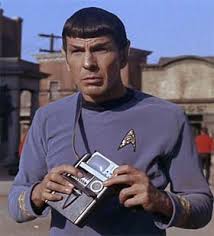
Additionally, the retcons unfortunately mean that this is no longer canon, and it cannot be. In Star Trek chronology, Discovery is one of the earliest Star Treks, being preceded only by Star Trek: Enterprise with Captain Archer leading the first mission of exploration with the Enterprise still being an experimental ship with the classification of NX-01 rather than the usual NC. As such, we must keep in mind that the next Trek that would follow Discovery would have been The Original. Naturally, the challenge is with understanding the technological shortcomings of The Original whilst utilising the technology for the visuals, rather than the innovative ships and weapons. Both Discovery and ST: Section 31 fail that challenge. One of the good examples was the tricorder they used. In Enterprise, they used what they referred to as a ‘hand scanner’, and in The Original, we had the typical standard issue tricorders (see picture). However, in Section 31, they whip out a tricorder that looks basically like a smartphone. This jump in technology is unfeasible and raises questions on why Starfleet would decide to downgrade the quality of their tricorders. One could argue, I suppose, that Section 31 could have had better quality equipment as they were authorised to do underground things, however, it is still not feasible considering Star Trek chronology.


Overall, Section 31 was not the worst film I’ve ever seen. But it isn’t and it will never be Star Trek. It was a beautiful film, but beauty is not enough. Sometimes I wish this technology could be utilised to continue on from where Voyager has left it, but I don’t know if I trust the current producers of Star Trek to be tasked with this. What made Star Trek special was eradicated and we must admit this. There is no hope for it, unless a ‘space Eggers’ awakens and becomes our in-real-life space Messiah.
Discover more from Decadent Serpent
Subscribe to get the latest posts sent to your email.
