

Author: Casey Morris. Born and raised in Texas, Casey Morris studied literature, philosophy, and ancient Greek at St. John’s College in Annapolis, Maryland. He loves reading and writing about literature, especially poetry old and new. He is also a fan of historical fiction, documentaries, and shoegaze.
The poetry of Dylan Thomas is often lauded for its originality. When asked about his work, many readers are familiar with the lyrical beauty of “Fern Hill” or the stoic poise of the villanelle for his dying father, “Do not go gentle into that good night.” During his short life and career, and undoubtedly after, Thomas’ poetry was remarkable for its force and vitality. His command of language, inventiveness, and blending of Anglo and Welsh literary traditions mark a unique contribution to the English canon. Writing during an age dominated by modernism, by W.H. Auden’s and Stephen Spender’s poetry of politics and social issues, Thomas turned inwards. Sensual experience, memory and time, loss of innocence, or the balancing of life and death all feature heavily in his work. Though Thomas did display an increased social consciousness in his wartime poems, the majority of his work is introspective, tuned to the body and its place in the universe. From a stylistic perspective, Thomas eschewed Auden’s plainspoken line. His style is florid and unpredictable. Free verse, variations of rhyme, strong yet melodious rhythms, wordplay, and rich imagery are all hallmarks of Thomas’ style. Taken together, these position him as a maverick poet during the twilight of modernism in pre-war, 1930s Europe. This status likely added to his later fame in and outside of literary circles, particularly during the rise of counterculture in the 1960s. Cherished by the likes of the Beatles and Bob Dylan, Thomas’ stature as a rebellious bard at odds with mainstream proprieties and literary culture is only partly true.
Dylan Thomas was born to a middle-class family in the Uplands area of Swansea, Wales in 1914. His father, David John (“Jack”) Thomas, was a teacher of English literature at a local grammar school. Despite his profession, Jack Thomas preferred to name Dylan after a character in a medieval Welsh text, the Mabinogion. In this context, the name “Dylan” symbolizes the sea, a recurrent image in much of Thomas’s poetry. His earliest memories of poetry were from his father’s recitations of Shakespeare and his exploration of the family library. Though Jack Thomas was an atheist, the poet’s mother, Lorrie, was deeply religious and regularly took the young Thomas to a Christian congregational church in Newton. Both of his parents were bilingual, speaking Welsh and English. Growing up in Swansea, Thomas was encouraged to write and speak English. But when visiting family in nearby Carmarthenshire, he spoke Welsh and learned of Welsh culture and traditions. From his earliest poems to his first published collections and later poetry, fiction, and plays, the sense of a double, paradoxical identity manifests in interesting ways. Thomas’ blend of Welsh-English identity and culture, of Christian and irreligious upbringing influences the later hybridism and in-betweenness of his collected poems. As we discuss these, an aesthetic emerges that does not fit into the modernist literary milieu of Thomas’ time. It does not wholly fit into the Romantic era preceding it, either. Instead, Thomas includes and exceeds both in a lyrical, vivacious style that challenges the reader to navigate paradox and doublespeak. The result is not so much cosmopolitan poetry as it is an artist confronting and even celebrating life’s competing forces: belief and cynicism, love and loss, or life and death.
The first piece we examine from Thomas’ “Collected Poems” is “And death shall have no dominion.” Originally published in the “New English Weekly” in 1933, the poem takes its title from the sixth chapter of Paul the Apostle’s epistle to the Romans in the New Testament. Thomas initially wrote the poem after agreeing with a friend, the Labour activist Bert Trick, to write about “Immortality.” It is an early example of Thomas’ style, with the famous refrain opening and closing each stanza. Regarded as one of his more difficult poems, it is a dense piece that alludes to both Christian and personal beliefs. Following an irregular meter, the poem rhymes abbbcddca. Here is “And death shall have no dominion” in its entirety:
And death shall have no dominion.
Dead men naked shall be one
With the man in the wind and the west moon;
When their bones are picked clean and the clean bones gone,
They shall have stars at elbow and foot;
Though they go mad they shall be sane,
Though they sink through the sea they shall rise again;
Though lovers be lost love shall not;
And death shall have no dominion.
And death shall have no dominion.
Under the windings of the sea
They lying long shall not die windily;
Twisting on racks when sinews give way,
Strapped to a wheel, yet they shall not break;
Faith in their hands shall snap in two,
And the unicorn evils run them through;
Split all ends up they shan’t crack;
And death shall have no dominion.
And death shall have no dominion.
No more may gulls cry at their ears
Or waves break loud on the seashores;
Where blew a flower may a flower no more
Lift its head to the blows of the rain;
Though they be mad and dead as nails,
Heads of the characters hammer through daisies;
Break in the sun till the sun breaks down,
And death shall have no dominion.
In the first stanza, the image is of dead men becoming one with “… the man in the wind and the west moon.” This tricky phrase is actually a conflation of two things: the “man in the moon” is a reference to a popular English nursery rhyme, in which the moon resembles a man’s face. The words “west” and “wind” are an allusion to one of Percy Bysshe Shelley’s poems “Ode to the West Wind.” In this poem, the wind is described by Shelley as a regenerative force that drives the natural process of the seasons. Thomas mixes these two references together in a kind of doublespeak that implies both God and earthly immortality, transcendence through cycles of death and rebirth. By writing “the man in the wind,” he also redefines the Christian notion of God in heaven to one more pantheistic. God or transcendence immanent in nature itself is a possibility that receives more treatment later in the poem. As Thomas continues, the souls depart the body: the dead men are nothing more than bones “… picked clean and the clean bones gone.” This line may be an allusion to an image common in classical poetry, especially in Homer, of carrion birds picking at the corpses of fallen warriors. After the decay of death, the souls ascend to heaven with “… stars at elbow and foot.”
The three lines that follow are significant, as they deflect from the Christian assumption of souls depicted so far. In each line, a kind of disorder is quickly resolved: madness turns to sanity, resurrection out of the sea, and perseverance of love all show the poet’s vision of death leading to immortality. The anaphora here (i.e. three uses of “though”) seems to resemble prayers and pleas to God from the book of Psalms. Although prayer-like in form, this is not a Christian vision of the afterlife. It is instead one unique to Thomas. In a 1933 letter to his friend and brief lover,
Pamela Hansford Johnson, Thomas expounded his understanding of death based on “Devotions upon Emergent Occasions,” a book by English metaphysical poet John Donne. In his letter, Thomas describes Donne’s vision of the body as one with the Earth. In death, the body, skin, hair, and organs find their place again with grass and mud. Even thoughts and ideas can be translated into terms of the body, its blood and sinews. This echoes the oft-quoted Old Testament verse from the book of Genesis, chapter 3 verse 9: “for dust thou art, and unto dust shalt thou return.” Within Donne’s framework, we can make sense of the final three lines. Sinking to rising from the sea or perished lovers to the persistence of love are movements not from earth to heaven. They are earth-bound. Contrary to descriptions of heaven earlier on, immortality now belongs to the everyday world. It is a thing as much as air, water, or mud. How is this possible? Thomas refines this idea in the next stanza.
This refinement turns out to be surprising, even unpleasant. A movement of Christian imagery is followed by another unexpected twist. After the refrain, we again read of the dead “lying long” in the sea. The adverb “windily” may refer to death, as ocean currents exert a “windily” or prolonged, sinuous effect on anything around. Though when Thomas writes they “… shall not die windily,” he implies they died honourably with their souls’ immortality intact. The next five lines present a challenge. The foregoing assertion of the soul’s unity with God or even Earth is upended in a series of terrifying images of torture and bodily dismemberment. We read of the dying “twisted on racks,” as their “sinews give way” and break. Even worse, the dying are “strapped to a wheel” in an apparent reference to a method of torture used in medieval Europe. Such agony is also mentally overwhelming, as faith “… shall snap in two,/ And the unicorn evils run them through.” This last line is another biblical allusion. In the Old Testament book of Numbers chapter 24 verse 8, God’s strength is compared to that of the mythical unicorn. The fate of the unbelieving and unsaved in the Christian tradition, even in the face of a miserable death, is God’s wrath and punishment. But Thomas then introduces a twist. Instead of heaven or hell welcoming the tortured souls, we encounter a powerful human image. Amid the horror of being “split all ends up,” the dead do not “crack.” “Crack” could mean death itself, but it more likely means the dead are not broken or dispirited; their faith abides in spite of a perilous fate. But is this religious faith or the doggedness of the human spirit? If the latter, how does immortality figure in a finite world?
Thomas’ answer comes in the final stanza, in which the mixed messaging is settled and immorality achieved. The poem concludes with images of lamenting, as the deceased no longer hear “… gulls cry at their ears/ Or waves break loud on the seashores.” Sensual experience is lost in death. To this, Thomas adds a second image of flowers. Widely used as a symbol of mourning, the flowers here have a double meaning: they mark the passing of the dead while implying they are not immortal, at least in the Christian sense of eternal life. As Thomas continues, we see his alternative perspective come to fruition. Even though “… they be mad and dead as nails,/ Heads of the characters hammer through daisies;/ Break in the sun till the sun breaks down.” Instead of souls ascending to commune with God, the dead decompose and reappear as sprouting daisies. This alludes to a 1917 poem titled “A Terre” by Wilfred Owen, whom Thomas loved. In his poem, Owen describes the dead as “pushing up daisies.” For Thomas, such rebirth and repurposing of the body as nourishment for new life carries on until the end of time, or until “… the sun breaks down.” Immortality, then, is a kind of natural regeneration or a return to Earth in a new form. This conception of life and death as interconnected and part of a natural continuum evokes Buddhist philosophy and teachings. It represents a stark departure from the Christian imagery of past stanzas and from Thomas’ religious background. Considering the influences of Shelley and Donne, who conceived of immortality in similar terms, this conclusion is fitting. But as is expected with Thomas, the path there is discursive and fraught with secondary meanings. A meandering interpretative effort and untangling of images uncovers at last his vision of immortality.
A similar journey is required to appreciate one of Thomas’ most well-regarded lyrical poems. Originally published in his 1946 collection “Deaths and Entrances,” “Fern Hill” pays homage to the poet’s boyhood memories of the rural Welsh countryside of Carmarthenshire. Fernhill was a farm kept by Thomas’ Aunt Ann in the village of Llangain. The village was where his mother’s family were from, and he often spent summers there while off from school. “Fern Hill” does not follow a traditional structure or rhyme scheme. It consists of six stanzas of nine lines each. Thomas includes some end-stopped rhymes, but the poem also has half rhymes and internal rhymes. Here is “Fern Hill” in its entirety:

Stunning in its beauty and rapturous music, Thomas recreates the joy and freedom of childhood. The first two stanzas establish the rhythm with varying internal and end-stopped rhymes. Several features catch the eye. First, the poem moves in a repeating pattern of tension and release: its lines are less indented on the page. The pattern consists of two opening lines of 14 syllables each followed by shorter lines of differing length. The longest lines receive no indentation. But the shorter the line, the further its place across the page. From stanza to stanza, this creates a push-and-pull visual effect. The effect illustrates an effort to give the poem a living, breathing quality. This quality is also strengthened by assonance and alliteration. Interestingly, assonance often accompanies internal rhyme in “Fern Hill,” increasing the tempo and collapsing the delay between rhymes. We sense the urgency of childhood energy in “… once below a time I lordly had the trees and leaves/ trail daisies and barley/ down the rivers of the windfall light.” The enjambed lines here accelerate the reading, a trend we see with alliteration, too. Thomas writes “… green and golden I was huntsman and herdsman, the calves/ sang to my horn, the foxes on the hills barked clear and cold.” Perhaps more than the assonance, the repetition of the aspirated consonants /h/ and the hard /c/ enliven the poem because they imitate the breathless running of the young Thomas. Another example of this is “house high hay,” which simulates his racing thoughts and wishes. Though not immediately obvious on first reading, these visuospatial and linguistic techniques capture the essence of childhood, its well of boundless energy and dreams.
Thomas’ diction and syntax work together to similar ends in “Fern Hill.” Some of the poem’s most important word choices relate to colour. “Green” and “golden” are used to elicit multiple meanings for the poem’s overarching themes: time and loss of innocence. “Green” is significant in relation to the poet’s age. A “green” youth is one without experience. It denotes innocence, particularly about rites of passage to maturity: responsibilities, sexual development, and greater knowledge of the world. However, “green” also refers to the setting. Lush images of apples, daisies, and grassy fields all give “green” a literal meaning. What’s more, Thomas’ recurring use of “green” in first-person nominative phrases (e.g. “as I was green”) moulds him into Fernhill, as much as the grass, fields, horses, or stars. The idea of “from dust unto dust,” of subject and object cohering into one whole resurfaces here not necessarily as a path to transcendence (i.e. as in “And death..”). Rather it is a statement on nature itself. It is Donne’s oneness of the body and the Earth in view not of death but childhood innocence and memories. Likewise, “golden” has its own nuance. But its connotations are more narrow: Thomas uses “golden” three times in the first two stanzas, specifically regarding time and its favour for him as a child. Thomas personifies time, which takes on a fatherly-like figure doting on the “golden” poet in the “heydays of his eyes” or “in the mercy of his means.” In this sense, “golden” expresses the limitless possibilities of youth. It captures the youngs’ immunity from time’s ravages of bodily decay and loss. More literally, “golden” is also the colour of the shining sun and barley and hay.
It permeates Thomas’ recollections of summer days at Fernhill, which in the poem amounts to two days and two nights.
Tracing these circadian rhythms in “Fern Hill” reveals its themes. Our analysis here will be twofold: we’ll discuss the first day and night before the second. As themes, time and loss of innocence evolve from beginning to end. In stanzas one to four, we read descriptions of pastoral beauty and bounty. Thomas recollects “… I was young and easy under the apple boughs/ about the lilting house and happy as the grass was green.” Carefree joy, a child’s joy, is juxtaposed with green grass and in later lines with the “happy yard” and farm at Fernhill. As detailed above, the affinity here of the poet and nature, and more deeply of his joy and nature’s bounty, is intentional. But “Fern Hill” is not just a remembrance of bygone memories. It is a rekindling of a lost essence: the child’s marvel at the “apple boughs,” “daisies and barley,” or “foxes on the hills” is driven by the laws of innocence. Only a child’s innocence trumps emotive truth over nature itself. In a child’s mind, the imagination reigns supreme and shapes reality according to its whims and conjurings. Hence, we read not of brooks and a fireplace, but the “pebbles of the holy streams” and “tunes from the chimneys.” The “trails of daisies and barley” flow “down rivers of the windfall light.” Further, a personified time crowns the young poet as “prince” and lord of Fernhill. And, at night, he dreams of owls “…bearing the farm away/ all the moon long.” Imaginative language and imagery are more impressionistic, more approximate to lived experience, than the factual. That’s exactly the point here. Innocence, in which emotion and experience are key, configures time in transcendent terms: loving, interceding, and full of possibility. In this vein, Thomas decidedly aligns himself with British romantics of the previous century, especially Keats, Shelley, Blake, and Wordsworth. But not surprisingly, this neo-romanticism only partly continues into the second day.
Effects of the passage of time, of the poet’s inevitable maturation, hail a thematic shift in “Fern Hill.” Upon waking, the poet sees “… the farm, like a wanderer white/ with the dew, come back, the cock on his shoulder: it was all/ shining, it was Adam and maiden.” Collected dew across Fernhill makes it seem pristine, Edenic in Thomas’ eyes. The image of the “spellbound horses” leaving the stable after the “birth of the simple light” may seem mysterious. Yet this represents a climax in the poem, from which there is no return. The “birth of the simple light” signals the emergence of reason and maturity. Opposed to this, the growing round of the sun implies the light of innocence, imagination and emotion, has burned its brightest and will slowly fade.
Time follows innocence, as it is compressed into “… the sun born over and over.” A disillusioned Thomas mourns that time only “… allows/ in all his tuneful turning so few and such morning songs.” From boundless possibility to now selective courtesy, time is no longer infinite. Time becomes a liability that, like the serpent in the Garden of Eden, deceives “before the children green and golden/ follow him out of grace.” The allusion to Adam and Eve leaving the Garden of Eden completes the thematic shift. Innocence is lost in the passage of time. As night approaches, Thomas’ romantic vision of Fernhill fades into the past, into the “… farm forever fled from the childless land.” The aged poet, “green” and “dying,” is forced to confront a universe that is indifferent to emotion and imagination. In doing so, Thomas invokes very modernist concepts of alienation and existential dread. Though “Fern Hill” ends in sorrow, it immortalizes in form and content the poet’s formative years in the Welsh countryside.
The final, and perhaps most famous, poem we examine is “Do not go gentle into that good night.” Written for his dying father and first published in the Italian journal “Botteghe Oscure” in 1951, the poem is a villanelle in iambic pentameter. As a French poetic form, a villanelle is written in tercets with five stanzas before a quatrain. The first and third lines repeat alternately, while in the quatrain they form a couplet. Rhyming aba abaa, here is “Do not go gentle into that good night” in its entirety:
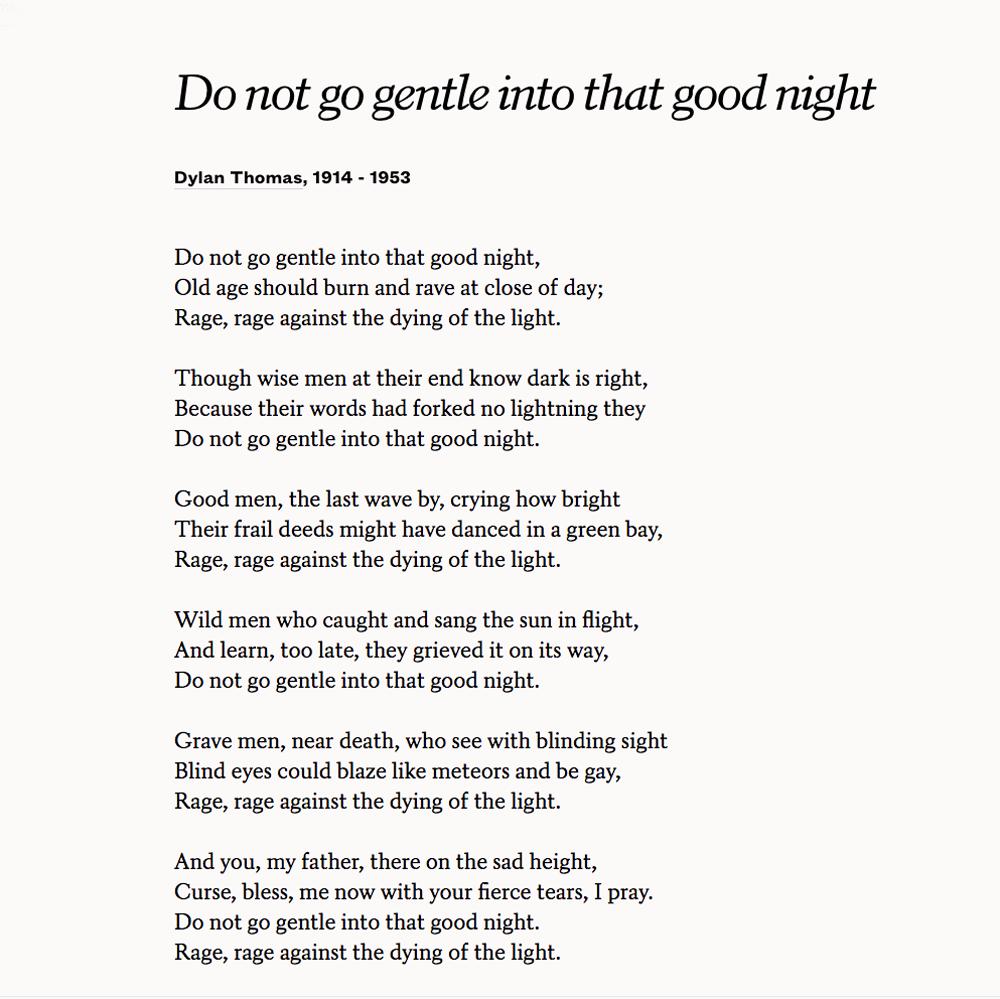
It’s easy to see why, if someone doesn’t know any other poems by Thomas or even who he is, they know this one. A masterpiece of raw emotion rendered in the strictures of form, Thomas comforts his father with love, stoicism, and poise. Though the poem addresses the wise, the good, the wild, and the grave, these serve as emotional signposts on his father’s road to death. The poem opens with a storm of anger. News of Jack’s diagnosis of throat cancer in mid-1933 affected both father and son. Jack continued to teach and share his love of literature, but Dylan embarked on arguably the most prolific period of his life. The mid to late 30s saw the publications of “18 Poems,” “25 Poems,” and “The Map of Love.” The intense feelings here certainly belong to both, though we sense Dylan’s devastation from the outset. Gradually, the burning and raving cools. Wisdom takes its place. As a teacher of English literature, Jack’s career was limited to the classroom while encouraging Dylan’s interest in writing. Accepting his “…words had forked no lightning” implies wisdom is tempered by the pain of foiled ambition.
Such intimate knowledge of his father’s literary dreams broadens in the next stanza. The cries of good men at “… how bright/ their frail deeds might have danced in a green bay” shows Jack’s awareness of the sea change death brings: life, its kaleidoscopic variety of experiences, desires, and relationships all die with the body and mind. As for anyone close to death, this knowledge provokes regret, even fear that his “frail deeds” were not enough. Painful as these lines are, what we discover here is another unity. The self, the universal “I” changes through space and time, but not thoroughly, not poignantly enough to conceive of death. Hence, we read the tears, and the rage for another day or hour. We hear the grasping for meaning and connection in an ineffable dark.
This sentiment continues through one more stanza. The wild men, who in their merriment, took for granted “… the sun in flight” are left to “… grieve it on its way.” Rich with nuance, these lines primarily stress the value of mindfulness. Life’s sacred gifts of love, friendship, beauty, and truth demand both thought and action. Without these, grief and regret await the heedless when it is “too late.” At this point, a shift in tone and imagery occurs. The cycle of fear and regret, of acceptance and rage stops. We are, as Thomas was, at his father’s deathbed. He writes “grave men, near death, who see with blinding sight/ blind eyes could blaze like meteors and be gay.” In his final months, Jack Thomas’ eyesight steadily deteriorated. Yet surrounded by family, his blindness meets the blindness of death with warmth, even gaiety. Thomas assures us of his father’s courage, even as the last moments prove too much to bear. The quatrain lays his father to rest: “And you, my father, there on the sad height,/ curse, bless, me now with your fierce tears, I pray./ Do not go gentle into that good night./ Rage, rage against the dying of the light.” As in “Fern Hill,” Thomas manipulates sonic textures here to immortalize the moment. His father’s passing, his final breath is as peaceful as the sibilance in “curse,” “bless,” and “fierce tears” suggests. This is not to imply a lack of grief or suffering. It is rather that, in form and content, his father’s death evokes these and more. “Light” and “night,” previously separated across tercets, are now joined together as end-stopped rhymes. The unity of “light” and “night” symbolizes the poet’s vision of the whole: life is drawn to death as darkness to light. The universe is not alien; the only indifference to overcome is our own.
In his wild, heretical poem, “The Marriage of Heaven and Hell” William Blake challenges and redefines Christian ideals of good and evil. Jesus is a virtuous rule-breaker. And the fallen angel, Satan, is almost heroic. If this sounds counterintuitive, even blasphemous, that’s the point. Blake’s argument of no progress without contrariety, of chasing risk and creativity, finds its living embodiment in the life and poetry of Dylan Thomas. I mention Blake not to identify Thomas as a neo-romanticist, which he partly is. Romantic, modernist, or anything else, his is a poetry of the whole. It’s an oeuvre of vitalism and force. The craftsmanship in “Fernhill” or “Do not go gentle…” invigorates us, emanating a timeless quality that moves readers of poetry or not. The force is his conviction, his appeals to reason, emotion, and spirit in spite of their discord. Cognitive dissonance belongs to Thomas’ verse as much as its music and lyrical beauty. This is what makes Thomas so resonant, and so necessary today. He brings poetry out of a dusty anthology or classroom into the mire of daily life. He is less concerned with an aesthetic tradition or the canon than he is with universal themes of life and death or love and loss. His poetry is meant to be read aloud as much as analyzed and critiqued. It will never be possible for us to ascertain whether he would have welcomed the fame and stature he has today. But we can understand why his poems are still widely quoted in books and films. We can understand why, if they know nothing else about him, people can recite his villanelle. Dylan Thomas achieves a style and voice distinctly his own. Yet it is a voice we turn to for its passion and beauty, its soothing of the restless wanderings of the heart.
Sources
BibleGateway. Genesis 3:19. 21st Century King James Version. 1994. URL:
BibleGateway. Genesis 3:22 – 24. 21st Century King James Version. 1994. URL:
BibleGateway. Numbers 24:8. . 21st Century King James Version. 1994. URL:
Boraston, MacLair, J. “The Birds of Homer.” The Journal of Hellenic Studies. Vol. 31. Pp. 216 – 250. 1911. URL: https://www.jstor.org/stable/624770
Brahambhatt, Rupendra. “7 brutal torture devices from the Dark Ages.” Interesting Engineering.
2024. URL: https://interestingengineering.com/lists/torture-devices-machines-dark-ages
“British Romanticism.” Poetry Foundation. 2025. URL:
Comerford, Patrick. “And death shall have no dominion.” 2014. URL:
“Dylan ail Don.” Roman Britain. URL:
https://www.roman-britain.co.uk/the-celts-and-celtic-life/celtic-religion/celtic-deities-and-heroes/d ylan-ail-don/
“Dylan’s Work.” Canolfan Dylan Thomas Centre. 2025. URL:
http://www.dylanthomas.com/dylan/dylans-work/
Earl, Peter. “What are some examples of anaphora?” 2016. URL: https://socratic.org/questions/what-are-some-examples-of-anaphora
Edwards, Jonathan. “‘Do Not Go Gentle into That Good Night:’ Dylan Thomas and the Art of Dying.” The Use Of English. pp. 71 – 78. URL:
“Fern Hill.” Britannica. URL: https://www.britannica.com/topic/Fern-Hill
“Fernhill.” Canolfan Dylan Thomas Centre. 2025. URL: http://www.dylanthomas.com/dylan-thomas-trails/west-wales/fernhill/#:~:text=’Fern%20Hill’%20 was%20the%20farm,two%20of%20Dylan’s%20greatest%20poems.
“Fern hill.” Shmoop University. 2025. URL:
Gardiner, Juliet. “Thirties Britain: The depressed decade?” The National Archives. URL:
“Glossary of Poetic Terms.” Poetry Foundation. 2025. URL: https://www.poetryfoundation.org/education/glossary/villanelle
Goodby, John, editor. “The Collected Poems of Dylan Thomas: The Centenary Edition.” Weidenfeld and Nicolson. 2014.
HSE Ireland. “Death-related religious rituals.” 2024. URL:
https://www.hse.ie/eng/services/publications/socialinclusion/interculturalguide/buddhism/care-dy ing.html#:~:text=Generally%2C%20Buddhist%20teaching%20views%20life,of%20life%2C%20d eath%20and%20rebirth.
Methven, Paul G. “‘And death shall have no dominion’ A new (June 2022) in-depth examination of one of Dylan Thomas’s most popular, captivating, but strangely bewildering poems.” Academia.edu. URL:
2_in_depth_examination_of_one_of_Dylan_Thomass_most_popular_captivating_but_strangely _bewildering_poems?auto=download
Popova, Maria. “The Story Behind Dylan Thomas’s ‘Do Not Go Gentle Into That Good Night’ and the Poet’s Own Stirring Reading Of His Masterpiece.” The Marginalian. URL:
Summers, Nora. “Dylan Thomas.” 2024. URL:
“The Marriage of Heaven and Hell Summary.” Shmoop University. 2025. URL:
Williams, Chris. “Poem of the month: ‘And death shall have no dominion.’” Canoflan Dylan
Thomas Centre. 2018. URL: http://www.dylanthomas.com/blog/poem-month-death-no-dominion/
Discover more from Decadent Serpent
Subscribe to get the latest posts sent to your email.
