
Author: Jack Salvadori. Jack is an Italian-born, London-based film critic, columnist, and filmmaker. With award-winning short films showcased at over 60 international festivals, he’s now developing both, a feature film and a theatre play. A familiar face at Cannes, Venice, and London Film Festivals, Jack spends most of his time at the BFI, watching everything from old classics to niche gems. He lives in London with his cactus.
When Brady Corbet’s The Brutalist premiered at the Venice Film Festival last September, it was immediately clear that cinema had regained something long thought lost: a commitment to visual grandeur and narrative ambition that recalls the golden age of filmmaking. Now, as the film enters wide distribution and collects major awards, its impact feels even more monumental.
From the moment the 70mm flickering Vistavision logo lit up the screen, The Brutalist announced itself as a cinematic achievement that feels both daring and heartfelt. At a time when many films blur together in mediocrity, Corbet’s magnum opus stands apart, reminding us of the textured magic that celluloid and meticulous craft can bring to the silver screen. The film’s 215-minute runtime may seem daunting in an era of diminishing attention spans, but it serves its purpose, inviting the viewers into an experience as richly layered as the architectural marvels it celebrates. This is a film to be savoured in its entirety, not half-watched on a laptop or glanced at during a scroll—it doesn’t just request attention; it commands it. And its bold duration is a statement in itself, demanding your commitment to the theatre.
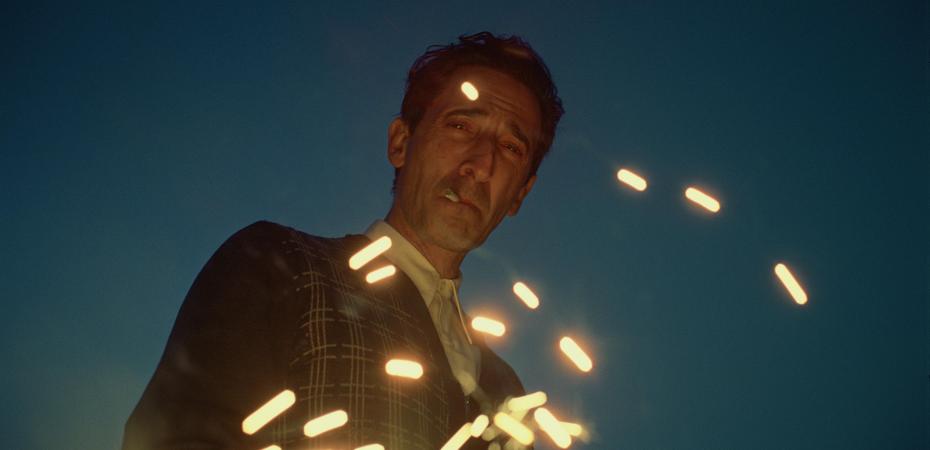
Adrien Brody delivers one of his career-best performances as László Toth, a Hungarian architect who emigrates to the United States after surviving the Shoah (Holocaust). His dreams of reshaping the world through his visionary designs collide with a society reluctant to embrace his brilliance. And brutal is not only Lazslo’ style, but also the cards that life as an immigrant deals him. The Land of Dreams, it turns out, is a mirage—a harsh contrast to the concrete, imposing shapes that the architect tries to trace on his path. Felicity Jones’s heartfelt portrayal of László’s wife adds depth to the story, offering a poignant reminder of the emotional toll tied to ambition and displacement.
The film’s narrative is framed by its exploration of modern architecture as both a physical and symbolic construct. László’s designs, rooted in the brutalist aesthetic, reflect not only his artistic vision but also his struggle to impose order and meaning on a chaotic, indifferent world. Guy Pearce shines as Harrison Van Buten, the enigmatic millionaire whose patronage becomes both a blessing and a curse for László. Van Buten commissions László to design a towering cathedral outside Philadelphia, a project as grandiose and unattainable as the American Dream itself. Their relationship becomes a microcosm of the compromises and conflicts inherent in creative pursuits under capitalism, as the film keeps digging into the post-war collective psychology and the evolution of modern architecture.
Corbet’s direction is unapologetically ambitious and fearless, crafting a narrative that spans continents and decades. The film’s meticulous production design and cinematography evoke the grandeur of classic auteurs while maintaining a distinctly modern sensibility. The inclusion of an overture and a mid-film intermission underscores its epic scope, reminiscent of cinematic experiences like Lawrence of Arabia and 2001: A Space Odyssey. During its Venice premiere, the audience’s excitement was so palpable that the last few seconds of the fifteen-minute long intermission culminated in a jubilant countdown, as if it was New Year’s Eve— a collective acknowledgment of witnessing something extraordinary.
At its core, The Brutalist is a profound meditation on art, ambition, obsession, and identity. László Toth is more than a character; he embodies the relentless drive to create and the sacrifices that often accompany such a calling, leaving viewers to grapple with the cost of greatness. With its sweeping narrative, stunning visuals, and emotional resonance, The Brutalist stands as a landmark achievement in modern filmmaking. As it continues to win accolades and captivate audiences, it solidifies its place as a leading contender at this year’s Academy Awards, and an enduring piece of contemporary cinema.
Discover more from Decadent Serpent
Subscribe to get the latest posts sent to your email.
