

Author: Giulia Prodiguerra. I grew up in the Italian countryside surrounded by art thanks to my family, who exposed me to books, comics and cinema from a very early age. There wasn’t that much to do on rainy days and I filled my hours picking from the bookshelves or playing videogames, which have become a stable part of my hobbies and shaped my interests growing up. I have been working as staff member at Lucca Comics & Games since 2006. After obtaining a Master’s Degree in English Translation, I moved to Scotland in 2016 where I kept pursuing writing (mainly self-published).
For many, the winter festive holidays end on the 2nd of January, with most people returning to work or school during that week. A melancholic moment, where the new year has just begun wrapped in cold and darkness and the festive lights need to be taken down until the next celebration.

But in Italy we have another tradition that, along with the Three Wise Men, takes us into the first week of the new year: the Befana. A figure every child is fond of, often perceived as a whimsical grandmother, almost like the relative that shows up only once a year but covers you with gifts. I remember as a kid still feeling the magic of the Christmas holidays until the Epiphany (the night between the 5th and 6th of January), hoping for some extra gifts in my stocking to reward my efforts at good behaviour.
Similarly to Santa Claus or Saint Lucy in the Northern regions of Italy, the Befana delivers gifts on the Epiphany Eve. But she doesn’t certainly have the same whimsical and friendly appearance of Santa or the majestic one of the Three Magi: she is usually depicted as a witchy-like old woman, wearing rags and riding a broom. We’re going to have a deep dive in this mysterious, ancient figure that has populated the whole of Italy’s folklore traditions for centuries.
The origin
The exact origin of the Befana is still shrouded in mystery, but seems to find its roots in old propitiatory pagan rituals spanning from the 10th to the 6th century BC: these were connected to the changing of seasons, and were meant to ingratiate the natural forces in the hope of a bountiful harvest. The twelfth night after the winter solstice celebrated the death and rebirth of Mother Nature. The Romans believed that during these twelve nights, supernatural female figures flew over the farmed fields to bless the upcoming harvest. These figures have first been connected to Diana, goddess of the moon, hunting but also vegetation.
Another theory connects the Befana with an ancient Roman winter celebration for Janus (god of beginnings, ending, passages, and transitions) and Strenua (goddess of new year, purification, and wellbeing), during which people exchanged gifts. As we can see from this connection with Janus and Strenua, the Befana seems to be one of the many embodiments of winter, metaphorically representing the unstoppable cycle of death and rebirth: the Epiphany symbolises the end of the year, the peak of winter, the moment of hibernation where we can do away with our old, withered energies and start fresh.
We have often seen winter depicted as a woman in many traditions across Europe and history: Bertha in Great Britain; Berchta in Austria, Switzerland, France and Northern Italy; Holda or Frau Holle in Germany; Frigg in Scandinavia.
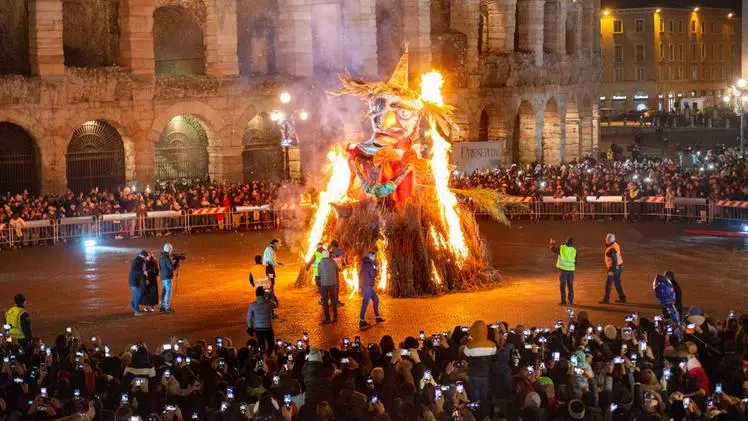
All these depictions hold versions where they are represented as old, white haired, haggard women, dressed in rags and with tattered shoes, which yet confirms the connection between these figures and the symbolism of rebirth. There is also a saying “Arriva l’Epifania / tutte le feste le porta via” (Which can be translated to “Here comes the Epiphany / it’s the end of all festivities”) Bonfires of rag puppets and props are particularly common too during the Epiphany. Other places such as Rome and Urbania will have street markets, parades and street performers, with the celebrations involving the whole community.
The religious version of the Befana’s origin tells us that the Three Wise Men, on their way to Bethlehem to meet the baby Jesus, met her on the road and asked her for directions. They invited her to join them on their travels to greet the infant Jesus, but being a dedicated housekeeper, she didn’t want to leave her cleaning duties unfinished, and declined the invitation. This would explain another of the most distinctive attributes of the Befana: the broom. After that, she had a change of heart, and set out on a journey to catch up with them, gathering some sweets and gifts for the baby Jesus.
However, due to the massacre of children ordered by King Herod in an attempt to kill Jesus, the Wise Men returned by another way, and never met her. So now the Befana is doomed to wander the world in search of them and the Baby Jesus, leaving small gifts and treats to well behaved children and lumps of coal or pieces of straw from her broom to naughty ones.
The appearance of the Befana holds some crucial elements which we’ll find in all depictions: a large, wrinkly nose; mended and tattered clothes; a shawl or a more typical pointed hat, and of course the broom. On top of her witchy appearance, the Befana is said to be covered in soot (since much like Santa, she uses the chimney to enter)
She’s a unique manifestation of death and rebirth in the shape of what many fear the most: old age and ugliness, which however don’t stop her from having a wonderful time, whether she’s flying around leaving treats or scaring naughty children. It’s the benevolent spirit of unavoidable change. Steve Siporin, author of The Befana is Returning, defines her as “grandmotherly but witchlike, the target of endless mockery but deeply beloved, ridiculous and dignified, domestic yet a wanderer, weak and dependent yet feared and powerful. She is an old woman played by a young man.”
Poems
There are different poems about Befana, which are known in slightly different versions throughout Italy.
Here is one of the versions:
La Befana vien di notte
Con le scarpe tutte rotte
Col vestito alla romana
Viva, Viva La Befana!
The English translation is:
The Befana comes by night
With her shoes all tattered and torn
She comes dressed in the Roman way
Long live the Befana!
Another version is given in a poem by Giovanni Pascoli:
Viene, viene la Befana
Vien dai monti a notte fonda
Come è stanca! la circonda
Neve e gelo e tramontana!
Viene, viene la Befana
The English translation is:
Here comes, here comes the Befana
She comes from the mountains in the deep of the night
Look how tired she is! All wrapped up
In snow and frost and the north wind!
Here comes, here comes the Befana!
Discover more from Decadent Serpent
Subscribe to get the latest posts sent to your email.
