
Author: Casey Morris. Born and raised in Texas, Casey Morris studied literature, philosophy, and ancient Greek at St. John’s College in Annapolis, Maryland. He loves reading and writing about literature, especially poetry old and new. He is also a fan of historical fiction, documentaries, and shoegaze.
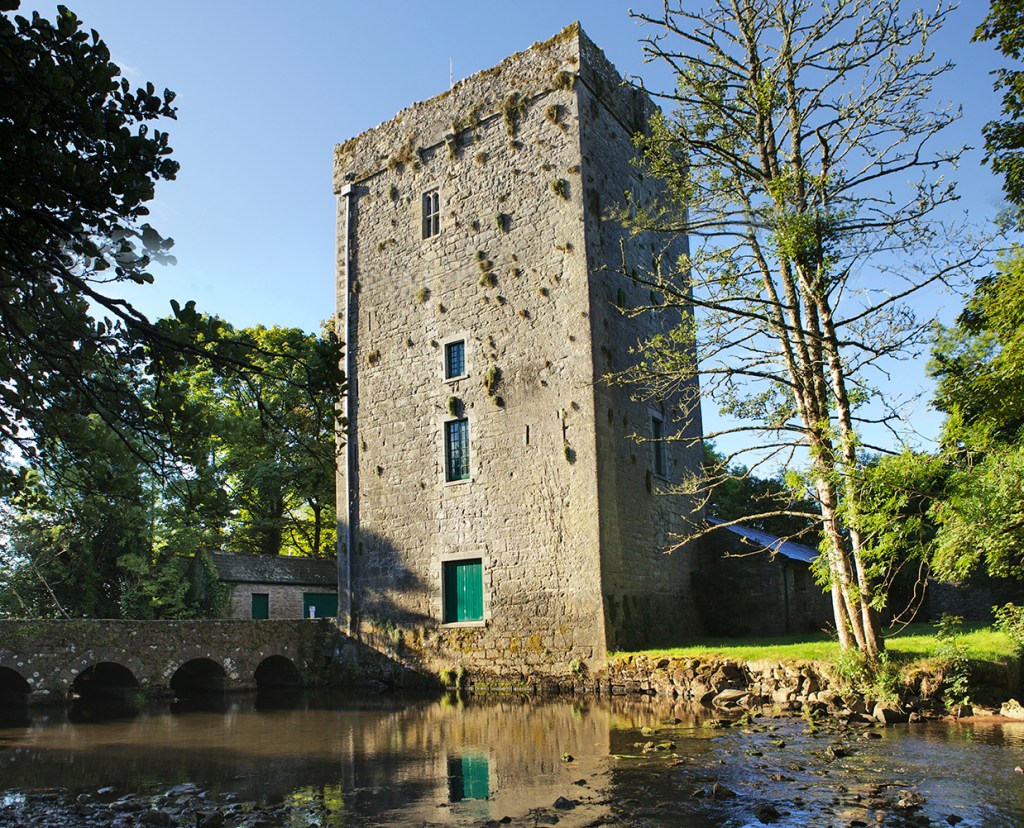
In 1928, the career of William Butler Yeats had reached a pinnacle. The internationally acclaimed poet had achieved nearly everything possible: he’d won the Nobel Prize five years earlier, become a senator of the Irish Free State, and even purchased a Norman castle in County Galway, Ireland. He later renamed the castle Thoor Ballylee and alongside the Irish dramatist Lady Gregory, co-founded the Abbey Theatre where many of his plays were performed. And despite an over 25-year age difference, Yeats finally married Georgiana Hyde-Lees about a decade earlier in 1917. Now at the cusp of old age, he could enjoy success as a poet and playwright.
But that’s not at all how “The Tower,” Yeats’ first collection since becoming a Nobel laureate, reads or resonates with the general reader. Instead of solace or wisdom, we read of the poet’s strengthening powers of vision and imagination. These culminate in a “rage against old age,” in which Yeats feels disconnected from the modern world. Vicissitudes of growth and decay, love and loss, or life and death are not to be resolved. Disturbances in the poet’s private or public life and broader unrest in Ireland move Yeats further from resolution. In “The Tower,” he attempts rather to transcend them. Such transcendence will have different connotations in each piece we examine, and the overarching vision Yeats proposes evolves from poem to poem. Alongside him, we discover how transcendence and the poet’s vision do not offer solutions for either the large-scale or very personal struggles he describes. “The Tower” will instead offer a different path forward: one that supersedes the real for the imaginary, the “dying generations” for the transcendence and vision of the poet’s craft. The result is a work that reorients the present moment out of its limited context and into the continuity of history.
How can poetry accomplish such lofty goals? It is best to understand the collection’s context first. “The Tower,” which includes some of the twentieth century’s most famous poems, immerses us in Ireland during the eclipse of Edwardian society by post-war modernity. The end of the Great War pushed political tensions in Ireland to a boiling point, in which the drive for self-governance was almost universally desired. Historical events such as the Irish War of Independence and the Civil War that followed consequently overshadow much of the collection’s imagery and tone. Yeats’ declining health, age, and growing isolation in a violent, revolutionary Ireland further contribute to the sense of unease in “The Tower.” The collection also draws heavily from the poet’s private life and experiences of love, loss, fatherhood, and the inevitability of death. ”Sailing to Byzantium,” “A Prayer For My Son,” and “Leda and the Swan” detail these experiences while exemplifying the collection’s themes and historical moments.
The first poem we examine is “Sailing to Byzantium.” Written in 1926 while Yeats was summering in Muckross House, County Kerry, the poem follows a rhyme scheme known as ottava rima. Originating in Italy, the scheme consists of eight lines of pentameter rhyming abababcc. The poem expresses Yeats’ dissatisfaction with a modern world he feels estranged from, particularly an Ireland he views as disinterested in or even hostile to the arts. The poem is also a reflection of his feelings on old age, a state he associated with less vitality and creativity. In this way, “Sailing to Byzantium” is an effort to regain his creative powers amidst what he viewed as undermining forces from within and without. Here is the poem in its entirety:
I
That is no country for old men. The young
In one another’s arms, birds in the trees,
– Those dying generations – at their song,
The salmon-falls, the mackerel-crowded seas,
Fish flesh or fowl, commend all summer long
Whatever is begotten born and dies.
Caught in that sensual music all neglect
Monuments of unageing intellect.
II
An aged man is but a paltry thing,
A tattered coat upon a stick, unless
Soul clap its hands and sing, and louder sing
For every tatter in its mortal dress,
Nor is there singing school but studying,
Monuments of its own magnificence;
And therefore I have sailed the seas and come
To the holy city of Byzantium.
III
O sages standing in God’s holy fire
As in the gold mosaic of a wall
Come from the holy fire, perne in a gyre,
And be the singing masters of my soul.
Consume my heart away; sick with desire
And fastened to a dying animal
It knows not what it is; and gather me
Into the artifice of eternity.
IV
Once out of nature I shall never take
My bodily form from any natural thing,
But such a form as Grecian goldsmiths make
Of hammered gold and gold enamelling
To keep a drowsy emperor awake;
Or set upon a golden bough to sing
To lords and ladies of Byzantium
Of what is past, or passing, or to come.
Aside from its arresting beauty and music, the poem describes Yeats’ perspective and, ultimately, his desire. It begins with harsh descriptions of the modern world, one at odds with “old men” who sing siren songs of “those dying generations.” It is also a wasteful world: the phrase “whatever is begotten born and dies” suggests that birth and death do not circumscribe anything of value. Life itself is an afterthought, a thing paltry as “fish flesh or fowl.” More damningly, the stanza ends with a statement on the whole. Being “caught in that sensual music” is likely a reference to the socio-political milieu of Ireland at the time. As a new republic dealing with its own internecine war between north and south, it is not surprising that Yeats would deplore a country too self-involved and self-destructive for the arts, for “monuments of unageing intellect.” This pessimism continues but eventually lifts in the next stanza.
It is also a shift in style. Fewer pauses in the lines imply the opening of Yeats’ thought while adding new imagery. The stanza begins with a turn to himself. Self-critical descriptions of his aged body deem it a “paltry thing” to be forgotten with the rest of the “fish flesh or fowl.” The soul is likewise trapped in this selfish condition, in which even its singing refers to “every tatter in its mortal dress.” And it studies only “monuments of its own magnificence.” Again, we read of a soul and, more broadly, of an age that neither looks before nor ahead. Even the soul, an immortal essence, is trapped in the same vicious cycle as the living and the dead. Within these circumstances, the body and soul become alienated in an Ireland too preoccupied for literature or for any art. These lines imply that, before the final couplet takes us to Byzantium, Yeats senses a conflict of values. The value-system of an emerging, republican Ireland and of the artist, of himself are not commensurate. And we do not find a resolution in the poem.
Instead, we arrive in Byzantium. In the third stanza, the shift in style and tone increases. Heavy-handedness and bitterness are replaced with reverence. The lines slowly loosen. Here, the poet immerses us in Byzantine rites and rituals. When Yeats entreats the sages to “come from the holy fire, perne in a gyre/ and be the singing masters of my soul,” he betrays just how deeply he desires connection with the past. And as the stanza continues, we see that this is not just longing for the past but for eternity. In his imagination, these sages have left the “gold mosaic of a wall” and entered his soul. “Perne in a gyre” refers to a few things: a “perne” is part of a spinning mill. Also called the bobbin, the “perne” is a spool that holds all the thread together as it is woven into cloth. “Gyre” refers to the circular motion of the “perne” as it turns during the weaving process. But how does this relate to the soul? Similar to a thread being woven into cloth, the soul is gradually woven into an eternal object of art. In Yeats’ words, it leaves the body or “dying animal” and enters “the artifice of eternity.” Through this imaginary process of removing the soul from the body and weaving it into something eternal, Yeats finds transcendence through the ages. Not only temporal but also a transformation of the spatial from barren and materialistic to visionary.
Transcendence through the ages and a new visionary realm are fully realized in the final stanza. The long-flowing lines here complete the stylistic shift, as though the stitching and unstitching have finally been finished. Yeats’ tone is almost incantatory, as he declares “… I shall never take/ my bodily form from any natural thing.” The soul and its vessel the body are instead “… a form such as Grecian goldsmiths make/ of hammered gold and gold enamelling.’ The choice of gold, a malleable yet precious metal, is significant as it refines images of fire in past stanzas. These are now solidified into the soul as a singing bird set to “keep a drowsy emperor awake.” The final image is again of singing, yet now this is song that lasts for eternity. Through the imagination and creative process, Yeats has fled the hedonism and aimlessness of modernity. The poet’s craft has transformed time and place into the timeless and visionary. Arriving in Byzantium was also symbolic for Yeats. It represented the gyrating core of European civilization in which he could commence his spiritual and visionary journey. A fuller account of Yeats’ underlying philosophy and his reasons for focusing on Byzantium is provided in his 1925 study A Vision. For us, “Sailing to Byzantium” is a no less satisfying journey from the real to the visionary. It attests to the transformative power of creativity. It reminds us that Yeats, and perhaps all artists, strive for permanence, for admission into “the artifice of eternity.”
Transcendence takes on a different meaning in “A Prayer For My Son.” In this poem, we read of Yeats’ concern for his son Michael in the midst of social upheaval in republican Ireland. The disillusionment with modern life seen in “Sailing to Byzantium” becomes much more real and threatening in this poem. Written in four stanzas of eight lines each, the poem’s rhyme scheme is ababcddc. Here is “A Prayer For My Son” in its entirety:
Bid a strong ghost stand at the head
That my Michael may sleep sound,
Nor cry, nor turn in the bed
Till his morning meal come round;
And may departing twilight keep
All dread afar till morning’s back,
That his mother may not lack Her fill of sleep.
Bid the ghost have sword in fist:
Some there are, for I avow
Such devilish things exist,
Who have planned his murder for they know
Of some most haughty deed or thought
That waits upon his future days,
And would through hatred of the bays
Bring that to nought.
Though You can fashion everything
From nothing every day, and teach
The morning stars to sing,
You have lacked articulate speech
To tell Your simplest want, and known,
Wailing upon a woman’s knee,
All of that worst ignominy,
Of flesh and bone;
And when through all the town there ran
The servants of Your enemy,
A woman and a man,
Unless the Holy Writings lie,
Hurried through the smooth and rough
And through the fertile and waste,
Protecting, till the danger past,
With human love.
The poem opens with reference to an anonymous ghost. This ghost is the Christian God, omnipresent in Irish life and culture. And Yeats praying that God protects his son while asleep and awake makes a strong implication. Post-war Ireland was a dangerous, politically unstable country with engagements between Irish revolutionaries and British military and police. Even after the Anglo-Irish Treaty of 1921, which granted most of Ireland Home Rule, deadly conflict continued between revolutionaries and Ulster unionists in the north. This state of affairs explains the unease around safety and well-being expressed by Yeats for his son. He goes so far as praying that God “… have a sword in fist” to protect Michael from the political violence. Though a staunch supporter of the Irish Free State, Yeats’ latent conservatism and his Protestant background seemed to provoke fears for his and his family’s safety during the worst of the civil war. This speaks to the tragedy of Irish sectarian violence, in which bystanders, women, and children were killed. Turning to religion for comfort and guidance does not yield the expected result for Yeats, however.
In the third stanza, Yeats speaks to God with a confrontational tone. Recognizing God’s creation and His omnipotence, the poet writes “You have lacked articulate speech/ To tell Your simplest want, and known,/ Wailing upon a woman’s knee.” We understand by inference that this wailing is likely the pain of war, or “all of that worst ignominy,/ of flesh and bone.” Though Yeats’ fascination with occultism and esoteric philosophy may have influenced the cynicism here, the tone and message are severe. The Christian God has failed to intervene in or even respond to the human suffering in Ireland. What’s worse, his son’s life is possibly at risk. Though He created the universe and taught “the morning stars to sing,” God’s response is silence and distance. We can therefore sense the poet’s anger in “You have lacked articulate speech” and even contempt in “To tell your simplest want.” How is God truly omnipotent if he cannot communicate? And where is his power if innocents are in danger, such as Yeats’ son?
In the final stanza, Yeats does not find an answer. He settles for a different path forward. Similar to “Sailing to Byzantium,” this path is forged through deliberate action. But unlike the previous poem, the imagination and artist’s vision are not key. The very real bond of human love is, and it is what punctuates the final image: an ironic allusion to the Book of Matthew in the New Testament. In Matthew chapter 2, verses 13 to 15 an angel visits Joseph in a dream. He warns him that King Herod is set to kill the baby Jesus, and thus upon waking Joseph flees with Jesus and Mary to Egypt. In his allusion, Yeats describes Herod’s men as “the servants of Your enemy” prowling through the town looking for Jesus. What is ironic here is that divine intervention saves the baby Jesus, Mary, and Joseph. But when faced with danger, God is not the saviour of Yeats or his son Michael.
We know this because, by the allusion’s end, Yeats does not identify God as a protector. It is rather “human love” that preserves the family. A few lines prior, Yeats even questions the veracity of original scripture when he comments “unless the Holy Scriptures lie.” Turning from God in favour of human love, human connection is also conveyed formally here. The half rhymes of “enemy/ lie” and “waste/ past” interrupt the consonance of the rhyme scheme, a choice that adds dissonance to the poem’s conclusion. This is not to discredit its argument for the protective power of human love. It is, perhaps, a refiguring of transcendence traditionally understood as loving and intervening into something unrecognizable at best. At worst, it is not there at all.
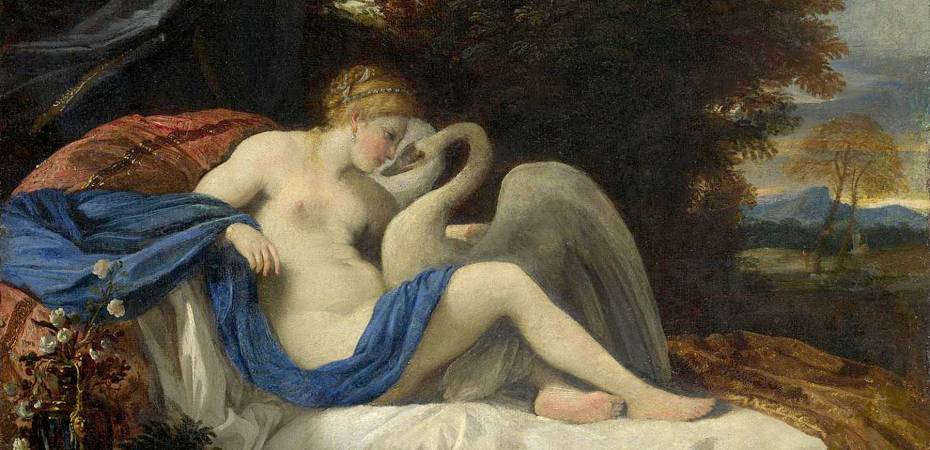
In the next poem, transcendence with an interest in human affairs returns in full force. “Leda and the Swan” is Yeats’ retelling of a classic Greek myth. Zeus, in the form of a swan, attacks and rapes Leda, Queen of Sparta, who becomes pregnant and gives birth to Helen of Troy. The poem is a Petrarchan sonnet, in which the first eight lines are the octave and the last six the sestet. Its meter is iambic pentameter, rhyming abab cdcd efgefg. Here is “Leda and the Swan:”
A sudden blow: the great wings beating still
Above the staggering girl, her thighs caressed
By the dark webs, her nape caught in his bill,
He holds her helpless breast upon his breast.
How can those terrified vague fingers push
The feathered glory from her loosening thighs?
And how can body, laid in that white rush
But feel the strange heart beating where it lies?
A shudder in the loins engenders there
The broken wall, the burning roof and tower
And Agamemnon dead,
Being so caught up,
So mastered by the brute blood of the air,
Did she put on his knowledge with his power
Before the indifferent beak could let her drop?
A brutal retelling of Zeus’ rape of Leda, the poem’s imagery is vivid and disturbing. In a smothering of wings and feathers, Leda relents to the god’s illicit purpose. She has no choice, as the “… sudden blow” of “the great wings” leaves her “… staggering” and caught “by the dark webs.” The next stanza suggests Leda has a passing thought of resisting. But this is quickly erased when her body is “… laid in that white rush” by the god’s “… strange heart beating where it lies.” This final line of the octave is interesting, as it evokes the unnatural union of god and human. But it was actually fairly common for Greek gods to sexually assault humans: Zeus, Poseidon, and even Dionysus were all guilty of the act at some point. What the line suggests is that for Leda (and likely for Yeats), this is obviously a violation. It is a crime with serious consequences for Leda and eventually the Trojans and Greeks.
By the beginning of the sestet, the consequence is clear. Zeus has impregnated Leda, and she will later bear Helen of Troy. As told in Homer’s Iliad, Helen of Troy is the central figure over whom the Trojan war is fought. The unnatural union here is not disastrous just for Leda. It influences the rest of Greek history, in both reality and myth. We should also note that Leda bore three other children by Zeus: Clytemnestra, Castor, and Polydeuces. Returning to the poem, after Zeus is finished Yeats quickly shifts to images of war and the death of Agamemnon. Greek leader Agamemnon was killed by his wife, Clytemnestra, as a result of her sister’s, Helen’s, abduction by the Trojans. The Greeks attacked Troy and set the city ablaze, with “the broken wall, the burning roof and tower” illustrating this. Zeus’ rape of Leda starts a series of events that affects generations of warriors, women, and children on both sides.
We move now to the last image. What do the final cryptic lines mean? Leda, and perhaps all Greeks and Trojans, being “… mastered by the brute blood of the air” implies a few things. The first is the process of history. When Yeats wrote “Leda and the Swan,” Ireland was fraught in a civil war between revolutionaries and unionists. Yeats held the view that political change, and the ultimate goal of a unified, sovereign Ireland, was likely not realistic without violence. Historic change propelled by violence was not a unique view in Yeats’ age, but it certainly risks misunderstanding and distortion by his audience. Being “… mastered by the brute blood of the air” is then a reflection of irresistible historic forces, often violent, that sweep up and move everyone forward. In the poem, this is the Greeks and Trojans. But the allegory of “Leda and the Swan” is that this reflects the evolution of Ireland under British rule to a self-governing state. This evolution is painful, deadly, and unwieldy as it repositions power and knowledge in new hands.
This leads to the second, final implication of “Leda and the Swan.” Yeats writes: “Did she put on his knowledge with his power/ Before the indifferent beak could let her drop?” These lines return the focus to Leda. As Queen of Sparta, she would already have more knowledge and power than the average Greek. However, the knowledge and power described here are transcendental and epoch-making: they belong to Zeus, whose decision to rape Leda unleashes forces that define the rest of Greek history. Yeats’ rhetorical question is meant for Leda after the fact. Does she realize what has happened? Is she aware of the momentousness of her ordeal? Following the same allegory above, we can ask: Is Ireland prepared for the cost of revolutionary change? Who is fit to lead such an effort? What’s more is the “indifferent beak” of Zeus. In the context of myth, reading that Zeus is indifferent to the plight of Greece is not very surprising. In allegorical terms, this suggests not that those swept up by history are indifferent. It is rather the movement, the process of history itself that transcends its own justification in its dogged path forward. In “Leda and the Swan,” transcendence and a vision of a free Ireland born out of violence challenge the reader to reassess what historic change really means.
“The Tower” is exhaustive in scope and depth. From the Irish War for Independence and Civil War to Yeats’ family life and even imaginary journeys to Byzantium and Troy, the collection displays the breadth of Yeats’ thought and purpose. What connects these diverse settings and thoughts together is Yeats’ poetic imagination. Through the imagination, Yeats is able to obtain transcendence across time and fashion a visionary realm not only for himself. The reader, too, journeys to experience the same soul-weaving ritual depicted in “Sailing to Byzantium.” The fatherly love and protection expressed in “A Prayer For My Son” speaks to the timeless bond between parents and children. And though unforgiving in its portrayal of sexual violence, “Leda and the Swan” captures an undeniable truth of all history. Often the driving force of any historical shift, particularly a geopolitical one involving one or more nations, requires a transfer of power and knowledge that itself is violent. In the case of Ireland, the fight for independence, for home rule and preservation of Irish culture was bloody and, at times, pitted the Irish against one another. What we read in “The Tower” acknowledges this while striving for something more. Yeats wanted more than a free Ireland or a safe and healthy son. He wanted more than an aged body in the twilight of his career. His pursuit of bodily and spiritual transcendence and of a visionary realm does not undermine these human concerns. On the contrary, the poet gathers these amidst his soul and its varied, timeless evocation in “The Tower.” Yeats shows us that the transcendence and vision he laboured for live on in these poems, in the “artifice of eternity.”
Sources:
BibleGateway. “Matthew 2: 13 – 15.” New King James Version. 1982. URL:
https://www.biblegateway.com/passage/?search=Matthew%202%3A13-15&version=NK JV
British Literature Wiki. “Notes on Leda and the Swan.” URL:
https://sites.udel.edu/britlitwiki/notes-on-leda-and-the-swan/#:~:text=This%20poem%20 by%20Yeats%20is,poem%20is%20ABAB%20CDCD%20EFGEFG.
Chaliakopoulos, Antonis. “14 Times The Greek Gods Shapeshifted To Rape Mortals.” The Collector. 2021. URL: https://www.thecollector.com/greek-mythology-rape-transformation/
International Encyclopaedia of the First World War. “Post-War Conflict (Great Britain and Ireland). URL:
https://encyclopedia.1914-1918-online.net/article/post-war-conflict-great-britain-and-irela nd/
Rogan, Mariana. “Leda and the Swan in the Collective Poetic Consciousness.” The Modernist Review. 2024. URL:
https://modernistreviewcouk.wordpress.com/2024/06/10/leda-and-the-swan-in-the-colle ctive-poetic-consciousness/
Sedia. Adam. “William Butler Yeats and the Occult: An Essay.” The Society of Classical Poets. 2020. URL:
https://classicalpoets.org/2020/05/19/william-butler-yeats-and-the-occult-an-essay-by-ad am-sedia/
The Burkean. “W.B. Yeats: Irish Revolutionary Conservative.” URL: https://www.theburkean.ie/articles/2018/01/24/w-b-yeats-irish-revolutionary-conservative
The Christopher Hill Gallery. “Adam Shaw Perne in a Gyre.” 2023. URL:
https://chgalleries.com/art/perne-in-a-gyre-by-adam-shaw#:~:text=The%20phrase%2C %20perne%20in%20a,through%20the%20cone%20of%20time.
The London Magazine. “W.B. Yeats and Sailing to Byzantium.” URL:
https://thelondonmagazine.org/article/w-b-yeats-and-sailing-to-byzantium/
The Quilt Show. “Bobbin.” URL:
https://thequiltshow.com/quiltipedia/what-is-a-bobbin#:~:text=A%20Bobbin%20is%20a% 20small,how%20to%20insert%20the%20bobbin.
Thoor Balleylee. Yeats Thoor Ballylee Society. 2024. URL: https://yeatsthoorballylee.org/history/
Yeats, William Butler. “The Tower.” Penguin Classics. 2017.
Discover more from Decadent Serpent
Subscribe to get the latest posts sent to your email.

