
Author: Albert Mackenzie.
Given the focus elections and power politics have had in recent news Conclave may be seen as coming out at the perfect time. Political games and scheming run through the centre of this film and keep the viewer gripped. However, this film is not purely about power, as many political thrillers can be, but about moral dilemma, and uncertainty, further engaging the viewer.
Conclave takes place after the death of an aged pope – following his death the Vatican is quickly plunged into a state of fierce election debate. Four main candidates rise from the cardinals to become favourites. The intrigue of the candidates is multi-faceted not only is each cardinal different as a person but they represent different directions in which the Catholic faith could go under their captaincy.
The American Bellini (Stanley Tucci), represents a liberal and reformist attitude, hoping to take the church forward into increased open-mindedness – Tucci’s portrayal endears us to Bellini, he is shown to be intelligent and caring. Trembley (Lithgow) is a moderate, however, his character’s views are not so key, his main trait is often his overly large ambition, and his scheming nature.
Tedesco (Castellitto) represents conservatism and traditionalism and is popular with the many cardinals who believe the Church has changed too much and too quickly. Lastly among the key candidates is Adeyemi (Msamati) a Nigerian who is also conservative but his potential to become the first African pope, along with his charisma draws many to his support.
On the surface therefore the film sets itself up to be a political thriller about ambition and power. Rumours and accusations fly at many of the candidates, and plots and attempted sabotage is uncovered. An element of mystery hangs over the film, as we try and dissect accusations or work out the story behind a later arriving and previously unheard-of member of the conclave, for example. However, the thing that Conclave gets very right is that central to the plot is the moral dilemma. Each candidate represents a different view, a different compromise and a different way forward.
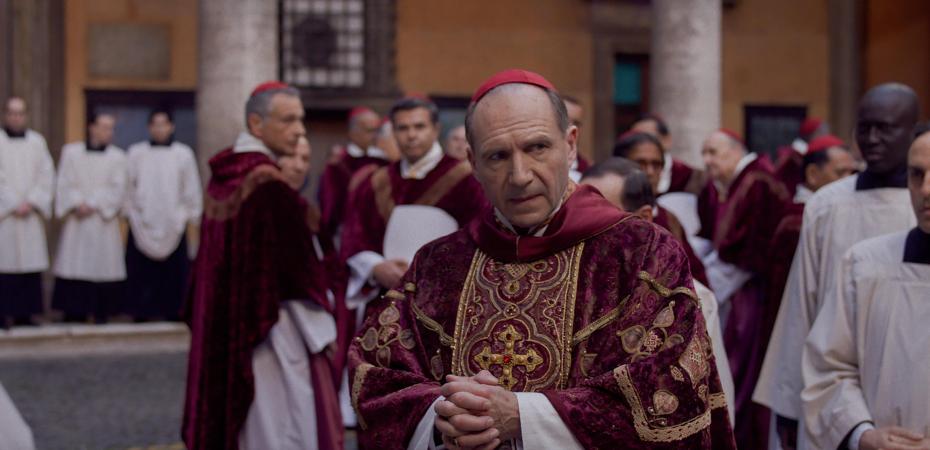
The ensuing election is portrayed largely from the perspective of Cardinal Lawrence (Fiennes) – who as dean is to lead the organisation of the election. It is through his role in the film that much of the deeper meaning shines through. Cardinal Lawrence, despite being in the highest echelons of the Catholic faith is full of doubts. Doubts about his own abilities, doubts about the church, and most crucial for a man who devoted his life to God, doubts about Christianity itself.
A key moment in the film is Lawrence’s speech, as dean and leader of the election, to the other cardinals:
“Let us ask for a pope who doubts, who sins and asks for forgiveness, and who carries on,”
Through this moment, we start seeing Lawrence as a potential fifth option for the pope, such is the power and intelligence of his speech. This also sets much of the tone for the rest of the film, showing us this election isn’t only about power but ideas and ideals.
Many films portray easy choices to their viewer, and it would have been easy to make a film that showed a good option for a pope, a bad option for a pope and led the audience to root for the obvious choice. However, Conclave offers no perfect options, only compromise and questions about which compromises are suitable and which are not. This really adds to the enjoyment of the film because as a viewer you are given the opportunity to ponder, to disagree with the protagonist and to empathise with the challenges they have.
The film does not, however, neglect the classic marks of a political thriller. There is still mystery, backstabbing, plotting, and twists constantly. The balance between the thriller and the moral dilemmas is what makes this film brilliant because for every surprising turn of events, there is also a moment of pause as we debate what choices the characters must make next.
The film is beautifully shot, with a number of excessively pretty, pensive, and long shots. Slow shots depicting dozens of umbrellas making their way slowly through the rain, or of candidates sitting alone add a ponderous tone to the film. A complaint I often see raised against a lot of modern cinema is that of style over substance, however, the many stunning shots of Conclave do not fall foul of this. The beauty of the film enhances an already intelligent film, rather than papering over a poor film’s cracks. For me, the slow and beautiful shots enhance the ponderous nature of the film and truly add to the experience.
All of the above could have been for nought, however, were it not for incredibly strong acting performances especially from Fiennes. In a film that focuses so much on nuance ,Fiennes’ performance typifies this, his performance is not brash, or bold but subtle – and it is often when he is alone and thinking that we begin to see him truly come into his own. As he wrestles with what to do in the next moment we can truly believe the pain his character is in.
Conclave is well worth a watch, whether you want to be entertained by a twisting thriller, impressed by strong acting or wowed by beautiful visuals this film has something to offer. But I would say most importantly if you want a film that will make you think Conclave is well worth a watch.
Discover more from Decadent Serpent
Subscribe to get the latest posts sent to your email.
