
Author: Casey Morris. Born and raised in Texas, Casey Morris studied literature, philosophy, and ancient Greek at St. John’s College in Annapolis, Maryland. He loves reading and writing about literature, especially poetry old and new. He is also a fan of historical fiction, documentaries, and shoegaze.
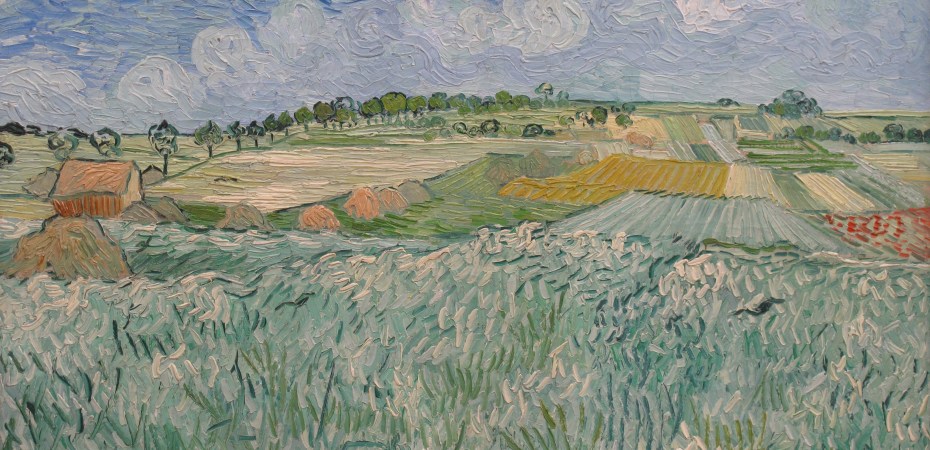
A triumph of any work of art is to immortalise lived experience. A chance meeting of lovers or the loss of a dear friend can find expression in painting, music, or language. But this movement from experience to art, from subject to object, is easy to take for granted. We all know or should know that the fragmented style of T.S. Eliot’s “The Wasteland” was not merely representative of the post-war social milieu in which Eliot found himself. He wrote the poem during significant personal distress and the failure of his first marriage. Similarly, after his release from the asylum in Saint-Remy early in the summer of 1890, Van Gogh embarked on one of the most prolific periods of his life. The final two months of his career were marked by paintings on a wider, more dramatic canvas. Brushstrokes were deeper, heavier. The intensity of colour contrast in “The Plain at Auvers” was confirmed in a letter to his brother to express his overwhelming sense of isolation and depression. Artist and artwork are intimately connected. One is often a reflection of the other. The subjective will of the artist finds its expression and permanence in the object of art.
Understanding this connection between art and artist is key to reading Joshua Mehigan’s debut poetry collection, “The Optimist.” Some of the book’s best poems, such as “The House Swap,” “Last Chance At Reconciliation,” “A Bird At The Leather Mill,” “Promenade,” and the eponymous “The Optimist” show Mehigan’s ability to realise this connection. Born and raised in upstate New York, and having lived for the past two decades in New York City, Mehigan’s poems are rooted in memory, place, and the transience of experience. These are often formed for him in unconventional or even tragic circumstances. A country house, a cancer ward, a leather mill, or a wedding are familiar territory for Mehigan, especially in “The Optimist.” Bringing these to the objectivity of the art, of poetry requires more than experience and memory. A sense of wonder, calm and searching, pervades these poems that dare to find beauty in the strange or mundane. Writing with close attention to metre, rhythm, rhyme, and pacing, Mehignan’s style is reminiscent of America’s leading formalists such as Elizabeth Bishop and Edgar Bowers. Subjectivity, like a rush of fallen leaves in autumn, is brought to its rich and varied expression in these finely crafted, visceral poems.
The first poem, “Promenade,” is set in Bowne Park, Queens in New York City. The poet observes a wedding on a windy day. The first image here is of a kite that “… leaps up, rasps fifty feet above/ until it is almost unusual/ and fastens there.” The dancing, flitting kite has a beauty “… like the possibilities of love.” The brief image of the kite foreshadows an extended image of the wedding: bunting adorns trees, the minister smooths his hair, and groomsmen and bridesmaids file and unhook their arms before the bride walks down the aisle. And, like the fluttering kite, the bride’s bun is loosened by the wind and undulates freely. To the astonishment of all present, this seems “… like the greatest miracle in Queens.” The poem’s final line returns to Mehigan, who muses: “Wish is the word that sounds like what wind means.” Much is happening here that deserves further attention. The kite is both the first image and simile; in its fluttering beauty, it is like “the possibilities of love” because love, too, is surprising, often unsought, and certainly enjoyed moment to moment. We then move from imagined possibilities to their realisation: the wedding brings objectivity to the poem in which possibilities of love are fulfilled. A stylistic detail to illustrate this fulfilment is the use of couplets, rhyming pairs of lines, from beginning to end. Interestingly, the poem ends with a return to the subjective. Though it’s not a complete return: by describing wind as sounding not like the word “wish” but its meaning, Mehigan’s onomatopoeia finds truth in the physical world. But this truth is still a “wish.” And wishes are made by subjects, by people. The line proposes truth in both ourselves and in the wind, the world. For a moment, the subject-object duality is suspended.
In the next poem, Mehigan continues to explore the subject-object relationship. In “The House Swap,” he describes the experience of two couples who switch homes for a weekend. One is a young couple used to living in the countryside, while the other is an elderly couple from a seaside town. The poem begins with precise observations of the former, who “… slept in an apartment where the view/ of quiet boats remanded them to sleep.” This leads to days spent “… in a drowsy bar/ where afternoon became a narrow sound/ of traffic sloshing through the rainy day” and, nights where “… the view/ at dusk was gull-swarmed barges hauling junk.” The young couple’s experiences are described in dull, almost lethargic terms. Though not from an urban environment, the lines here tell of how their lives have slowed since the swap. When they are out and about, the bar they visit is “drowsy.” Outside, the sound of traffic is like white noise “sloshing through the rainy day.” Staying in the apartment is also an image mentioned twice in the first three stanzas. The implication here is that of seeking rest, something we can infer was needed by the young couple.
In contrast, the elderly couple experience country life. Mehigan writes: “Meanwhile, the ones they swapped with sat and learned/ what country life is like, upon a porch./ The husband, from the window, watched the storm./ His aging wife, in bed, no longer called.” Although we read of the elderly couple as inactive and separated, this image is quickly eclipsed by the coming storm.
The final stanza announces its arrival, where “the blue tarp on the woodpile lifting up” suddenly “… seemed a women’s gown/ that never floated, as he’d hoped, away.” What begins as descriptions of the elderly couple suddenly becomes more pointed. The storm, like an upwelling of long-suppressed desire, arrives and transfigures the final image of description to one of declaration. This also marks a change in point of view. Up to the final stanza, the poem has treated both couples in an observational manner. But, when the storm arrives, we quickly see it as a metaphor for the elderly husband’s desire for his wife or just for intimacy. And, as it arrives at the poem’s end, this surge of desire is implied as long, if not permanently, unrequited. In a movement opposite to “Promenade,” from objectivity slowly emerges a very human story in “The House Swap.”
In regards to stories, Mehigan proves himself a master in the eponymous poem “The Optimist.” This is personally one of my favourite pieces in the book. It lends itself easily to memory, and it touches upon some of the best parts of lived experience. Originally published in the April 2000 issue of Poetry Magazine, this poem briefly tells the story of a dying cancer patient. For the sake of reference, the poem in its entirety is provided below:
The film showed stars of varying magnitude,
The left side Libra, and the right side Cancer,
Mapping the brain’s horizons, vanishing points
Respectively of reason and desire.
The doctors liked her cheerful attitude,
Hope being all she had in her position.
She waited, calm. Touch burned out first, then vision.
Emotion slipped. Last would be lungs and heart.
But, noting trends, they told her taste was next.
She asked then, could they pick out her last dress?
She wasn’t making light. It seemed to her
That cancer just rehearsed life’s attitude.
That one’s desires must taper to a point,
Which has position, but no magnitude.
Finding beauty and dignity in the face of imminent death is a gift distinctly human. For both Mehigan and his subject, this choice is made gracefully. We see and hear this in the ease of the lines, the supple diction, and the emergence of rhyme in the last two stanzas. By just focusing on the rhyme alone, we see its progression from the “Cancer” and “desire” half rhymes in the first stanza to fuller rhymes of “position” and “vision” in the second. By the last stanza, the rhymes completely agree: “attitude” and “magnitude.” What does this tell us? As the rhymes become fuller and more resonant, so does the resonance of death. A parallel thematic progression moves through the poem, too. We begin with an imaging of the patient’s brain that reveals a tragic outcome. In the second stanza, time is condensed to show the gradual loss of bodily functions, sense by sense and organ by organ. Yet all this is powerfully counterbalanced by the resilience of the patient’s conscious mind. Her cheerfulness and ironic query to the doctors about the dress show she hasn’t given up yet, that her “hope” still abounds and presses her onwards. In a way similar to and yet more poignant than “The House Swap,” the poem ends not in the poet’s but the subject’s train of thought. In the language of cancer and endless visits by specialists, doctors, and nurses, she finds a way to express her undying wish to live another day. Hence, the repurposing of “position” as not the location of a malignant brain tumour but her desire. The use of “magnitude” as not the growth of this tumour but her increasing desire to live. We see the movement again from objectivity, which here is the diagnostic language of science, to subjectivity, the boundless well of desire immortalised in rhythm and rhyme.
Measureless desire features in some of the later poems in “The Optimist.” In “Last Chance At Reconciliation,” Mehigan writes about a man anxious to reconcile with his lover. Readers familiar with Dylan Thomas’ “Do Not Go Gentle Into That Good Night” or Elizabeth Bishop’s “One Art” will find here another solid adaptation of French poetic forms in English. But instead of the villanelle, Mehigan adapts the triolet. Written in eight alternately repeating lines of iambic pentameter, its use of repetition makes it another piece easy to commit to memory:
He’s certain where he’s headed it’s too late.
West Broadway glitters in a mist of rain
That amber cones of light elucidate.
He’s certain. Where he’s headed, it’s too late
To stop for flowers, dry off, or get things straight:
A story, his misshapen hat, his brain.
He’s certain where he’s headed. It’s too late.
West Broadway glitters in a mist of rain.
One of the first impressions of this poem is its music. The iambic metre resembles natural speech, and Mehigan’s use of caesura in lines 4 – 7 helps depict a man who is truly indecisive about what he needs to do. Each of the pauses in these lines shows the back and forth of his thinking, even though this is told narratively by Mehigan observing from the outside. Each of the end-stopped rhymes ends with the same long vowel sound. When spoken, this sound originates from the back or bottom of the throat and is pronounced with the mouth wide open. In terms of lack of closure, physically and metaphorically, this is the perfect sound to build rhymes with as it emphasises the circumstance of the poem’s subject: he seeks a presently unobtained reconciliation with his lover. The repetition of the first two lines contributes to this sense of urgency. And, in perhaps the most significant stylistic detail in the poem, the penultimate line introduces a pause (i.e. a full stop) to separate it into two clauses. This sadly suggests that it is indeed too late for reconciliation for the unnamed man. Thematically, this piece again shows Mehigan’s ability to give permanence to a profound experience. Subjectivity here is expressed primarily in the formal decisions Mehigan makes: we see the man’s anxious thought process reflected in the abundance of pauses and images of him deciding what to do in the pouring rain. Carefully selected details (i.e. the man’s story, his hat, and his brain) tell us Mehigan is aware there’s a lot under the surface. But this observation quickly passes. The story, for Mehigan and for us, ends. The poem’s final two lines affirm the continuation of the man’s story elsewhere, for better or worse.
This sense of observant wonder is seen in other pieces such as “A Bird At The Leather Mill.” In this poem, Mehigan returns to upstate New York. The setting is a leather mill with an unexpected visitor. While the workers are busy going about their duties, a crane suddenly appears “… in the center of the floor/ of the mill, lost and tentative. Its bill/ looked like a fancy awl with a down handle.” Surprised and bewildered, the men at first “… imagined that a person had strolled in/ like a green salesman or a debutant.” But as the crane walks through the mill towards the loading dock, the men “… prowled with laundry bags/ to grab and hold it like a secret hope/ harboured in exile.” The poem ends with each of the men taking turns “… explaining what he’d do/ if it came back. They bragged, or chaffed, aware/ the thing was lost, but never saying so.” As we’ve seen in previous poems, Mehigan gently guides the reader here first through observations to a kind of emotional awakening. The first lines feature descriptions of the crane and the worker’s initial shock. This collective surprise quickly turns into an intense desire for the bird to stay, as the men try to capture it. Mehigan’s strong language in this image describes the workers more than the crane: “harbouring a secret hope in exile” implies the alienation the men feel at the mill, likely because of their work and other socioeconomic factors. Their sudden greed for the bird also suggests long-held hopes of acquiring something better for themselves: self-advancement, luxury, wealth, more educational or professional opportunities, or better mental or physical health are all possible treasures they seek. The crane is then chiefly metaphorical as it represents the unreachable for the mill workers. They are left with what they started: great intentions they can only speak about but never quite realise. “A Bird At The Leather Mill” shows Mehigan’s empathy for such workers, undoubtedly like so many he grew up around in upstate New York. It is also a sober reminder that beauty, artistic or otherwise, deeply touches us all. And such beauty outlives us all through the stories we tell and pass on.
When reading “The Optimist,” a recurring theme emerges in poem after poem. Whether we read of a dying cancer patient or an anxious, dishevelled stranger, we see the dogged desire to strive for something more. This desire could be for living a bit longer or the reconciliation of a relationship. For the elderly husband watching the storm, this desire was for lost intimacy. But what generally is this desire? Why is it there regardless of circumstance? For Mehigan, this desire seems to be life itself. It is the ever-present, driving force accompanying us from birth to death. And instead of desire, perhaps a better word is spirit. Spirit in the sense of what persists in all of us from our earliest memories to our final moments, however conscious those may be. What Mehigan suggests is that this spirit is universally present in each of us, and through this spirit, we can find permanence or, in a way, transcendence. Mehigan achieves this permanence in each of the poems in “The Optimist.” Subjectivity is immortalised in each poem, and its varied expression is captured in a remarkable array of settings and circumstances. An interesting question then arises: what about you and I? What can we do to transcend life and death? That may be a question only you and I, separately, can answer. Surely, there are many ways to endeavour for truth and beauty. And, when the time comes, we can share our endeavours with those who live on. You can buy ‘The Optimist” here.
Sources
“The Last Works of Vincent Van Gogh,” Google Arts & Culture. URL:https://artsandculture.google.com/story/the-last-works-of-vincent-van-gogh/bgIyYrW4yOjUJA“The Optimist,” Mehigan, Joshua. Ohio University Press. Athens, Ohio. 2004.
Discover more from Decadent Serpent
Subscribe to get the latest posts sent to your email.
