
Author: Giulia Prodiguerra. I grew up in the Italian countryside surrounded by art thanks to my family, who exposed me to books, comics and cinema from a very early age. There wasn’t that much to do on rainy days and I filled my hours picking from the bookshelves or playing videogames, which have become a stable part of my hobbies and shaped my interests growing up. I have been working as staff member at Lucca Comics & Games since 2006. After obtaining a Master’s Degree in English Translation, I moved to Scotland in 2016 where I kept pursuing writing (mainly self-published).
One of the things that fascinates me the most about any kind of folkloristic tradition across the world, it’s the ability to resist the unstoppable advance of modernity. No matter how much certain habits, rituals, superstitions get forgotten and incorporated into others, some pockets always resist, taking new shapes and thriving in their own nooks.
There are places where even in the face of perfectly rational explanation, humans still strive to understand what lies beyond the veil and whether there’s any way of controlling or making it favourable to us. It’s part of our human nature and builds our heritage, identity, and ability to deal with reality.
Among these, is one of my favourites, which is aptly a Christmas tradition: the Mari Lwyd.
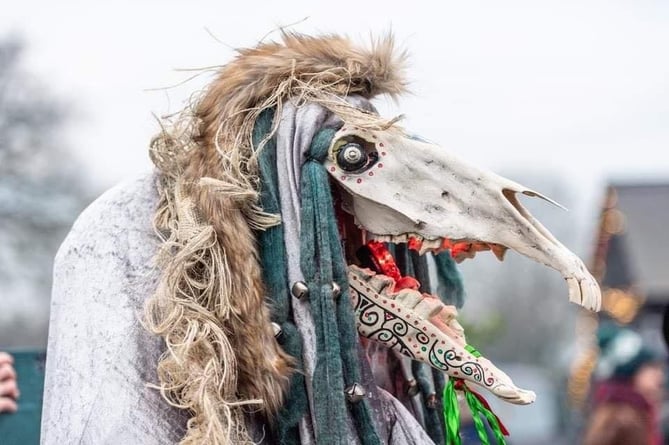
At first glance, it’s certainly not something anyone would associate with the sparkling decorations and warm glow of the Christmas period:

But one thing at a time.
Who, or what, exactly is Mari Lwyd?
The Mari Lwyd is a wassailing (going door-to-door) folk custom found in South Wales. It consists of a horse’s skull (although now it’s often made out of paper or wood), hidden under a sackcloth decorated with ribbons and flowers. Originally the same horse skull would be used and preserved for the rest of the year.
The eyes are made out of glass, and the lower jaw is fixed on a spring which allows the mouth to open and shut.
Wassailing (the term comes from Middle English wæs hæil meaning ‘be in health’) can be traced back as early as the 13th century and takes the name from the wassail and the wassail bowl. Originally the wassail was a sugary spiced drink consisting of mulled ale, curdled creams, roasted apples and eggs. Those who partook in sharing the hearty beverage were wassailing. The custom was seen as a crucial moment for the community going through the dark hours of winter, involving door-to-door charity giving, and then evolved to incorporate singing.
One of the most important points is that wassailing, since the beginning, has involved propitiatory rites of singing and drinking to ward off the evil spirits and ensure a bountiful harvest for the following season. With the passing of centuries, it has become strictly tied with the tradition of Christmastide.

The first recorded mention of Mari Lwyd can be found in “A Tour through Part of North Wales” by J. Evans, published in 1798.
In more recent years, the tradition seems to be more closely associated with the South of Wales, particularly Glamorgan and Gwent. The tradition seemed to have disappeared at the beginning of 1900s, but it resurfaced in the 1960s in the town of Llangynwyd.
Why is Mari Lwyd a horse? Same as the precise origin of the tradition itself, lost somewhere down the centuries of wassailing (which can be traced back to the 13th century), the origin of the name is mysterious: the Welsh translation of it, Grey Mare, recalls the heritage of the pale horses in Celtic mythology, where horses are supposed to be able to cross to the underworld and be favoured by the gods. One notable example is Rhiannon, a figure from the Otherworld (the realm of deities, spirits and ancestors), depicted as riding a majestic white horse that could ride faster than any other.
We can indeed find horses in other English traditions: Hoodening in Kent and Old Tup in Nottinghamshire and Derbyshire, both involving dressing up a horse’s head and going from house to house at Christmas.
The other translation is Grey Mary (or Grey Mare), and this seems to be linked to a Nativity story from proto-Christian times: the Grey Mary is supposed to be the pregnant horse sent out of the stables when Mary arrived to have Jesus. To this day, she roams the land trying to find somewhere new where she could have her foal. An unusual dark take to be associated with the Holy Family and the most well-known Christian traditions.
But What does Mari Lwyd Actually do?

The Mari is considered a mischievous spirit, and the village is its hunting ground. The prop is taken around the village, usually between Christmas Day and 12th Night (5th of January), by at least three people, often dressed up as stock characters like Punch and Judy, or the Sergeant and the Merryman. The group will go door to door and will then sing a song requesting to come into the house. The occupants will sing back, initially denying the entrance, in an improvised battle of rhyme known as “pwnco” (“challenge song”).
Below we can see an example:
Mari Lwyd carol
Wel dyma ni’n dwad
Gyfeillion diniwad
I ofyn am gennod i ganuOs na chawn ni gennad
Rhowch wybod ar ganiad
Pa fodd mae’r ‘madawiad, nos heno‘Does genni ddim cinio
Nac arian iw gwario
I wneud i chwi roeso, nos heno
Mari Lwyd carol
Here we come
Dear friends
To ask permissions to singIf we don’t have permission,
Let us know in song
How we should go away tonightI have no dinner
Or money to spend
To give you welcome tonight
Pwnco is not dissimilar to the flyting tradition, a poetic competition of the Scottish makaris (poets) of the 15th and 16th centuries, in which two highly skilled rivals engaged in a contest of flamboyant and fierce verbal abuse.
This means that in modern terms you are supposed to have a rap battle to prevent Mari from getting into your house. If the host loses the showdown, Mari can enter the house and take food, gifts, booze and even money.
(I personally would immediately fail as I can’t sing to save my life)
The Mari can be identified as one of the many ways we have, as humans, of dealing and controlling the dark and menacing spirits of the frigid winter, appeasing them with songs and offerings, before they retreat again beyond the Veil of the Unexplained.
This submission entered the Christmas Horror Competition. To vote, like the story on WordPress. The post with the highest number of likes will win the competition. A survey form will also be circulated on our social media to collect votes. Keep your eyes peeled and vote for your preferred story.
Discover more from Decadent Serpent
Subscribe to get the latest posts sent to your email.

[…] commercial meanings of Christmas. Throughout the world, various regional customs such as Krampus or Mari Lwyd give Christmas something of a distinct flavour that turns a global festival into a local […]
LikeLike
[…] Entry 1 – Mari Lwyd, Giulia Prodiguerra, https://decadentserpent.com/2024/12/01/eerie-stories-from-the-world-of-folklore-mari-lwyd/ […]
LikeLike