
Author: Dinah Kolka. Dinah is the founder of Decadent Serpent and a graduate of Edinburgh Napier University with a BA(Hons) in English Literature. Her work has been featured in publications such as The Salisbury Review and The Mallard. She was also published in the Scottish Book Trust’s 2018 anthology Rebel. In 2023, Dinah self-published her own collection of short stories, The Search and Other Stories.
WARNING: This review contains spoilers.
The problem I have with Heretic is that it is stylistically perfect. An interesting premise, with no plot holes, well shot, and well written. There was essentially nothing wrong with the Heretic. And I think this was my problem.
The premise of the film was simple – two Mormon girls zealously knock on a man’s door to convert him, only to find him to be far more sinister than he originally presented himself to be. Wooed by the promises that there is in fact, a woman in the house (as otherwise, according to their beliefs, they would not be able to be alone in the house with the man) and the promises of blueberry pie, they come in only to discover that they cannot come out.
This film hit close to home – having been a Jehovah’s Witness in my youth, there were many similarities that were so acute, that on occasion, it made for quite an uncomfortable watch. Some of the debates the girls were having with the villain mirrored closely the conversations I have had with people whose doors I knocked on. The performances from the two girls (Sophie Thatcher & Chloe East) were excellent – one of them more timid and pure, reminiscent of many people I’ve met in my JW days. What was particularly personal, was the other girl, outspoken and happy to engage in a challenging debate – it was in her that I saw the shadow of my old self.
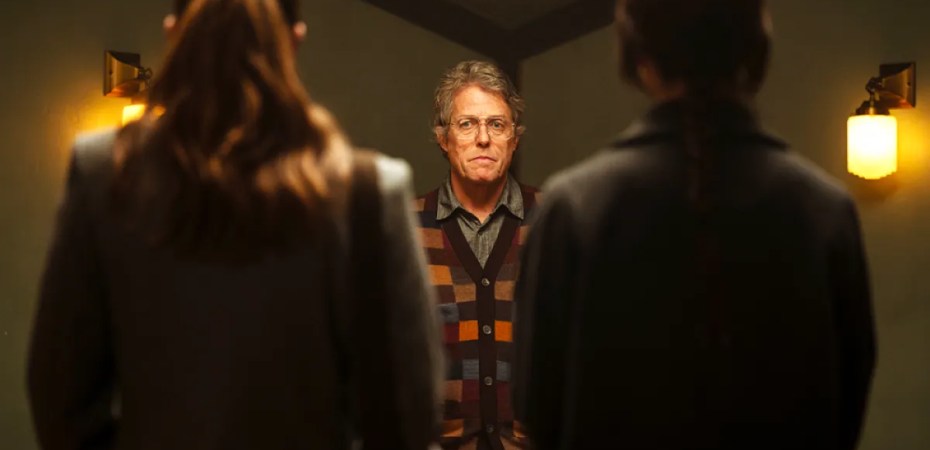
On the other hand, Hugh Grant’s performance was equally stunning – this was his second ever horror film since ‘The Lair of the White Worm’ in 1988 where he played Lord James D’Ampton, who discovers an ancient worm cult on his land. This seems to be a far more mature role, especially considering his foray into romantic comedies, such as Bridget Jones films, which led to him slowly fading into irrelevance. He plays the villain excellently, likely due to the fact that the role was written for him. His natural joyful face helps his seemingly polite debate style which quickly descends into horror.
Saying that I felt that the film was missing something substantial, a binary, further nuance, and a deeper moral to the story. If the villain essentially goes through all religions and believes them to be all about control and ends up worshipping the concept itself, you’d expect a force that would challenge his worldview – however, none of the sisters really challenge what he says properly, they just try to buy themselves more time to think up their escape.
If religion is all about control, surely the defiant force against it should be focused on refuting the concept thereof? The film is going around in bizarre circles of religious control with no substance – it doesn’t know what it really is about. The film doesn’t have what Longlegs has – the beautiful, rugged beauty of the landscape, the dreamy dusks of Oregon, or the aesthetic shots. This film must work harder in order to become memorable, and I believe it failed to achieve this through fear of truly exploring its own message.
Despite the film seemingly clearly about religion in some sense – it is surprisingly ambivalent about the concept. Religion is neither a force of good nor bad in this – it just exists as an alien belief no one is really trying to dissect. Other than the villain, that is – who is purposefully throwing around Reddit-like atheist claims in order to make himself seem educated with little to no challenge from the Mormon girls. If the film’s focus is control in the generic sense, then the religious element acts only as fluff and is thus baseless.
We don’t seem to see a gradual shattering of faith when met with the controlling force, and we don’t see the Mormon girls defiantly sticking to their principles either – they don’t seem to be really into it themselves in the first place. This puts the premise in a quite disingenuous position – despite both actresses being formerly Mormon, they both act in the film as ex-Mormons pretending to be Mormons, not zealous ministers as they are supposed to be portrayed.
This brings out my key issue with the film – it contains no moral message other than ‘watch out for people who want to control things, be it religion or psychopaths.’ And I suppose this is the actual premise of the film – it’s all focused on control – the villain is trying to control them directly, and the sisters are also being controlled by their own religion. The depth of the film is non-existent and although an excellent watch on the basic level, it missed something I expected from it.
If the debate on the essence of religion had been explored more, this film would have received a solid 8/10 from me. Realistically though, I can’t help but give it a 6/10. It was a great film, one that you would find on Netflix with your friends on a random Friday night and have a great time watching it – I may be expecting too much from the modern cinema, yet I still hope to feel something when I sit in that chair. It’s been a long time since I had this feeling though.
Discover more from Decadent Serpent
Subscribe to get the latest posts sent to your email.
