
Author: Dinah Kolka. Dinah is the founder of Decadent Serpent and a graduate of Edinburgh Napier University with a BA(Hons) in English Literature. Her work has been featured in publications such as The Salisbury Review and The Mallard. She was also published in the Scottish Book Trust’s 2018 anthology Rebel. In 2023, Dinah self-published her own collection of short stories, The Search and Other Stories.
Visiting Eastern Europe always brings a lot of joy to me – it feels like a return to a place a little closer to my own culture, having been born and brought up in Poland. So I decided to travel to Bulgaria to discover how much the Balkans really differ from a country that often considers itself ‘Central Europe’. I don’t even know how we picked it – the idea was to go somewhere we’ve never been before and this just seemed like a fine choice.
Bulgaria proved to be a surprising destination, a gorgeous place where Soviet-era buildings grow neglected as moss and grass overgrow the once-looked-after monuments showing off the former dominance of the USSR in Eastern Europe. This also intersects the deep historical backdrop of the country which shed blood during many rebellions against the Ottomans, and grew in strength and size over the years, while dealing with the arrival of Orthodox Christianity, the USSR and then finally, NATO.
We soon found out the hard way that the roads in Bulgaria leave a lot to be desired. One feels like one is in fact visiting an unfinished country. We drove down the streets of Sofia with people driving like this was the first time they were driving a car – and yet, there was no beeping, no shouting, no anger at all. Despite people driving like absolute maniacs, they seemed to just accept that no one’s going to be better – so it actually made for a slightly less stressful trip.
Sofia was a baffling place, to say the least – gorgeous governmental buildings, art galleries and museums in large imposing buildings, but on the other side, horrid roads and poverty peeking out from every corner alongside the stray cats and dogs staring hungrily hoping for a bit of chicken and some warmth. Dark faces were staring back at us intently too, which I found slightly more freeing – people in Eastern Europe have a tendency to have no qualms in looking directly at everyone they pass, out of curiosity (and a little bit of judgment too). After such a long time in the UK, I found it quite pleasant, to finally be able to simply people-watch.
Our Airbnb was a quirky apartment in the city centre that required getting up 5 flights of stairs. The block had a resident cat too, which would loiter nearby, distrustful of strangers. My favourite feature of the bathroom was the Bulgarian wet-room imitation, which was just a tiled bathroom with a shower in the middle of the room and a drain in the middle of the floor. When one would shower, the water would wet everything in its vicinity – the toilet paper, the toilet itself, the sink, the hand towel and the poor little spider hiding in the corner of the room. A few times, I forgot what I was doing and having placed a fresh stack of clothes in the bathroom, I found them completely soaked afterwards.
Thankfully, there was an AC which doubled down as a heater, which made ungodly noises throughout the night, wafting the heavy heat all over the room to the point of the flat becoming a sauna. I am ashamed to admit that I only figured out on my penultimate day that the heat could, in fact, be turned down and I did not have to either freeze to death or roast myself like a Christmas turkey.
There was also a quirky attic/terrace space as every Bulgarian clearly seems to be addicted to smoking. Upon walking up the narrow stairs and hitting myself over the head off the low ceiling, upon opening a door and hitting myself over the head once again off another low ceiling, I found myself in a little room with fake grass on the ground and a sliding patio door leading me out towards the roof with no care for any health or safety regulations (I could throw myself off it if I really wanted to and I’m not sure if I was comfortable with this level of personal freedom). But the view was marvelous and on a very clear day, one could see the outline of the nearby mountain range which made everything so much better.
On the first day, we decided to stroll around Sofia and taste some of the finer Bulgarian foods. The food was delicious, and the wine was sweet and despite being tired from the travel, I found myself delightfully lulled into a pleasant feeling of the holiday just beginning. I could trust the Bulgarian waiter with my life, as he asked ‘Bread?’ and we just nodded. He asked: ‘Cake?’ we also nodded. And the cakes were gorgeous too – a pistachio chocolate layer cake and a biscuit cake tasted like heaven and I felt like my life was complete for once. If you ever visit Sofia – I truly recommend MOMA, it’s a quirky and perfectly traditional place and the food will melt in your mouth.
RILA
The next day, we got up relatively early and made our way to our first destination. Rila can be found all the way up on the mountain range, it was a truly blessed place. Getting out of Sofia was a slow and mundane process, passing by large industrial areas and abandoned buildings, looming in front of us, the quasi-post-apocalyptic husks left unfinished, just like so many others. The famed brutalist, Communist-era blocks of flats were imposing and grand, a reminder of an era that was gone, but still sent ripples throughout the country that were still felt now. In front of them, at a rugged bus stop, the huddled elderly were sitting awaiting a bus, watching the cars passing by at a fast speed.
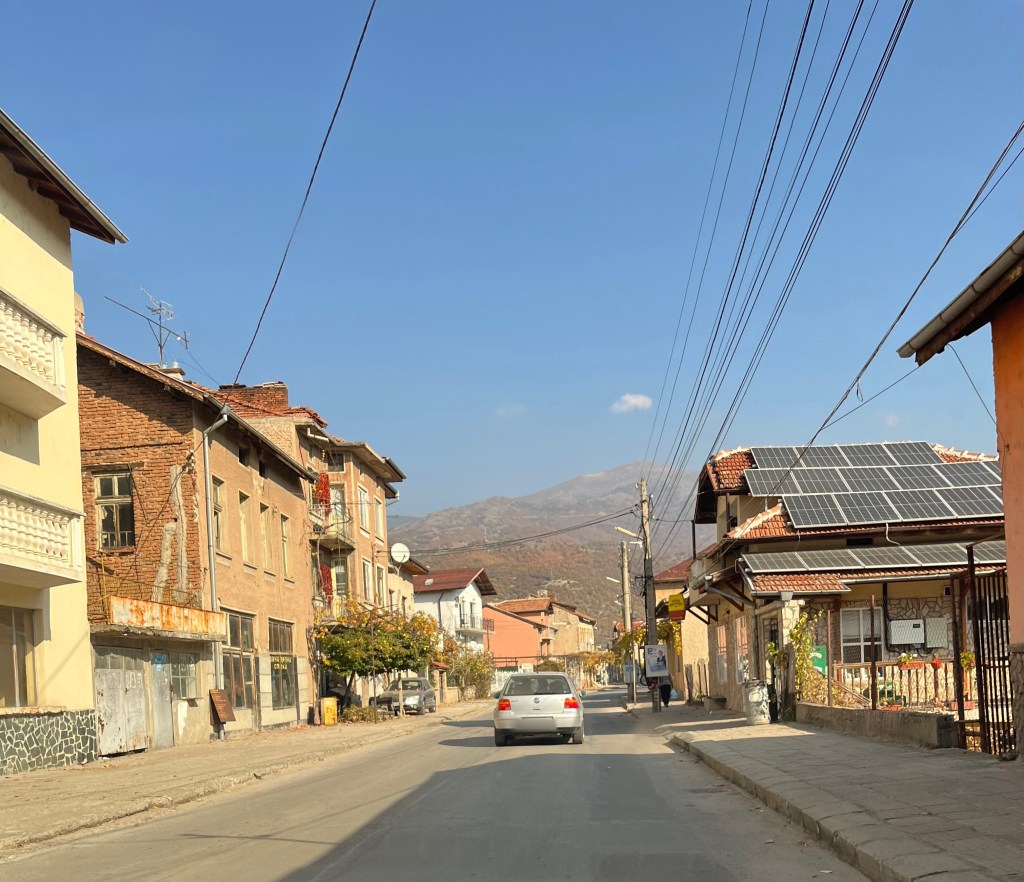
As we passed by, the views changed from the desolate industrial wasteland into individual villages, all more or less looking the same with varying levels of degradation. The number of abandoned buildings was astonishing, many houses have had their foundations and external walls set, but no other work has been done in years. Others, were in an awful condition, with paint peeling off the walls and an overgrowth of weeds devouring them alive. But in one of the rooms, there was a light and the TV satellite dish installed on the roof suggested that someone lived there.
Sometimes, as we entered a straight road, it felt almost as if we reached America, with its long straight roads, flat steppes, and a mountain range looming in the background.
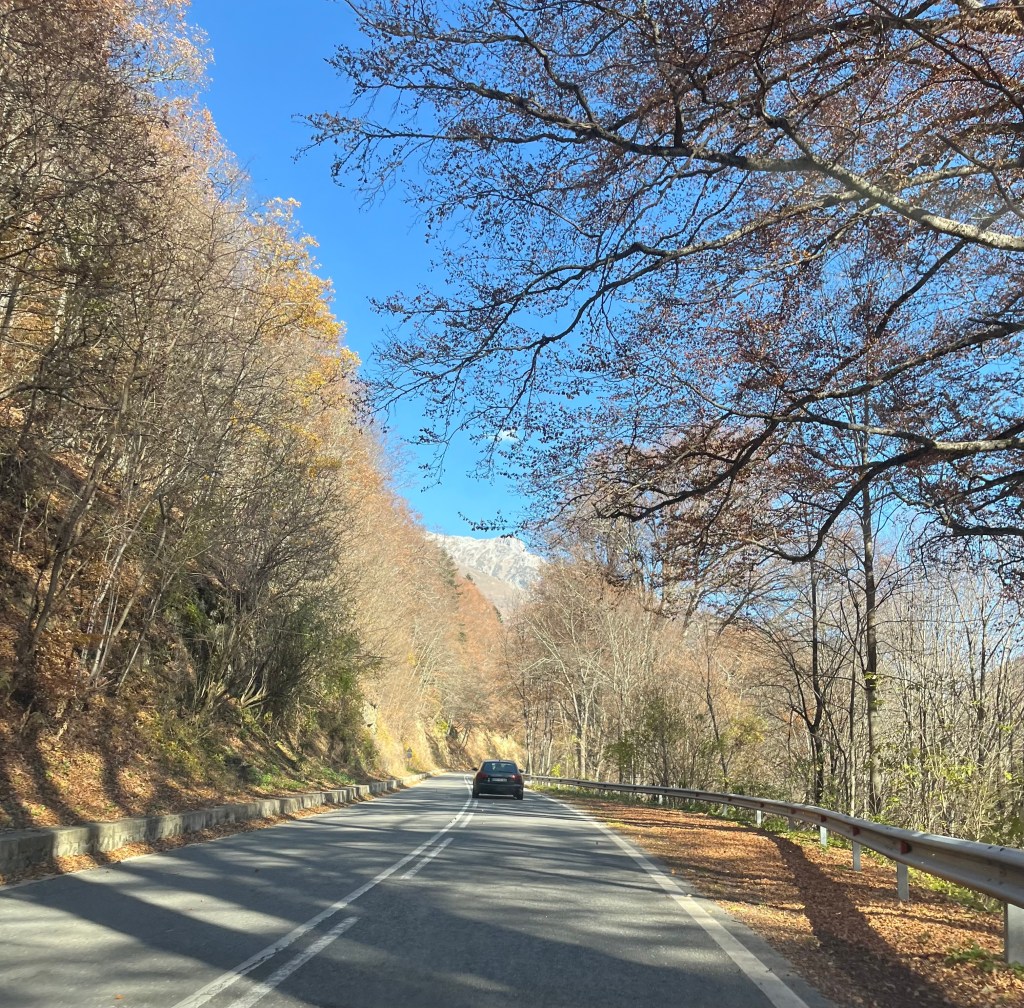
Eventually, the scenery changed into a forested route, winding and winding upwards. Despite it being November, the trees were still rich in leaves, with the wealth of them also blanketing the hills surrounding them. The coppery hues were prominent and as the area was getting more mountainous, the forest became thicker and thicker with the golden crown creating a tunnel through which we were graced to pass. The birch trees were scattered throughout, with their narrow, long trunks and soft, delicate branches.
A lone white cross was placed firmly in the ground on the side of the road, alongside many others that we passed, indicating that many people had died driving there.
It was interesting to see the difference in the death culture between the UK and Bulgaria. Where in the UK, it sometimes feels that death is only spoken about in whispers, like a stray, injured dog no one wants to look at; in Bulgaria, people come forth with their radical acceptance of death. The commemorative plaques, tombstones, and even printed obituaries with the faces of the ones who passed away can be found everywhere – on the storefronts, electricity generators, trees, and front doors. Where for some it could be uncomfortable, it is clear that the Bulgarians care deeply for their loved ones and celebrate them both in life and in death. They don’t shy away from the faces of the ones who passed away – they accept it throughout. It was surprising to see face-to-face with death, seeing the acute reminders thereof. And I suppose this served another purpose too – the haunting reminder of the consequences of reckless driving.
Many places across the map have black spots, although rare in the UK – Bulgaria is dotted with them all over. Many such places suggest that there are incidents that are common in the area – many of the black spots have very clear markings for no overtaking as the roads are mostly single-carriageway. Despite this, reckless overtaking was extremely frequent and often done dangerously. During our short 8-day stay we have seen 4 car accidents.
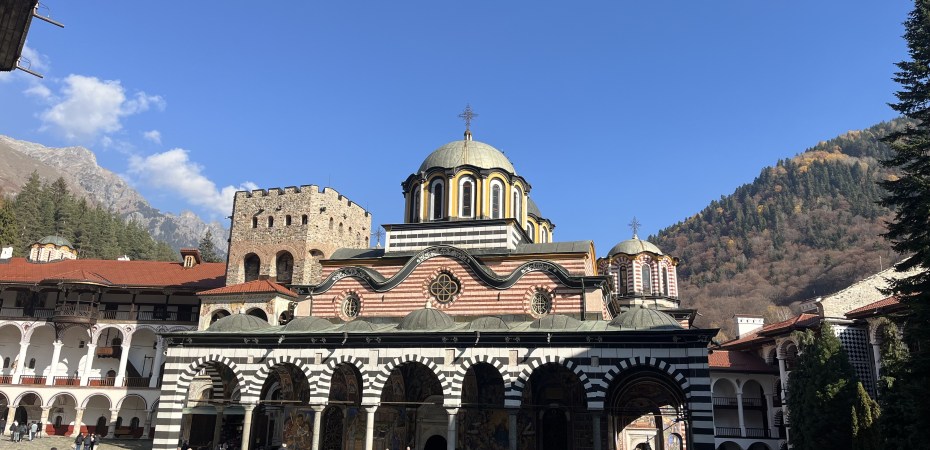
Finally, after a windy drive up the mountain, we eventually saw the Rila Monastery in all its beauty. Nestled in a perfect spot where the mountains and forest met, the monastery worked harmoniously with nature, rather than against it. The place was naturally packed with tourists, and we found ourselves following the crowd to find something to eat. Noticing the sign that said ‘Traditional Bulgarian Breakfast’ we were wooed by the smell of the pastry. Richly decorated with icing sugar, we devoured them quickly. We also tried their ‘milk’, which was closer to a yoghurt rather than milk, but was fresh, tasty, and full of diary. We finally proceeded through to the monastery. It was a truly sacred experience. Outside the cathedral, many cats could be found, clearly strays that were fed by the monks. The monastery itself was richly decorated in frescoes presenting various biblical and theological stories.
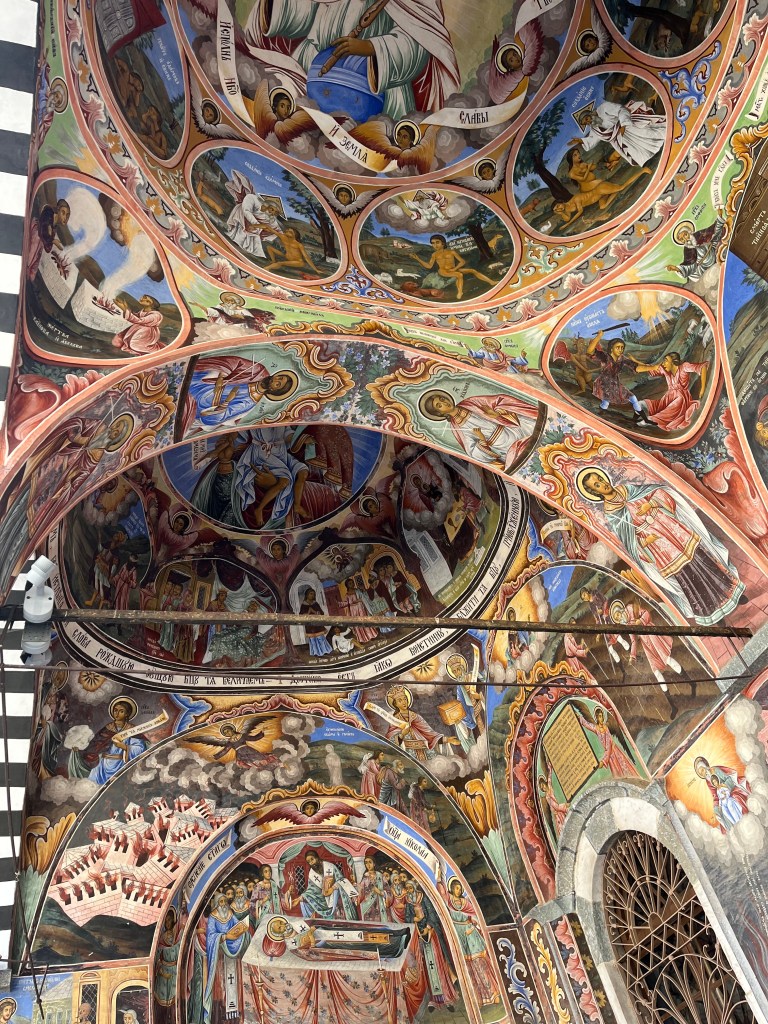
The interior of the monastery was breathtaking and awe-inspiring. We were not allowed to take pictures, however, the images ingrained in my mind I will cherish forever. In the middle of the cathedral, there was a large low-hanging chandelier/candelabra with a multitude of candles. The chandelier was made of gold or possibly brass with icons engraved into it. The cathedral very clearly had a divine feeling to it, and it felt eerie walking through its halls.
As we left and drove down, we were looking for a place where we could have a coffee and we drove until the road ended at Kirilova Polyana. We found what possibly looked like a coffee shop as it was clearly labelled ‘coffee and tea’ in Cyrillic. I asked if they serve it in broken Bulgarian, to which the lady disappeared into the house which looked like a regular residential house and came out with a small plastic cup filled with an espresso and another cup filled with tea of some description. We sat at the table outside on the plastic garden chairs. The meadow we found ourselves in was gorgeous, with a rusted patio on the backdrop of rich and dense evergreen forest. On the other side, however, the mountain range was visible, tall and high, covering the entire valley. We gave the coin to the lady and proceeded further on our journey.
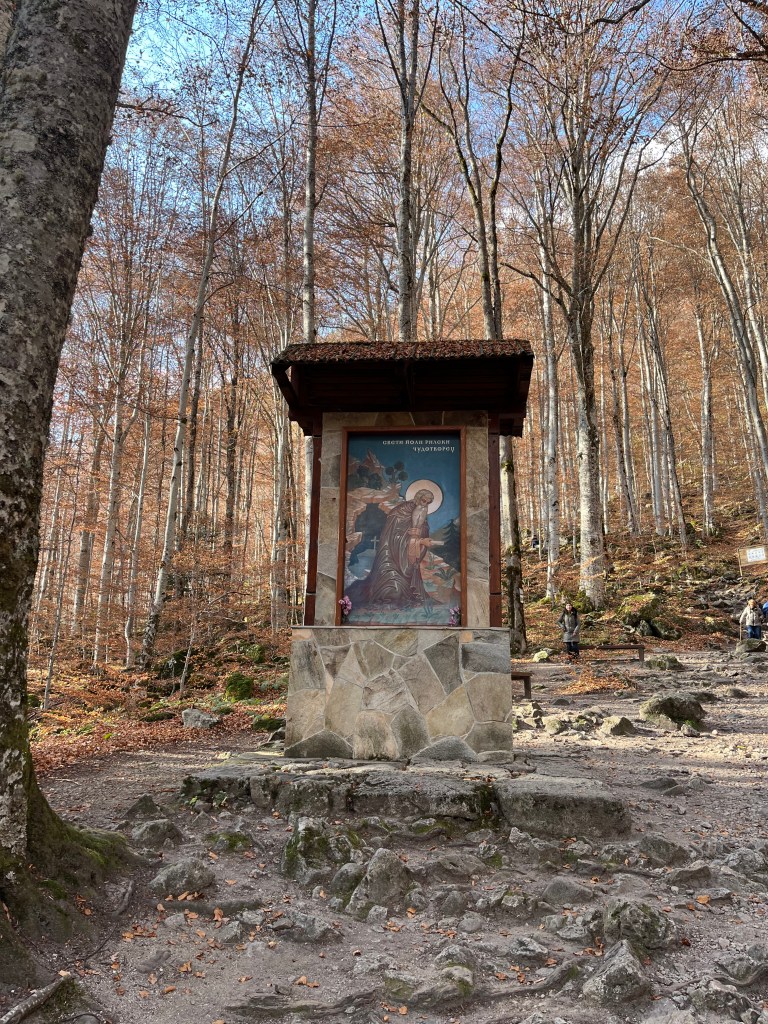
As we continued down, we noticed a large icon on the side of the road alongside steps going up the mountain. I was curious to see what was up there, so we stopped and went to scout it out. As it turned out, it was the route that the Venerable Ioan Rilski took when he went up the Rila Mountain to seek spiritual self-perfection. At the time, the mountains were uninhabited and he roughed it under the stars, living in a stone cave for twelve years. Many monks followed in his stead and thus the Rila Monastery was built. We walked up the stairs, unsure of what we could find, only to realise that we were walking in the footsteps of Saint Ioan, up the pathway he likely walked many times.
Having reached halfway of the pathway, we encountered a small Orthodox church hidden near an entrance to a cave, alongside St Ioan’s tomb. Was that cave the same cave where St Ioan lived for 12 years testing the strength of his will? I couldn’t tell you, all the markings were in Bulgarian.
At the top of the pathway, we were met with a tap with water directly from the mountain with a gorgeous mosaic of St Ioan. Although the sanctity of the place was slightly ruined by giggling tourists, I have nonetheless enjoyed sitting there and taking in the views. The water was fresh tasting and truly refreshing, and the trees on the other side were basking in the glory of the sun. It made perfect sense why the Orthodox chose these places for their pilgrimages and why they so closely reminded them of God. At that moment, I felt the divinity of the moment too.
We quickly realised that it was Sunday trading and we weren’t going to find an open restaurant so we found our way to one of the shops and bought what we could – some bread, sausage, and cheese. Feasting upon these simple goods which reminded me of my home country so much (it’s not that this is exclusive to Poland), I reminded myself how good it is to actually cherish the simplicity of things. The best things in life often are not the ones that call for over-consumption. They are found in the simple moments of enjoying a view and eating some bread. We are so often forced into over-consumptive habits, that we never actually get to choose the simplicity, either due to it being bizarre or simply unnecessary. However, being forced into it, you get to enjoy it once more with the childlike wonder for it.
The next day, we took a leisurely stroll to the National Military Museum for a pleasantly autistic day. On the way, we discovered my favourite feature of the country – the coffee & hot chocolate vending machines which are pretty much everywhere. For about 40p you can enjoy a nice hot choccy on a cold day – again, it brings back my point about the best things being simple. You don’t have to go all the way to Starbucks and get 25 different syrups and sprinkles – sometimes the secret is in a 40p hot chocolate and a stray cat. I became delightfully obsessed with these vending machines for the remainder of my stay, finding them to be my little respite when it got too cold.
Especially after realising that we hadn’t done enough research and the National Military Museum was in fact closed on that day and we had to leave. (Who would have thought that a museum would be closed on a Monday!!)
We decided to instead spend money on nonsensical items, such as an ushanka hat and generally browsing the goods from stalls in the city centre. I was fixated on finding some jewellery when one of the babooshkas selling her goods started speaking to me in Bulgarian.
I really couldn’t understand what she was saying so I just decided to say in Russian:
‘Я немного говорю по-русски’
The woman continues, shoving a small perfume bottle under my nose. I smile and nod still trying to respond in my broken Russian when she continued speaking. I started to panic when suddenly, I was saved by another person coming to the stall.
When we walked away, my boyfriend looked at me and said, ‘You do know that she was speaking in Russian to you, right?’
I shrugged my arms and said ‘я не понимаю’ grinning, and quickly walked away from the stalls.
We realised there really wasn’t that much we wanted to do in Sofia that day so we went back to the car and drove off in a random direction. We noticed a ‘Montana’ on the map so we drove there, pretending to have a purpose.
Montana proved to be a small town with some ancient Roman ruins in it, and not really much else in it. We went to have dinner in the first restaurant we found and the waiter was delighted to be able to test his English language skills on us.
After the meal, I asked him ‘Do you get many tourists here then?’
‘Oh yes, plenty in the summer!’
‘Are they all coming to see the ruins?’
‘Oh yes, they are very popular!’
Part of me really struggled to believe him but his English was excellent so I took him for his word. We got in the car, trying to decide what to do next. Then, the realisation that we could just drive for 5.5 hours to Varna occurred to us. And so we commenced. (Spoiler alert: it took us 8 hours).
VARNA
As much as we wanted to drive fast, every possible obstacle has presented itself to us. Apparently, there was no motorway from Montana to Varna. We had to drive through windy roads with only trucks for company. Then it started raining heavily. Thankfully, nearing the end of the journey, we encountered a small strip of a motorway, and we sighed with relief.
Not for long though – as we entered the motorway, we encountered holes of the size of the entire car, as well as large dips in the motorway where it was basically wavy. Add to it the constantly changing speed limits (still praying we won’t be surprised with a bunch of speeding tickets), it was almost impossible.
However, eventually, our excitement was unmatched as the salty air coming from the Black Sea enveloped us and we found ourselves exactly on the other side of Bulgaria.
In order to actually enjoy our stay, we booked the first Airbnb we could find. As we followed Google Maps carefully, exhausted from the journey, my bf’s eyes were bloodshot from driving for hours, it was already 2:30am and all we wanted to do was to go to sleep.
But Google Maps had something else in store for us. We were creeping up a windy road higher and higher at an extremely steep incline, in very narrow spaces between large white houses. It was clearly a lovely area and would have probably looked much nicer if it wasn’t late at night. As we climbed up, the road started to look less and less like a road. As it led us nowhere, we had to stop and reverse. We went the other way, a way that seemed more logical. This, however, also required a lot of climbing at an extremely steep incline, where at some point, we realised that the road had simply finished. The road has turned into a building site, with the road randomly turning into gravel with large chunks of the road being removed from both sides and a ditch to the left of us.
I left the car to help direct my boyfriend but this failed and the car drove directly into one of the side ditches. I saw smoke coming out of the car and I could smell burning, and as a non-driver, I realised it was over. The car was going to explode and we were going to have to pay hefty fees for destroying the car and probably also get arrested for antisocial behaviour in Varna.
Terrified of what was in store for us, I urged my bf to leave the car so he wouldn’t die when the car exploded.
He looked at me mildly stressed: ‘What?’
‘Get out, get out, there’s smoke, can’t you see?!’
‘Yeah, I burnt the clutch.’
‘You did what?’ I gasped.
‘I burned the clutch. It’s nothing, it happens.’
‘What do you mean.. it’s nothing?’
‘We’re not going to explode if that’s what you’re worried about.’
I stood there in shock for about 5 minutes trying to compose myself. I realised I knew far less about cars than I thought I did. Being a passenger princess does truly come with consequences.
Eventually, we managed to get into the hotel, which was a lovely spot wedged in the hill overlooking the Black Sea. I was never this happy to get into a bed.
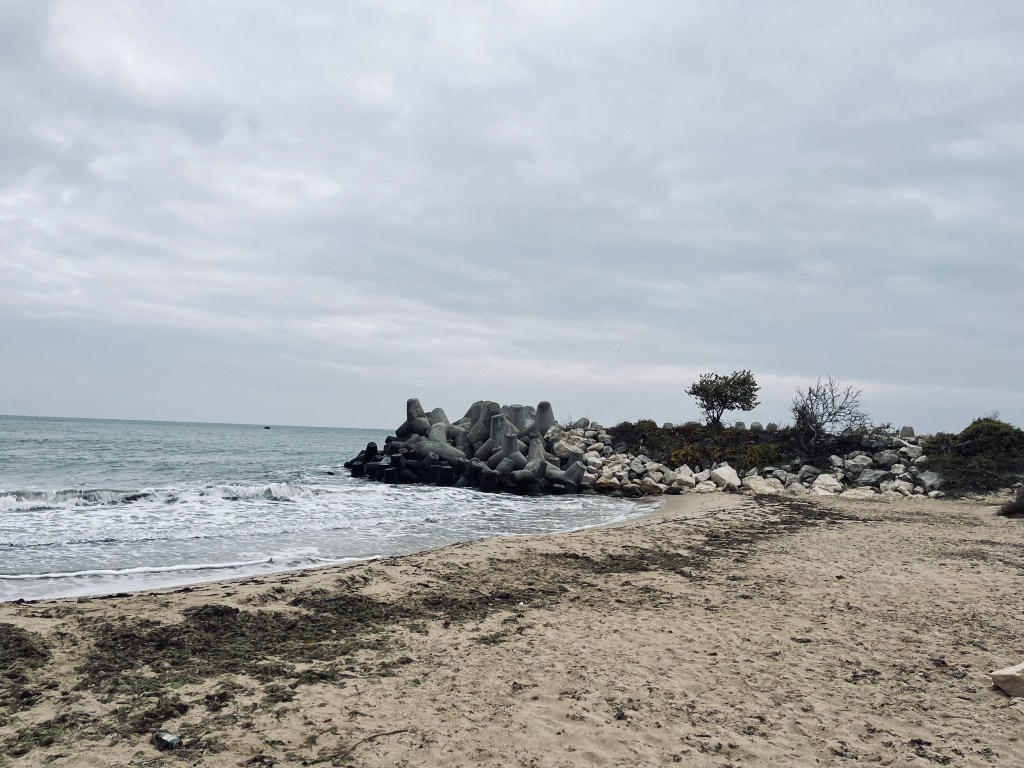
The next day, when I woke up, I ran directly to the window. I wasn’t sure what to expect but it was so much better than I imagined. In front of me, there it was – the Black Sea. It loomed in the distance, in its full glory.
As we walked, we found many stray cats and the closer to the sea we got, the more stray cats we encountered. Finally, we arrived almost at the beach. In the little hallway, we suddenly saw three ginger kittens huddled together. When they saw us, they ran towards us as if they finally found who they were looking for. The Cat Distribution System works well in Bulgaria – unfortunately, we had to leave them behind (I do have to admit, I did look up the procedure for adopting stray Bulgarian kittens but we simply did not have enough time or space to take dozens of cats we stumbled upon).
As the kittens followed us to the beach, the gorgeous view enveloped in front of us. But then, I looked to the side and noticed a seagull picking at something. It was the mother of the kittens. And nearby, there was another kitten from the litter, dead in the sand. This has soured Varna for me so severely, that I no longer wanted to look at the strays or the views in general. We left quickly, without feeling bad about not giving it a proper chance. This was the end of our bittersweet visit to the Black Sea.
Part 2 coming soon.
Discover more from Decadent Serpent
Subscribe to get the latest posts sent to your email.
