
Author: Dinah Kolka. Dinah is the founder of Decadent Serpent and a graduate of Edinburgh Napier University with a BA(Hons) in English Literature. Her work has been featured in publications such as The Salisbury Review and The Mallard. She was also published in the Scottish Book Trust’s 2018 anthology Rebel. In 2023, Dinah self-published her own collection of short stories, The Search and Other Stories.
It is estimated that 50%-75% of Scotland’s ash trees will perish over the next 20 years. Ash trees have been affected by the fungus called Hymenoscyphus fraxineus which swarms its way through the tree leaves into the tree and blocks the movement of water inside it. Initially, it appears as small spots on stems and branches, which progressively grow larger. Young ash plants are particularly susceptible to this issue, leading to tree dieback. But this is far worse – the fungus spores are easily carried by the wind and spread from tree to tree leading to a decay on a national scale and a near-extinction.
Ash Rise is a moving exhibition created in honour of the ash tree. It is a collaboration between the Scottish Furniture Makers Association, Scottish Forestry, and the Association of Scottish Hardwood Sawmillers. The collection brought together people who genuinely care for the ash trees and used their art and creativity to transform decaying trees into something beautiful once again.
Ash tree holds significant cultural value in British history – ash sap was traditionally given to newborns to repel witchcraft. Ash trees were considered sacred, and known for their healing and protective properties. They played essential roles in agriculture, military, and tool-making, helping to build the foundation of the British nation. Over the years, the ash tree has become a part of everyday life, providing shade for many weary heads needing rest.
It was truly moving to see the passion embedded within each piece created with so much care. Exploring the artworks, I realised how much affection the artists put into their work as they were working with this medium.
The exhibition can be found at the Royal Botanic Gardens Edinburgh. It’s a medium-sized collection, ranging from small pieces to larger furniture and even a kayak.

I really liked the work by Rebecca Kaye titled Weatherings I, II, and III. Her work aimed to reflect daily weather conditions from 1995 to 2022 depicting the grain pattern of ash trees.
Plenty of temperature data was collected from locations where ash trees for Ash Rise were felled. This marriage of statistics and creativity offers us a unique insight into how weather and various environmental factors impact nature in our lives.
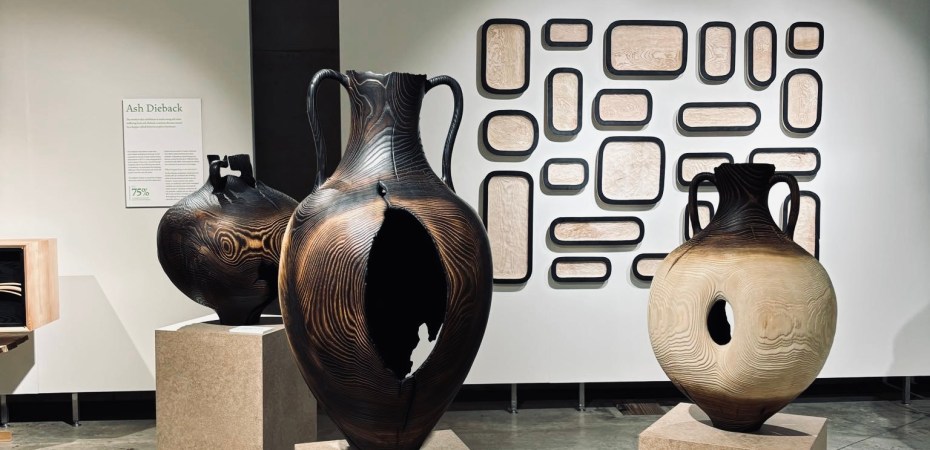
My absolute favourite however was Fire Vessels done by Duke Christie (featured photograph). Christie drew inspiration from the Greek amphorae to create these. However, these are made from charred wood and each vase is proportional to the dimensions of the ash branch from which they were crafted. There is something profoundly moving in the way they are charred and hollow, reminiscent of the ash trees that are slowly vanishing.
The variety of items presented is intriguing– there are functional furniture pieces, skillfully crafted by woodworking experts, alongside more art-focused artworks. This collaboration united individuals who particularly cared about the tree, seemingly from very different disciplines yet connected on one shared goal – the commemoration of a diseased tree that will soon be extinct.
I think overall, the exhibition was a really wholesome experience – it was fascinating to see a collaboration among diverse artists, and as someone literally running an interdisciplinary magazine, I appreciate different disciplines working together towards a common goal. However, I feel like the artists had a stronger footing due to their natural desire to evoke a strong message within their creations. Some furniture pieces were simple and basic, like a large table or a chair, while the artwork often had a more impactful presence, harnessing the genuine sorrow surrounding ash tree dieback.
Overall, I would strongly recommend seeing the exhibition – I never expected decaying trees to move me so deeply, but I sensed that this would be a special experience. You can find it in the Royal Botanic Gardens, and it is truly a sight to see. It is also a free exhibition, and it is running until 12th January 2025. And while you’re there – why won’t you take a stroll in the gardens and have a look at the large selection of plant life they have to offer? Find more information at https://www.rbge.org.uk/whats-on/ash-rise/57863.
Discover more from Decadent Serpent
Subscribe to get the latest posts sent to your email.
